
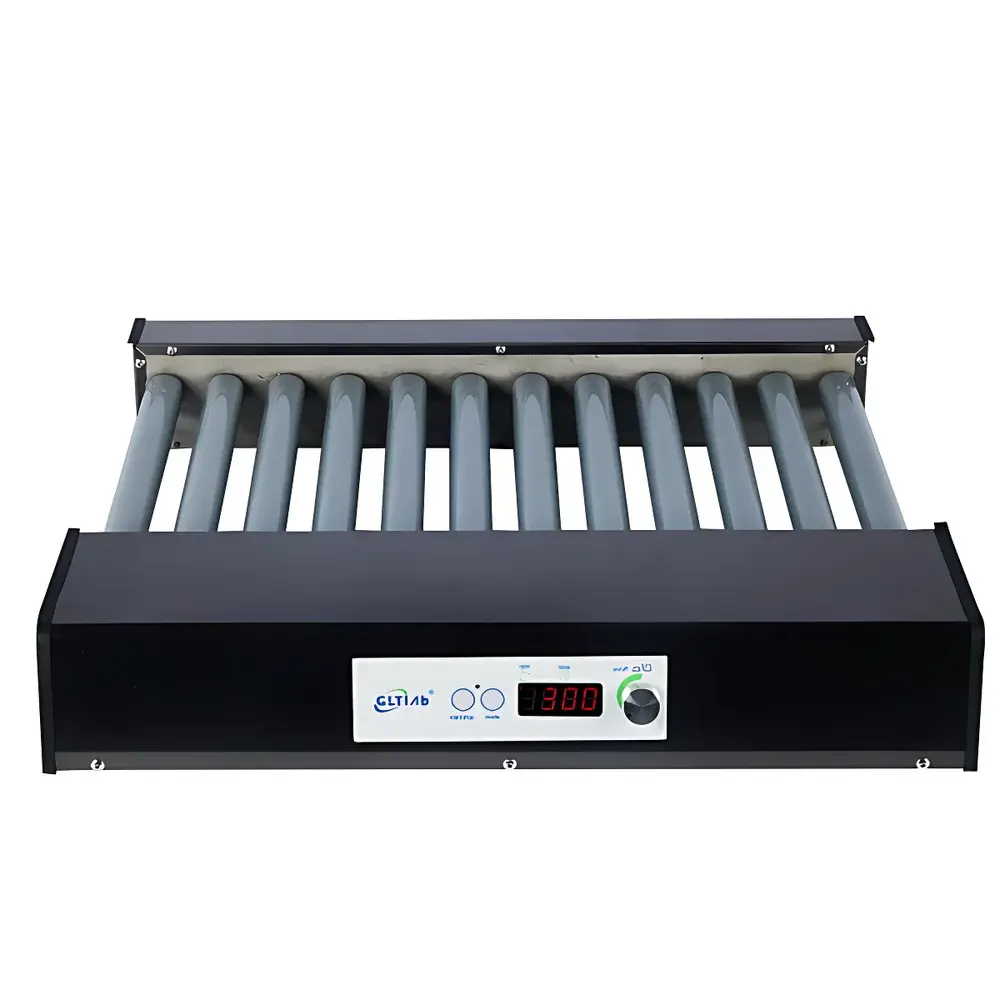
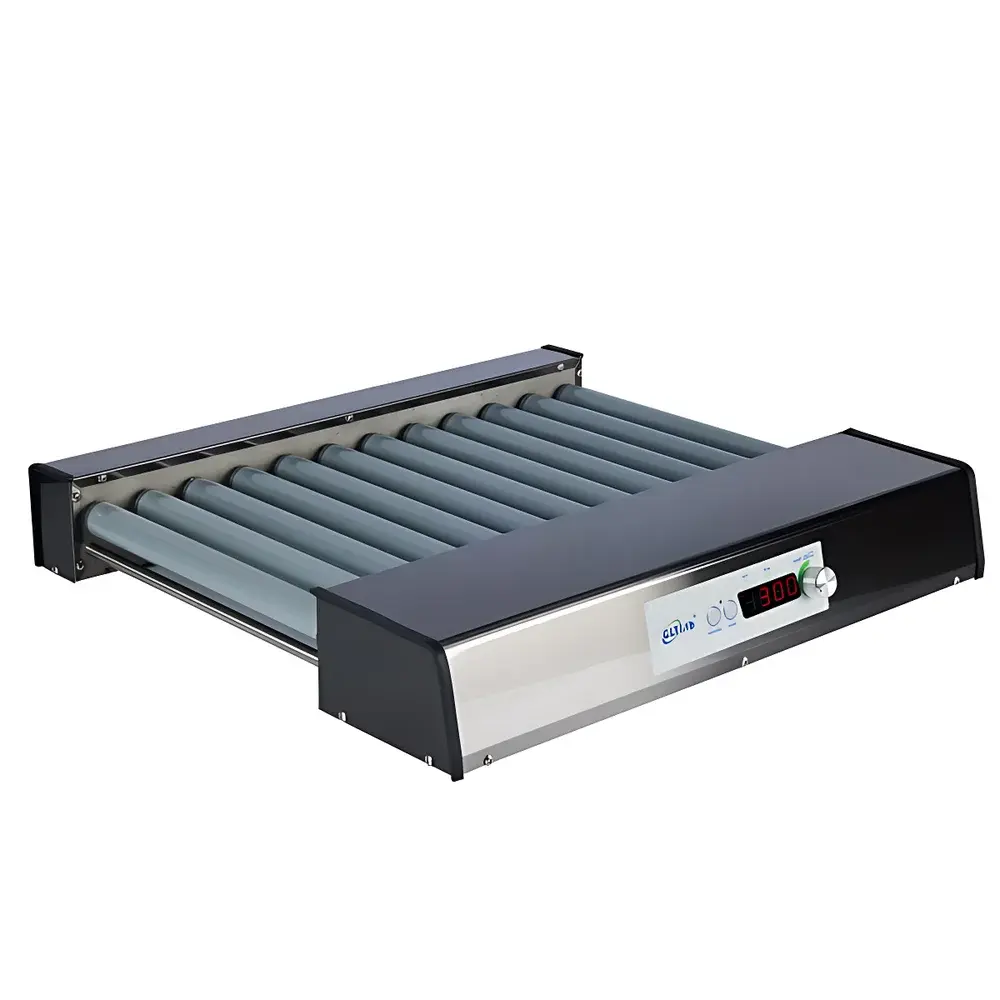
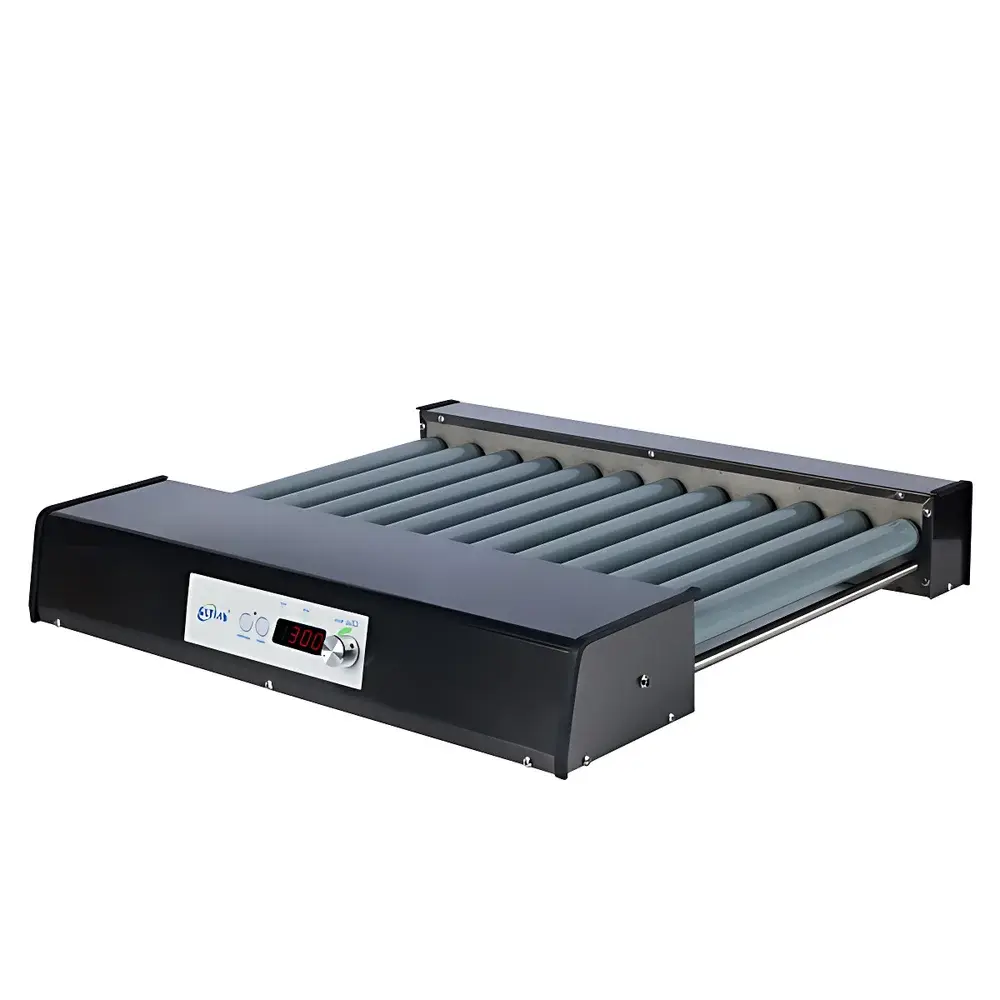
GLTLab TR-12-600 CNC-Controlled 12-Axis Roller Mixer
| Brand | GLTLab |
|---|---|
| Origin | Guangdong, China |
| Manufacturer Type | Direct Manufacturer |
| Instrument Category | Domestic |
| Model | TR-12-600 |
| Instrument Type | Mixing & Homogenization Equipment |
| Timer Range | 1 s to 200 h |
| Oscillation Frequency | 5–300 rpm |
| Oscillation Amplitude | 13 mm |
| Number of Shaking Platforms | 12 |
| Roller Dimensions | 340 × 30 mm |
| Roller Reversal Interval | 1–15 min |
| Max Load per Roller | 10 kg (uniformly distributed) |
| Control System | CNC-controlled, digital display, stepless speed regulation |
| Unit Dimensions (L×W×H) | 560 × 600 × 100 mm |
Overview
The GLTLab TR-12-600 is a precision-engineered, CNC-controlled 12-axis roller mixer designed for consistent, low-shear rotational homogenization of viscous, sediment-prone, or shear-sensitive samples. Unlike orbital shakers or vortex mixers, this instrument employs synchronized 360° continuous rolling—combined with programmable bidirectional rotation and timed axis reversal—to ensure uniform sample agitation without introducing turbulent shear forces. Its mechanical architecture follows the principle of coaxial cylindrical rolling, where each of the twelve independently supported rollers rotates at user-defined speeds (5–300 rpm), enabling precise control over mixing kinetics across diverse viscosities—from aqueous suspensions to high-solid-content battery slurries and polymer pastes. The device is engineered for integration into regulated laboratory environments, including cold rooms (4 °C), CO₂ incubators, and temperature-controlled cabinets, supporting long-duration protocols such as cell culture maintenance, blood anticoagulation, and anaerobic microbial propagation.
Key Features
- CNC digital control system with real-time RPM feedback and non-volatile parameter memory for repeatable protocol execution
- Twelve independent 340 × 30 mm stainless-steel rollers, each rated for up to 10 kg load under uniform distribution
- Stepless speed regulation from 5 to 300 rpm, with resolution ≤1 rpm and stability ±0.5 rpm over 24 h
- Programmable bidirectional rotation with adjustable reversal interval (1–15 minutes), minimizing sediment stratification in heterogeneous suspensions
- Extended timer range from 1 second to 200 hours, supporting both short-term dispersion and multi-day stabilization workflows
- Low-profile chassis (560 × 600 × 100 mm) optimized for under-bench placement and compatibility with environmental chambers
- IP20-rated enclosure with reinforced aluminum frame and corrosion-resistant roller shafts for extended service life in humid or saline lab conditions
Sample Compatibility & Compliance
The TR-12-600 accommodates standard laboratory vessels—including 15 mL and 50 mL conical tubes, serum bottles (up to 500 mL), glass vials, and custom cylindrical containers—when secured using optional roller clamps or silicone cradles. Its gentle rolling motion preserves structural integrity of fragile biological entities (e.g., primary cells, platelets, microcapsules) while preventing phase separation in battery electrode slurries (e.g., NMC, LFP, Si-anode composites) and nanomaterial dispersions (e.g., graphene oxide, MXene colloids). The instrument meets general electrical safety requirements per IEC 61010-1:2010 and supports GLP-compliant operation when paired with audit-trail-capable software (see Software section). While not intrinsically rated for explosive atmospheres, it is routinely deployed in Class II biosafety cabinets and inert-gas gloveboxes for oxygen-sensitive formulations.
Software & Data Management
The TR-12-600 operates via embedded firmware with local digital interface only; no proprietary PC software is bundled. However, its RS-232 serial port (optional TTL adapter available) enables integration with third-party laboratory information management systems (LIMS) or programmable logic controllers (PLCs) for centralized scheduling and event logging. When connected to validated data acquisition platforms, the device supports timestamped run records—including start/stop time, total elapsed duration, average RPM, and reversal count—satisfying documentation requirements under ISO/IEC 17025 and FDA 21 CFR Part 11 when combined with appropriate electronic signature controls. Firmware updates are delivered via USB flash drive and require manual initiation to maintain configuration integrity.
Applications
- Electrode slurry homogenization for lithium-ion and solid-state battery R&D (anode/cathode pastes, binder dispersion)
- Maintenance of anticoagulated whole blood and platelet-rich plasma during transport or assay preparation
- Long-term suspension of mineral concentrates, ceramic precursors, and pigment dispersions to inhibit gravitational settling
- Low-speed substitution for roller bottles in adherent mammalian cell culture (e.g., Vero, HEK293) under hypothermic conditions
- Controlled gas–liquid dissolution in sealed cylinders (e.g., H₂, CO₂, O₂ infusion into solvents or bioreactor media)
- Accelerated aging studies of coatings, adhesives, and polymer gels requiring shear-free thermal-mechanical conditioning
- Pre-analytical sample stabilization in clinical labs prior to flow cytometry, ELISA, or PCR workflows
FAQ
Is the TR-12-600 compatible with refrigerated or CO₂ incubator environments?
Yes—the unit operates reliably at ambient temperatures from 4 °C to 40 °C and relative humidity up to 80% non-condensing. Its low heat dissipation (<12 W idle, <45 W peak) prevents chamber temperature drift.
Can individual rollers be disabled or operated at different speeds?
No—rollers are mechanically coupled in groups of four and operate synchronously at the same setpoint speed. Independent axis control is not supported in this model.
What is the maximum tube diameter supported per roller?
Standard rollers accommodate cylindrical vessels up to 50 mm in outer diameter; optional wide-bore rollers (TR-12-WB kit) extend capacity to 75 mm.
Does the device include validation documentation for GMP use?
The base unit ships with Factory Acceptance Test (FAT) report and electrical safety certificate. IQ/OQ documentation templates and on-site qualification support are available upon request through GLTLab’s Technical Services division.
How is maintenance performed on the roller drive mechanism?
Roller shafts utilize sealed, maintenance-free ball bearings. Annual inspection of belt tension and motor coupling alignment is recommended; replacement parts kits (belt, encoder disc, fuse) are stocked globally via authorized distributors.



