
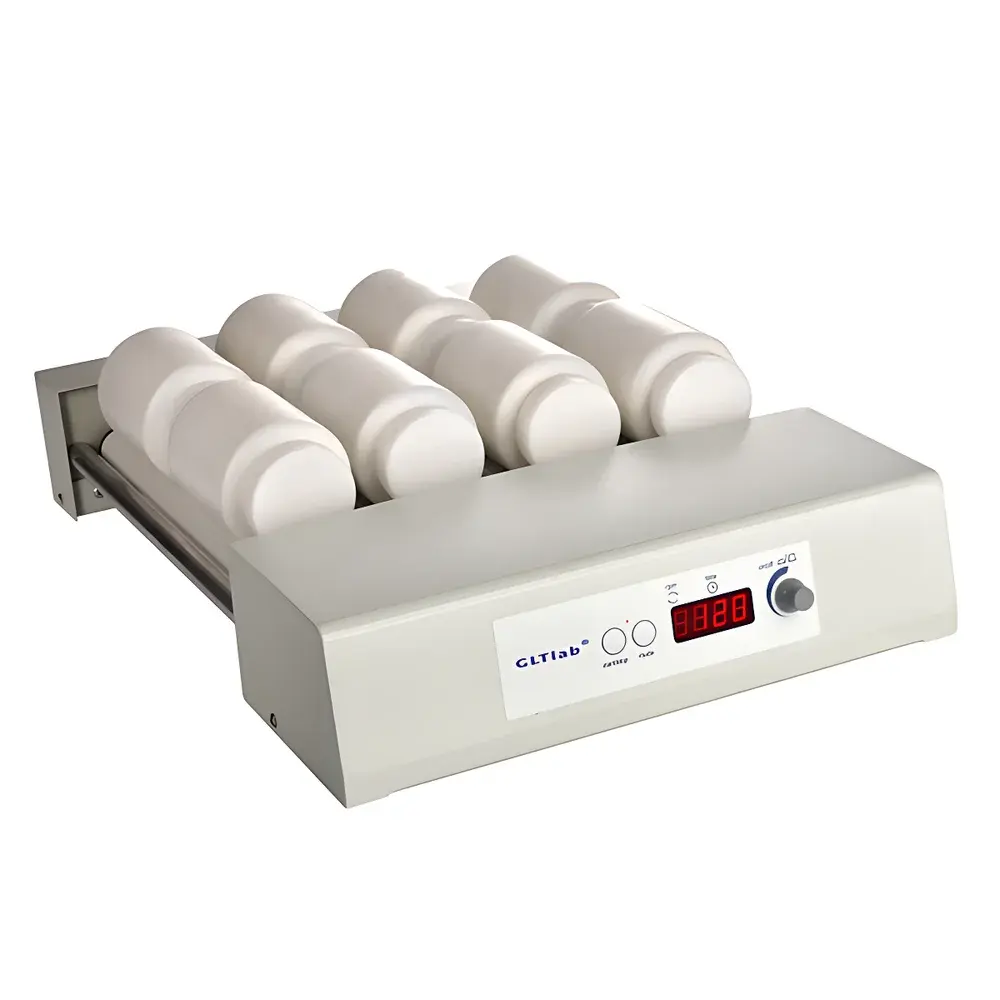
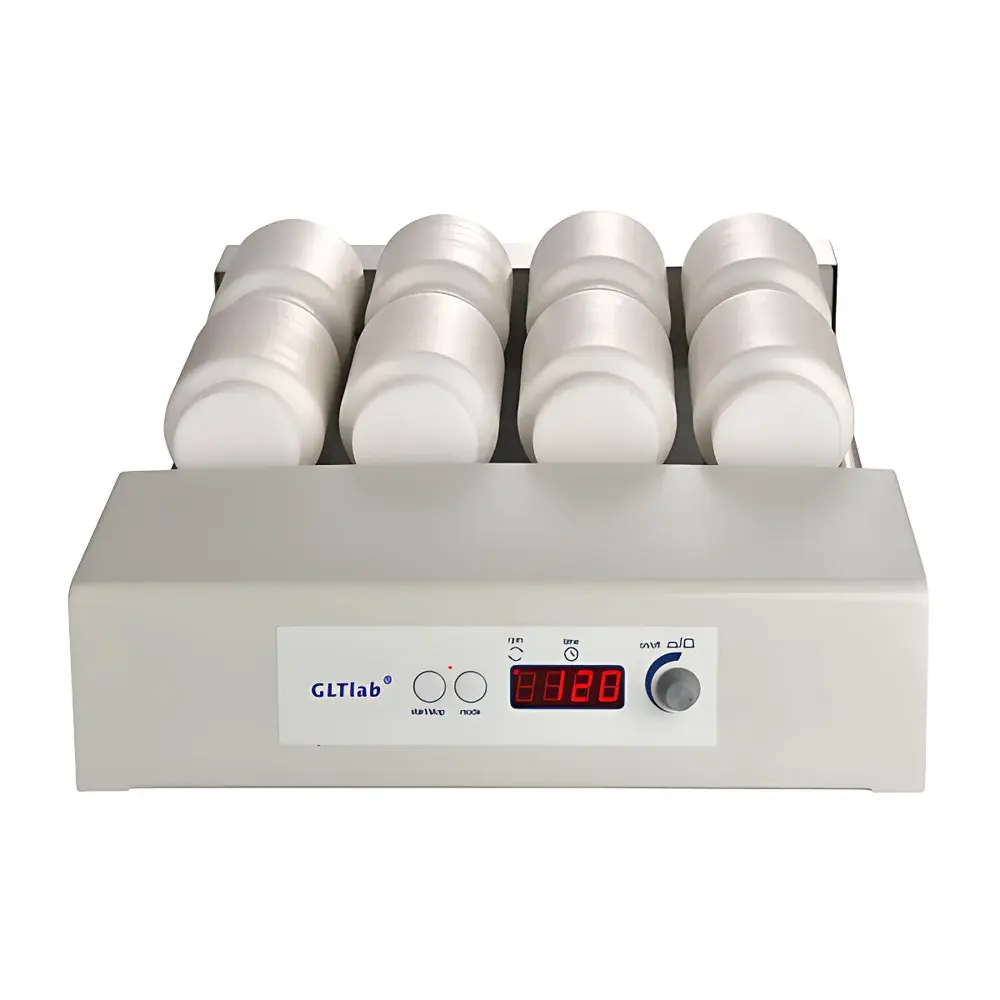
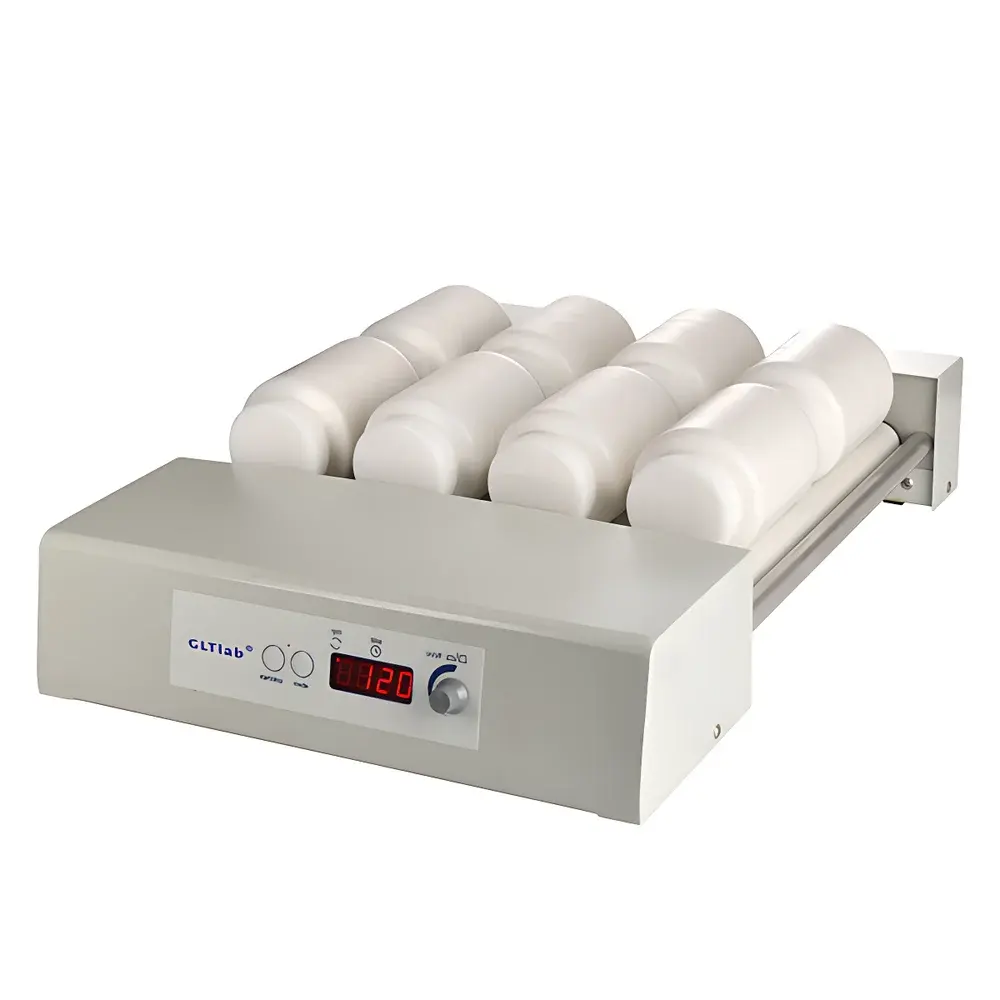
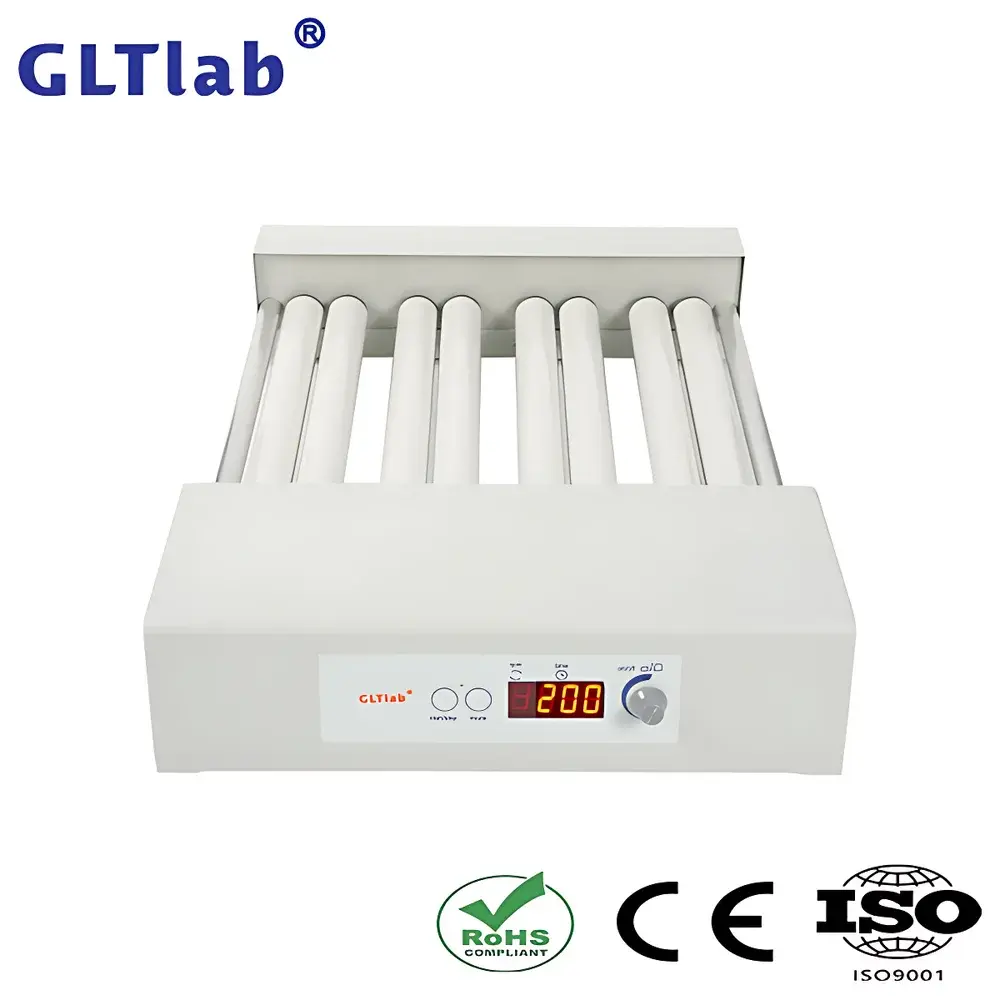
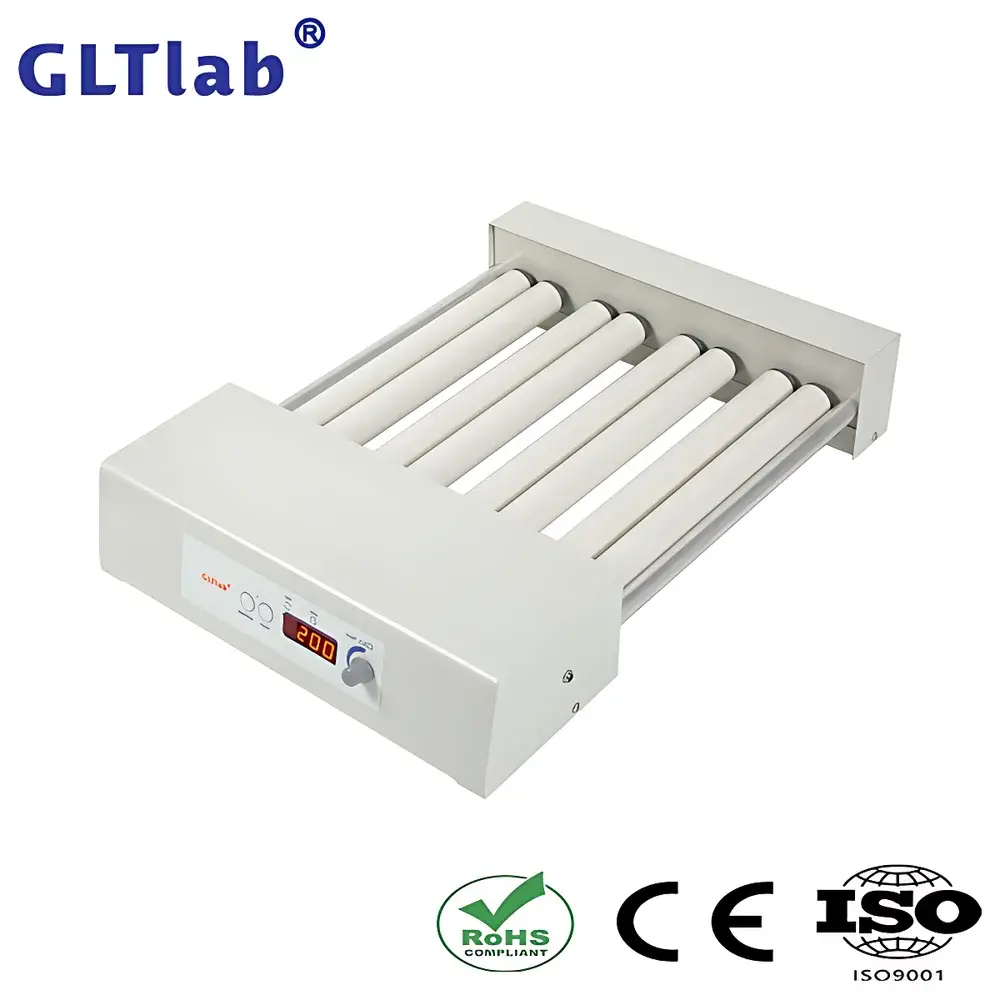
GLTlab TR-8 8-Axis Orbital Roller Mixer
| Brand | GLTlab |
|---|---|
| Model | TR-8 |
| Origin | Guangdong, China |
| Manufacturer | GLTlab Instrument Co., Ltd. |
| Type | Benchtop Orbital Roller Mixer |
| Number of Rollers | 8 |
| Speed Range | 5–300 rpm |
| Load Capacity | 10 kg |
| Timer Range | Up to 200 h |
| Roller Dimensions | 340 × 30 mm |
| External Dimensions (W×D×H) | 556 × 392 × 98 mm |
| Net Weight | 9 kg |
| Control Interface | Digital LED Display with Direction Reversal Function |
| Drive Mechanism | Brushless DC Motor |
| Compliance | Designed for GLP-compliant laboratories and industrial R&D environments |
Overview
The GLTlab TR-8 is an 8-axis orbital roller mixer engineered for high-reproducibility homogenization of viscous, heterogeneous, or shear-sensitive samples in research, quality control, and pilot-scale manufacturing settings. Unlike vortex or shaker-based mixers, the TR-8 employs a precisely synchronized orbital rolling motion—where each of its eight independently mounted rollers rotates around a central axis while simultaneously revolving along a fixed circular path. This dual-motion geometry generates gentle yet effective convective mixing without introducing excessive shear, air entrapment, or thermal stress. The device operates on a brushless DC motor platform, ensuring long-term torque stability, low electromagnetic interference, and minimal maintenance across continuous operation cycles. Its mechanical architecture supports consistent rotational inertia and uniform angular acceleration, critical for repeatable dispersion of battery electrode slurries, polymer composites, and pharmaceutical suspensions.
Key Features
- Eight parallel stainless-steel rollers with precision-machined 340 × 30 mm cylindrical surfaces—optimized for secure tube/clamp retention and balanced dynamic loading.
- Digital LED interface with real-time rpm display, programmable timer (0.1 min to 200 h), and automatic bidirectional rotation reversal to prevent sedimentation stratification.
- Adjustable speed range of 5–300 rpm, calibrated to ±1% accuracy across full load (up to 10 kg), verified per ISO 17025 traceable procedures.
- Benchtop footprint (556 × 392 × 98 mm) designed for integration into fume hoods, gloveboxes, or cleanroom-compatible workflows; base includes non-slip rubber feet and vibration-damping mounts.
- Compliance-ready firmware architecture supporting audit trails for time-stamped operation logs—compatible with laboratory information management systems (LIMS) via optional RS-232/USB data export.
Sample Compatibility & Compliance
The TR-8 accommodates standard laboratory containers—including 15 mL and 50 mL conical tubes, glass vials (up to Ø35 mm), custom jigs for pouch cells, and cylindrical mixing jars up to 120 mm in height. It is routinely deployed in battery material formulation labs where homogeneity of cathode slurries (e.g., NMC/LFP with PVDF binder and conductive carbon) must meet ASTM D7928 and IEC 62660-1 specifications for particle distribution consistency. In chemical process development, it supports ISO 8502-12–compliant blending of thixotropic gels, silicone elastomer prepolymers, and ceramic slip formulations. All structural components conform to RoHS Directive 2011/65/EU and CE marking requirements for electrical safety (EN 61010-1:2010). No internal lubricants contact sample zones; all wetted parts are electropolished 304 stainless steel.
Software & Data Management
While the TR-8 operates as a standalone instrument, its embedded microcontroller records operational metadata—including start/stop timestamps, cumulative runtime, average rpm, and direction-switch events—stored in non-volatile memory. Optional PC connectivity enables export of CSV-formatted session logs for inclusion in electronic lab notebooks (ELN) or FDA 21 CFR Part 11–aligned documentation packages. Firmware updates are delivered via encrypted USB stick to maintain integrity during GLP/GMP audits. No cloud dependency or proprietary software installation is required; raw log files are human-readable and compatible with common statistical analysis platforms (e.g., JMP, Minitab).
Applications
- Battery R&D: Uniform dispersion of Li-ion cathode/anode slurries prior to coating—reducing agglomerate formation and improving electrode density consistency.
- Advanced Materials: Homogenizing nanocomposite pastes containing graphene oxide, CNTs, or metal-organic frameworks in high-viscosity polymer matrices.
- Pharmaceutical Development: Blending high-potency active pharmaceutical ingredients (APIs) with excipients in suspension-based oral dosage forms under cGMP-aligned mixing protocols.
- Adhesives & Sealants: Preparing silicone, epoxy, and polyurethane formulations requiring bubble-free homogeneity before rheological characterization or curing trials.
- Academic Research: Supporting reproducible sample preparation in soft matter physics, colloid science, and electrochemical interface studies where mechanical agitation artifacts must be minimized.
FAQ
What types of containers can be mounted on the TR-8 rollers?
Standard 15 mL and 50 mL conical centrifuge tubes, 20–35 mm diameter glass or plastic vials, and custom-designed clamps for flat-bottomed jars or flexible pouches (up to 10 kg total mass).
Does the TR-8 support validation documentation for regulated environments?
Yes—operational parameters are logged with timestamped audit trails; IQ/OQ templates and calibration certificates (traceable to NIM China) are available upon request for GxP compliance.
Can the direction reversal interval be customized?
Direction reversal occurs automatically every 30 minutes by default; this interval is fixed in firmware and not user-adjustable to ensure mechanical longevity and mixing repeatability.
Is the TR-8 suitable for explosive or solvent-rich atmospheres?
No—it is rated for general laboratory use only (IP20 enclosure); operation inside explosion-proof enclosures requires third-party certification and is not supported out-of-the-box.
How is speed calibration verified during routine maintenance?
Calibration is performed using a NIST-traceable handheld tachometer; GLTlab provides annual recalibration service with certified report compliant with ISO/IEC 17025 standards.



