
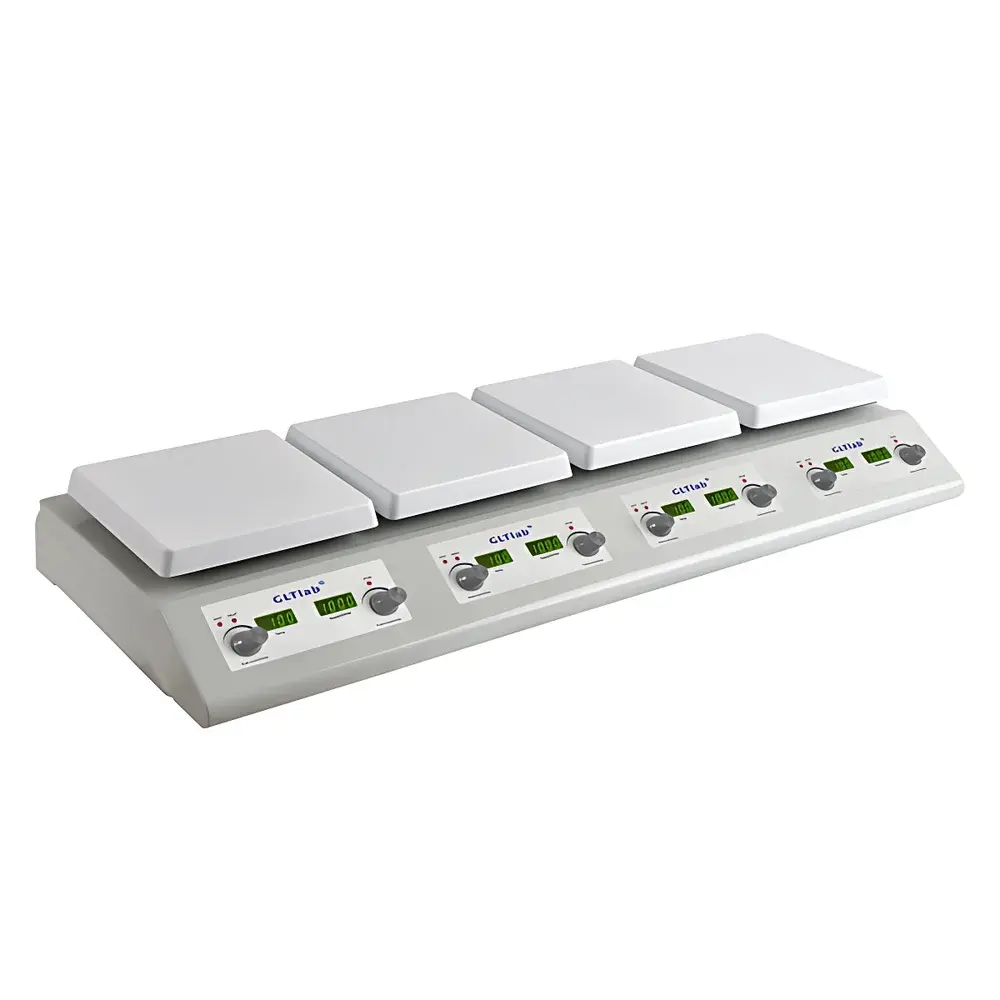
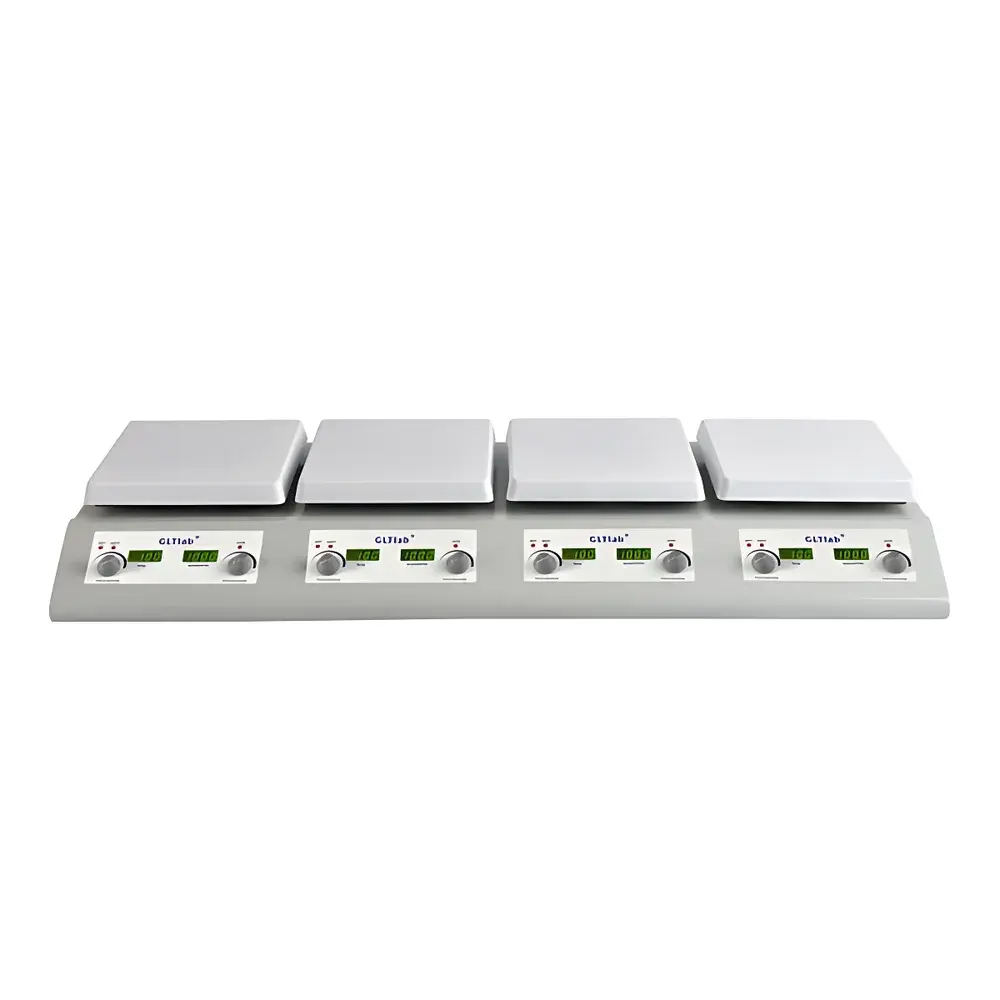
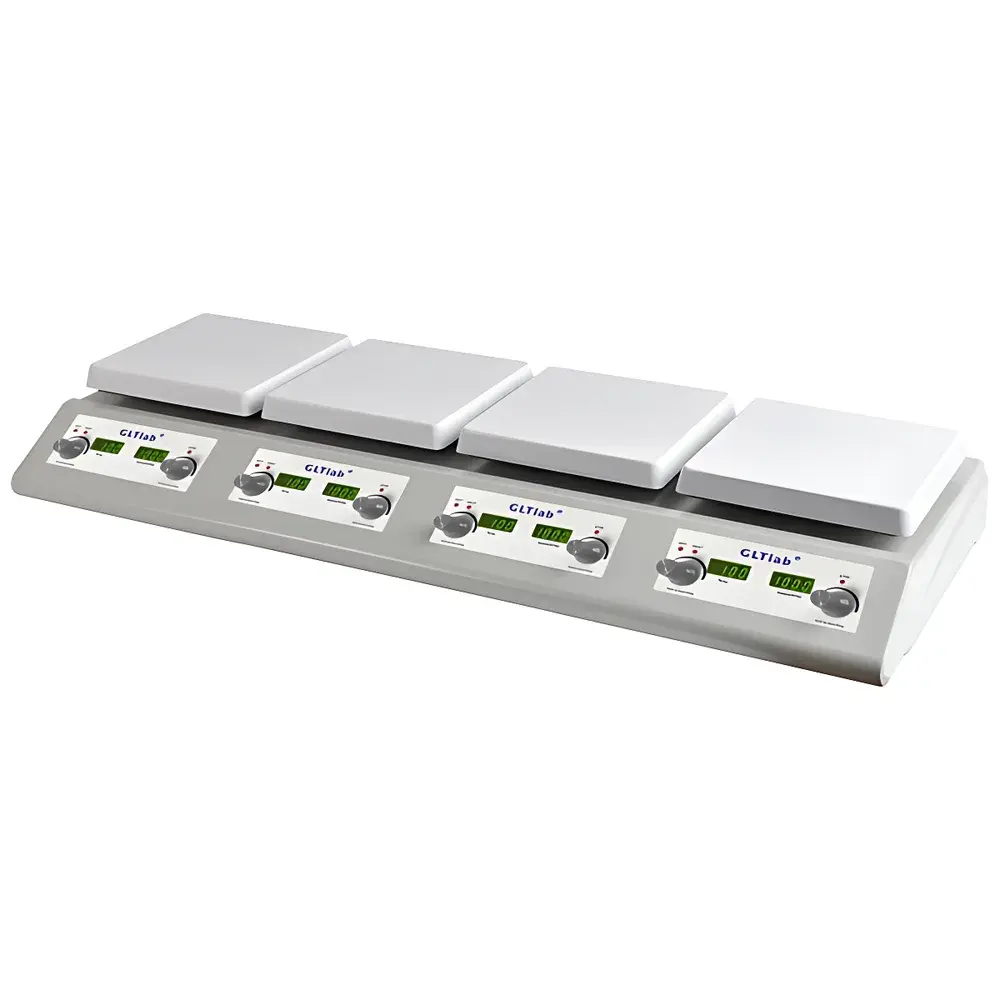
GLTlab SHA-4P Quad-Position Heated Magnetic Stirrer with Independent Temperature Control
| Brand | GLTlab |
|---|---|
| Model | SHA-4P |
| Type | Heated Magnetic Stirrer |
| Positions | 4 independent stations |
| Max. Stirring Volume per Station | 10 L (H₂O) |
| Speed Range | 150–1500 rpm |
| Solution Temperature Range | 35–200 °C |
| Plate Surface Temperature Range | 35–400 °C |
| Temp. Setting Resolution (Solution) | 0.1 °C |
| Temp. Stability | ±1 °C |
| PT1000 Sensor Accuracy | ±0.5 °C |
| Display | LED |
| Panel Material | Ceramic-coated aluminum |
| Plate Dimensions | 178 × 178 mm (7″ square) |
| Power | 3200 W |
| Voltage | 200–240 V AC, 50/60 Hz |
| IP Rating | IP21 |
| Operating Ambient | 5–40 °C, ≤80% RH |
| External Probe Calibration | Yes |
| Optional Automation Protocol Support | Yes |
Overview
The GLTlab SHA-4P is a precision-engineered quad-position heated magnetic stirrer designed for laboratories requiring simultaneous, independent control of temperature and agitation across four distinct reaction vessels. Utilizing robust Peltier-free resistive heating elements embedded beneath a ceramic-coated aluminum plate and high-torque brushless DC motors driving magnetic coupling systems, the SHA-4P delivers stable thermal output and consistent rotational motion under sustained load. Each of its four positions operates autonomously—allowing differential setpoints for speed (150–1500 rpm) and solution temperature (35–200 °C)—making it especially suitable for comparative kinetic studies, parallel synthesis optimization, multi-sample digestions, or quality control workflows where reproducibility across replicates is critical. Unlike single-station units, the SHA-4P eliminates batch-to-batch variability introduced by sequential processing, thereby improving inter-run consistency and throughput efficiency in regulated environments.
Key Features
- Four fully independent stirring and heating stations with individual LED displays and control knobs—no shared thermal or mechanical coupling between positions.
- Ceramic-coated aluminum heating plate (178 × 178 mm) offering rapid thermal response, uniform heat distribution (±2 °C across surface), and resistance to chemical corrosion and mechanical abrasion.
- High-resolution temperature control: 0.1 °C setting resolution for solution temperature, supported by integrated PT1000 sensors with factory-traceable calibration and user-accessible external probe calibration functionality.
- Thermal safety architecture including overtemperature cut-off, real-time plate surface monitoring, and visual “hot surface” warning indicator compliant with IEC 61000-4-2 ESD immunity standards.
- Brushless DC motor design ensures low electromagnetic interference (EMI), silent operation (<55 dB at 1 m), and maintenance-free service life exceeding 20,000 hours.
- Modular rear-panel interface supports optional RS-485 or USB-to-serial communication for integration into laboratory automation frameworks (e.g., LabVIEW, Python-based control scripts, or LIMS-triggered protocols).
Sample Compatibility & Compliance
The SHA-4P accommodates standard laboratory glassware—including round-bottom flasks (up to 5 L), beakers (up to 10 L), and digestion vessels—when paired with appropriately sized magnetic stir bars (recommended: 30–50 mm elliptical or cross-shaped bars for viscous media). Its solution temperature range (35–200 °C) covers common applications such as buffer equilibration, enzymatic assays, polymer dissolution, and acid digestion procedures per EPA Method 3050B and ASTM D5511. The instrument conforms to IEC 61010-1:2010 (Safety Requirements for Electrical Equipment for Measurement, Control, and Laboratory Use), carries CE marking, and meets RoHS 2011/65/EU directive requirements. While not inherently 21 CFR Part 11 compliant, audit-ready data logging (via optional software module) supports GLP/GMP-aligned documentation when used with validated external temperature probes and timestamped electronic records.
Software & Data Management
The SHA-4P operates natively via front-panel controls but supports optional PC-based supervision through GLTlab’s proprietary StirControl Suite (v3.2+), which enables remote parameter configuration, real-time graphing of temperature/speed profiles per station, automated ramp-hold sequences, and CSV export of time-stamped datasets. When connected via RS-485, the unit responds to Modbus RTU commands—facilitating integration into centralized lab infrastructure managed by SCADA or ELN platforms. All logged data includes metadata: station ID, UTC timestamp, setpoint vs. actual values, error flags (e.g., “stir bar stall”, “sensor disconnect”), and operator ID (if authenticated via network login). Audit trail generation adheres to ALCOA+ principles when deployed with validated IT infrastructure.
Applications
- Parallel optimization of reaction conditions in organic synthesis and catalysis screening.
- Standardized sample preparation for ICP-MS, AAS, and UV-Vis analysis—ensuring homogeneity and matrix stabilization prior to measurement.
- Controlled thermal activation of hydrogels, nanocomposites, and stimuli-responsive polymers during formulation development.
- Multi-vessel digestion of environmental soils and biological tissues per ISO 11466 and USP <231> heavy metal testing protocols.
- Cell culture media pre-warming and pH buffer equilibration under sterile hood conditions (non-sterile unit; requires laminar flow enclosure).
FAQ
Can the SHA-4P maintain temperature uniformity across all four positions simultaneously?
Yes—each station features independent PID-controlled heating and real-time feedback from dedicated PT1000 sensors, enabling ±1 °C stability per position even with differing vessel geometries or thermal masses.
Is external temperature monitoring mandatory for GLP-compliant use?
No, but recommended: internal plate sensing ensures thermal delivery; however, solution-phase accuracy requires immersion of a calibrated external PT1000 probe, particularly above 100 °C or in viscous media.
Does the unit support programmable temperature ramps?
Yes—via StirControl Suite, users can define multi-step profiles (e.g., 35 °C → hold 10 min → ramp to 95 °C at 2 °C/min → hold 30 min) with separate parameters per station.
What stir bar sizes are optimal for 10 L vessels?
Elliptical stir bars measuring 40–50 mm in length and ≥8 mm diameter provide optimal torque transfer and vortex stability in tall-form containers at speeds up to 1200 rpm.
Can the SHA-4P be integrated into a validated computerized system?
Yes—when combined with documented IQ/OQ protocols, secure network configuration, and electronic signature-enabled software, it meets baseline requirements for FDA-regulated environments under 21 CFR Part 11 Annex 11 guidelines.



