
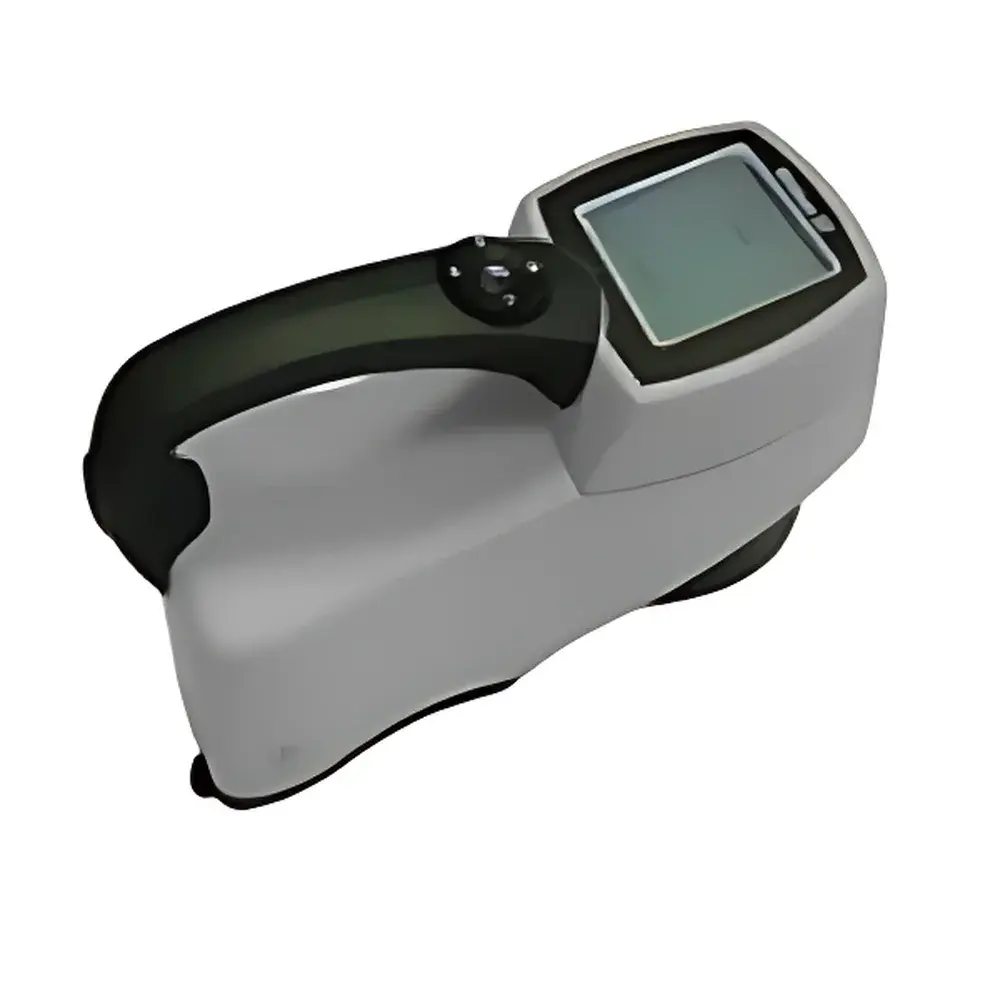
HunterLab MiniScan EZ Portable Colorimeter
| Brand | HunterLab |
|---|---|
| Origin | USA |
| Model | MiniScan EZ |
| Optical Geometry | 45°/0° and Integrating Sphere (D/8°) |
| Aperture Options | LAV 31.8 mm / SAV 6.0 mm / VSAV 6.0 mm / D/8° LAV 25.0 mm / D/8° SAV 14.3 mm / D/8° VSAV 6.0 mm |
| Measurement Repeatability (ΔE* avg on BCRA II tiles) | 0.05–0.25 |
| Spectral Range | 400–700 nm |
| Light Source | Pulsed Xenon Lamp (>500,000 flashes) |
| Display | 6.4 cm × 6.4 cm LCD with 0°/90°/180°/270° orientation |
| Power | Rechargeable battery pack or 120/220 VAC adapter |
| Weight | <1.5 kg |
| Compliance | ASTM E308, ISO 11664, CIE No. 15, USP <1061>, FDA 21 CFR Part 11 (software-enabled) |
Overview
The HunterLab MiniScan EZ Portable Colorimeter is an advanced, handheld spectrophotometric color measurement instrument engineered for high-precision, field-deployable color analysis across industrial quality control environments. Based on dual optical configurations—45°/0° geometry for directional surface reflectance and D/8° integrating sphere geometry for diffuse, multi-angle measurements—the MiniScan EZ delivers metrologically traceable color data in accordance with CIE, ISO, and ASTM standards. Its core spectral engine employs a pulsed xenon lamp (rated for >500,000 flashes) and a high-stability monochromator system, enabling consistent spectral acquisition from 400 nm to 700 nm at 10 nm intervals. Unlike conventional portable colorimeters relying solely on tristimulus filter-based detection, the MiniScan EZ utilizes full-spectrum capture to support advanced color difference metrics—including ΔE*, ΔECMC, ΔE00, and FMC II—as well as metamerism index (MI) evaluation and fluorescence compensation. The inclusion of dedicated green tile calibration—a proprietary feature unique to this platform—actively monitors and corrects for wavelength drift in real time, significantly enhancing long-term photometric stability and inter-instrument agreement.
Key Features
- Patented dual-point calibration system: white tile + green tile verification ensures spectral fidelity and minimizes drift over extended operational cycles
- Modular aperture architecture supporting six interchangeable measurement modes: 45°/0° LAV (31.8 mm), 45°/0° SAV (6.0 mm), 45°/0° VSAV (6.0 mm), D/8° LAV (25.0 mm), D/8° SAV (14.3 mm), and D/8° VSAV (6.0 mm)
- True one-handed operation enabled by ergonomic rubberized grip, balanced mass distribution (<1.5 kg), and perimeter-mounted tactile buttons
- Rotatable 6.4 cm × 6.4 cm LCD display with four viewing orientations (0°, 90°, 180°, 270°) for optimal readability in constrained workspaces
- Dual-power architecture: integrated rechargeable Li-ion battery pack or universal 120/220 VAC adapter—no proprietary charger required
- Onboard memory stores up to 2,000 measurements with timestamp, operator ID, and sample metadata
- Ruggedized housing rated IP54 for dust and splash resistance; designed for continuous use in production floors, warehouses, and loading docks
Sample Compatibility & Compliance
The MiniScan EZ accommodates a broad spectrum of physical sample types without requiring accessory modification: opaque solids (e.g., painted panels, plastic injection-molded parts), translucent films, powdered pigments, viscous pastes, metallic finishes, and fluorescent-enhanced materials. Its D/8° configuration supports measurement of textured, brushed, or pearlescent surfaces per ISO 2813 and ASTM D2244. For food-grade applications—including meat, dairy, confectionery, and baked goods—the instrument complies with USP guidelines for color assessment in pharmaceutical and nutraceutical manufacturing. All firmware and software modules adhere to FDA 21 CFR Part 11 requirements for electronic records and signatures when paired with optional compliant software packages. Data integrity is reinforced through GLP/GMP audit trails, user-access controls, and encrypted export protocols compatible with LIMS integration.
Software & Data Management
HunterLab’s EasyMatch QC software (v5.0+) provides full bidirectional communication with the MiniScan EZ via USB or Bluetooth. It enables method-driven workflows, statistical process control (SPC) charting, tolerance zone mapping, and automated report generation compliant with ISO/IEC 17025 documentation frameworks. Raw spectral data (31-point reflectance curves) are exportable in CSV, XML, and CxF/XRGA formats for third-party analysis. The software supports multi-instrument synchronization, allowing centralized calibration management across distributed facilities. Audit trail functionality logs all user actions—including calibration events, parameter changes, and result deletions—with immutable timestamps and operator authentication. Optional cloud-based data vault services provide secure, encrypted backup and remote access for global QA teams.
Applications
- Plastics & Polymers: batch-to-batch color consistency verification for extruded profiles, injection-molded components, and masterbatch validation
- Coatings & Paints: real-time gloss-independent color matching on curved substrates, automotive OEM touch-up verification, and RAL/BS/ANSI standard compliance checks
- Textiles & Apparel: shade sorting of dyed fabrics, yarn lot acceptance, and digital color library synchronization with Pantone and DIC standards
- Food & Beverage: objective quantification of browning (L*), redness (a*), yellowness (b*), and hue angle shifts during thermal processing, storage, and shelf-life testing
- Printing & Packaging: spot color verification on flexo/gravure substrates, ink formulation feedback loops, and substrate-induced metamerism analysis
- Pharmaceuticals: tablet coating uniformity assessment, capsule shell color stability monitoring, and excipient batch release per ICH Q5C guidelines
FAQ
Does the MiniScan EZ require annual factory recalibration?
No. Its green tile self-diagnostic function and stable xenon source enable user-performed verification at defined intervals (e.g., daily pre-shift checks). Factory recalibration is recommended only after physical impact, extreme environmental exposure, or deviation beyond ±0.15 ΔE* on BCRA II reference tiles.
Can the MiniScan EZ measure transparent liquids or gels?
Yes—when used with optional transmission accessories (e.g., liquid cell holder, clear film clamp) and configured in D/8° mode with specular component included (SCI), it meets ASTM D1209 and ISO 6271 requirements for transparent material color assessment.
Is spectral data accessible for custom algorithm development?
Yes. Full 31-channel spectral reflectance data (400–700 nm, 10 nm step) is available via EasyMatch QC export or direct serial/USB query using documented ASCII command protocol.
How does the MiniScan EZ handle fluorescent whitening agents (FWAs)?
It incorporates UV-adjustable illumination and dual-mode measurement (UV-included/UV-excluded), enabling accurate Yellowness Index (YI E313), Whiteness Index (WI CIE/Tappi), and fluorescence correction per ISO 105-J03 and ASTM E313.
What is the warranty coverage and service support structure?
HunterLab provides a standard 24-month limited warranty covering parts and labor. Global service centers offer certified repair, NIST-traceable calibration certificates, and on-site technical training for QA/QC personnel.




