
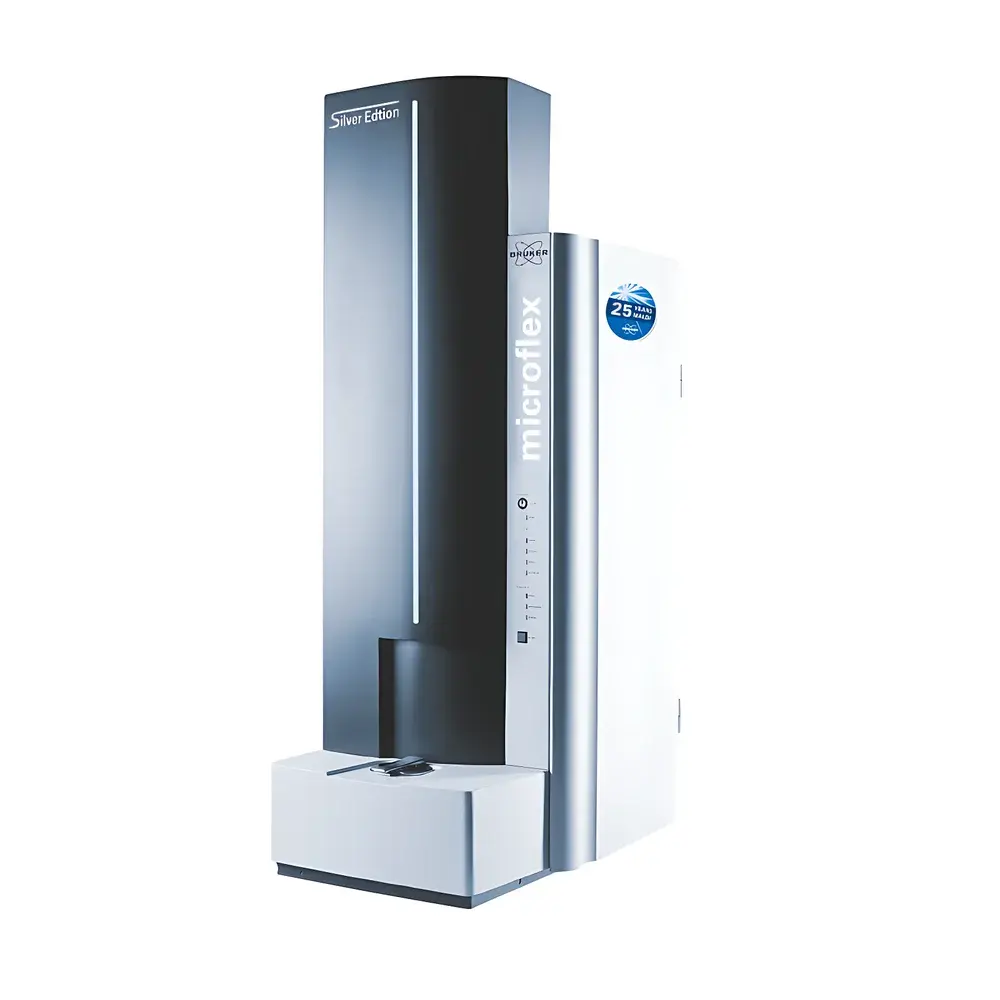
Bruker microflex LRF MALDI-TOF Mass Spectrometer
| Brand | Bruker |
|---|---|
| Origin | Germany |
| Instrument Type | Time-of-Flight (TOF) |
| Configuration | Benchtop MALDI-TOF |
| Operating Modes | Linear & Reflectron |
| Resolution | Up to 15,000 (m/z 1,000–2,000, reflectron mode) |
| Laser | Nitrogen laser, 337 nm, adjustable repetition rate up to 60 Hz |
| Ion Source | microScout™ pulsed ion extraction source |
| Detector | Microchannel plate (MCP) |
| Vacuum System | Oil-free, maintenance-free turbomolecular pump with WhisperMode™ acoustic dampening |
| Sample Target | AnchorChip™ patterned stainless steel target |
| Software Platform | Compass Suite (including ProteinScape™, BioTools™, Polymerix™) |
| Regulatory Compliance Option | Compass Security Pack (21 CFR Part 11 compliant audit trail, electronic signatures, user access control) |
| Sample Throughput | High-speed automated acquisition enabled by precise AnchorChip™ spot positioning and integrated autoPSD (automated post-source decay) capability |
| Ionization Mode | Positive/Negative selectable |
| Mass Range | Broad dynamic range suitable for small molecules (e.g., lipids, additives), peptides, oligonucleotides, and synthetic polymers |
Overview
The Bruker microflex LRF is a compact, benchtop matrix-assisted laser desorption/ionization time-of-flight (MALDI-TOF) mass spectrometer engineered for high reproducibility, robust daily operation, and broad-spectrum analytical flexibility. Based on orthogonal TOF geometry and optimized ion optics, the system delivers precise mass measurement across a wide m/z range—from small organic molecules and lipids to intact peptides, oligonucleotides, and synthetic polymers. Its dual-mode acquisition—linear and reflectron—enables method-specific optimization: linear mode prioritizes sensitivity and mass range for high-molecular-weight analytes (e.g., proteins, polymers), while reflectron mode provides enhanced mass resolution (up to 15,000 at m/z 1,500) and mass accuracy (< 100 ppm typical, calibration-dependent) for structural confirmation and impurity profiling. Designed for routine laboratory environments—including QC labs, food safety testing facilities, and academic core facilities—the microflex LRF integrates hardware reliability with software-driven workflow automation.
Key Features
- microScout™ ion source with pulsed extraction technology ensures consistent ion acceleration and minimizes energy spread, directly contributing to high mass resolution and inter-run reproducibility.
- AnchorChip™ target technology enables highly uniform sample crystallization in predefined, geometrically accurate spots—reducing shot-to-shot variability and enabling fully automated, position-guided data acquisition.
- Oil-free, maintenance-free vacuum system with WhisperMode™ acoustic isolation achieves <45 dB(A) operational noise—ideal for open-lab or shared instrumentation spaces without dedicated acoustic enclosures.
- 60 Hz nitrogen laser (337 nm) with fiber-optic beam delivery ensures stable pulse energy distribution and extended lamp lifetime; laser repetition rate is software-adjustable to balance sensitivity, duty cycle, and target longevity.
- Gridless reflector design eliminates ion scattering losses associated with traditional mesh-based reflectors, improving transmission efficiency and signal-to-noise ratio—particularly critical for low-abundance analytes.
- Automated Post-Source Decay (autoPSD) functionality allows in situ MS/MS-like fragmentation without external collision gas or hardware modification, supporting rapid sequence validation and adduct identification.
Sample Compatibility & Compliance
The microflex LRF accommodates diverse sample classes without requiring major hardware reconfiguration: lipid extracts from edible oils, synthetic oligonucleotides, polyethylene glycol standards, tryptic digests, and intact monoclonal antibody subunits—all within a single instrument platform. Ionization polarity (positive/negative) and acquisition mode (linear/reflectron) are selected per analysis via software, enabling method development for heterogeneous sample sets. The system complies with ISO/IEC 17025 requirements for testing laboratories when operated under documented SOPs. Optional Compass Security Pack implements full 21 CFR Part 11 compliance—including role-based user authentication, immutable audit trails, electronic signatures, and data integrity controls—making it suitable for regulated environments (e.g., food authenticity verification under EU Regulation No. 1169/2011, or polymer batch release under ISO 13877).
Software & Data Management
Data acquisition and processing are unified within the Compass software suite. Core modules include ProteinScape™ for protein identification and characterization, BioTools™ for biomarker discovery and spectral comparison, and Polymerix™ for polymer molecular weight distribution (MWD), end-group analysis, and repeat unit determination. All modules operate on a common spectral database architecture supporting metadata tagging, batch processing, and cross-platform result export (mzML, CSV, PDF). Raw data files are stored in Bruker’s proprietary flexFormat™ (with embedded calibration parameters and instrument settings), ensuring long-term traceability. Compass supports direct integration with LIMS via standard ODBC connectivity and offers configurable reporting templates aligned with GLP/GMP documentation standards.
Applications
- Food Authenticity & Adulteration Screening: Rapid detection of adulterants in olive oil (e.g., soybean or sunflower oil dilution), honey (corn syrup substitution), and dairy products (melamine or whey protein spiking) using lipid or peptide fingerprinting—without chromatographic separation.
- Polymer Quality Control: Real-time MWD analysis, catalyst residue detection, and copolymer composition assessment directly from reaction mixtures or finished resins.
- Oligonucleotide & Peptide Verification: Confirmation of synthesis fidelity, depurination artifacts, and phosphorylation status in therapeutic oligos and synthetic peptides—leveraging high mass accuracy in reflectron mode.
- Microbial Identification Support: While not a clinical ID system per se, its high-resolution spectra support reference library expansion and strain-level differentiation in environmental or industrial microbiology workflows.
- Impurity Profiling in Biopharmaceuticals: Detection of low-level deamidation, oxidation, or truncation variants in purified protein samples, especially when combined with enzymatic digestion and targeted autoPSD interrogation.
FAQ
What sample preparation methods are compatible with the microflex LRF?
Standard dried-droplet, thin-layer, and sandwich protocols are supported; AnchorChip™ targets are optimized for reproducible crystallization with minimal matrix-analyte segregation.
Can the system perform quantitative analysis?
Yes—semi-quantitative relative abundance comparisons are routinely performed using internal standards and normalized peak intensities; absolute quantitation requires validated calibration curves and matrix-matched standards.
Is the microflex LRF suitable for regulatory submissions?
When configured with Compass Security Pack and operated under validated SOPs, it meets data integrity requirements for regulatory filings in food, polymer, and biopharma sectors.
How does the reflector design improve performance over conventional TOF systems?
The gridless reflector eliminates ion loss at metallic meshes and reduces angular dispersion, resulting in higher transmission efficiency, improved mass resolution, and greater signal stability across extended acquisition sessions.
What maintenance is required for the vacuum system?
None—the oil-free turbomolecular pump is sealed and rated for >20,000 hours of continuous operation; no pump oil changes, filter replacements, or venting cycles are necessary during normal use.







