
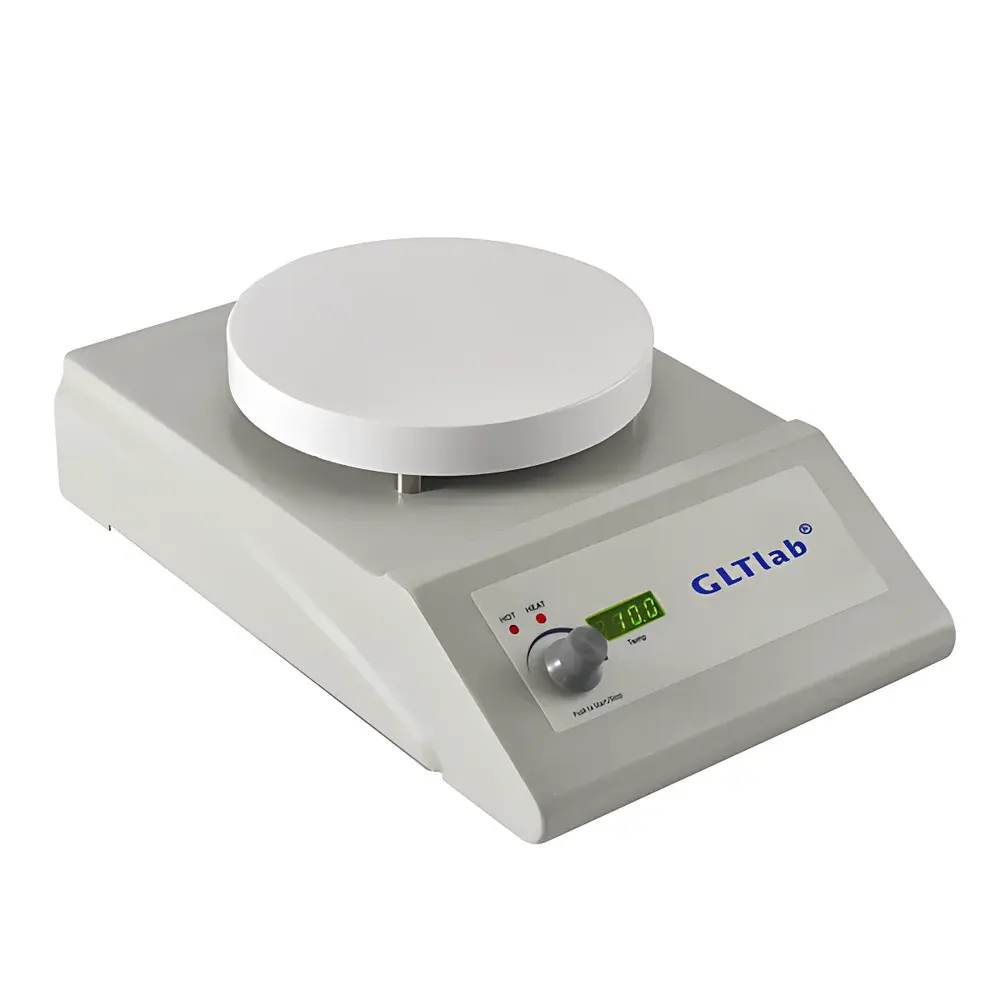
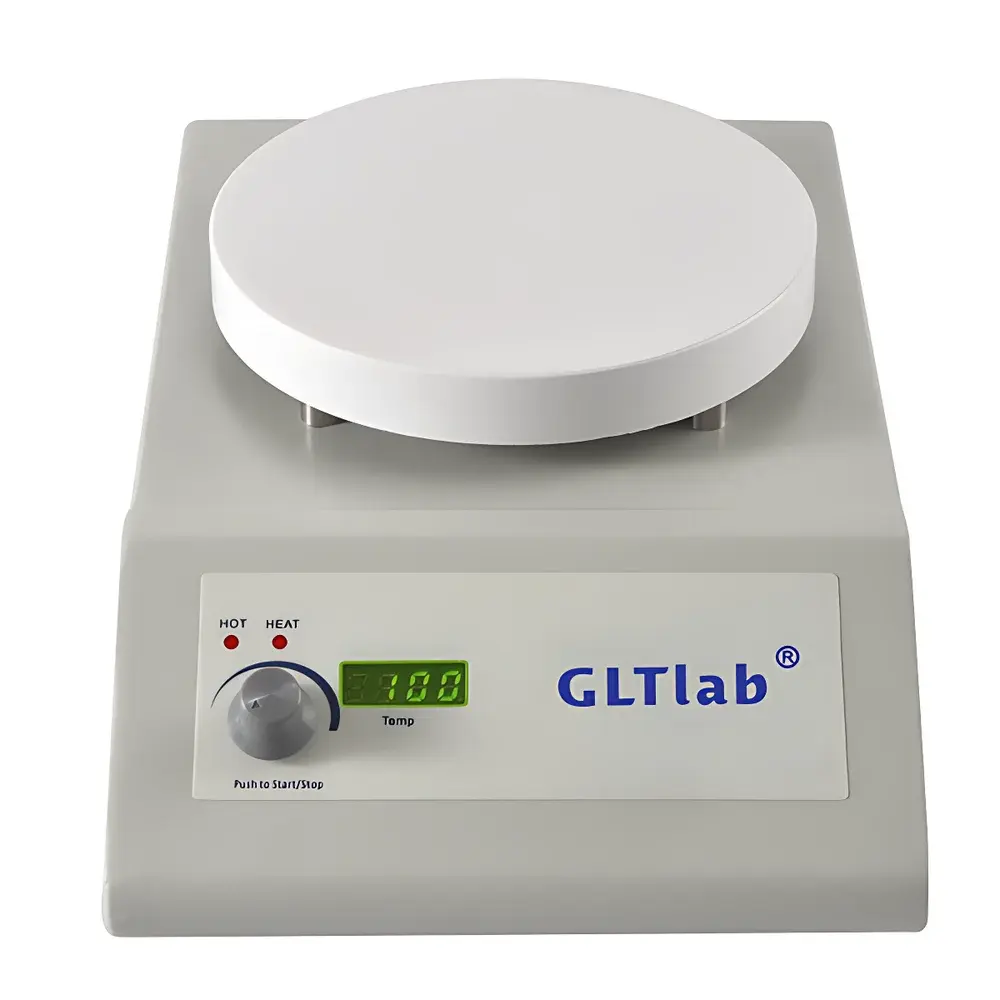
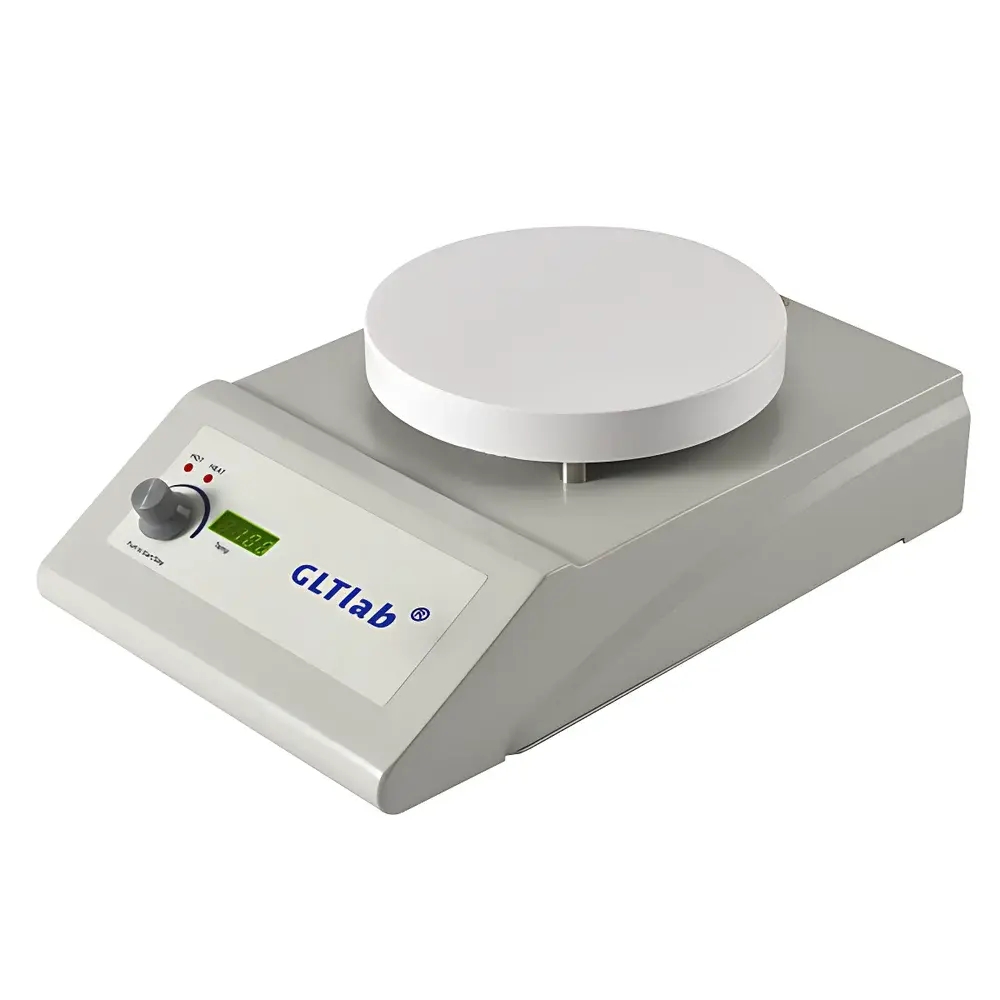
GLTlab SHA-1R-2D 6-Inch Ceramic-Top Magnetic Hotplate Stirrer with Dual-Range Temperature Control (35–400°C Surface / 35–200°C Solution)
| Brand | GLTlab |
|---|---|
| Origin | Guangdong, China |
| Manufacturer Type | Direct Manufacturer |
| Model | SHA-1R-2D |
| Instrument Type | Magnetic Hotplate Stirrer |
| Max Stirring Volume (H₂O) | 20 L |
| Speed Range | 150–1500 rpm |
| Surface Heating Range | 35–400°C |
| Solution Temperature Range | 35–200°C |
| Temperature Setting Resolution (Surface) | 1°C |
| Temperature Setting Resolution (Solution) | 0.1°C |
| Temperature Stability | ±1°C |
| PT1000 Sensor Accuracy | ±0.5°C |
| External Probe Calibration Function | Yes |
| Stirring Position Count | 1 |
| Panel Material | Alumina-Coated Aluminum |
| Panel Diameter | 150 mm |
| Power Rating | 600 W |
| Input Voltage | 100–130 V / 200–240 V AC |
| Frequency | 50/60 Hz |
| IP Rating | IP21 |
| Operating Ambient | 5–40°C, ≤80% RH |
| Dimensions (W×D×H) | 190 × 290 × 100 mm |
| Net Weight | 3.5 kg |
Overview
The GLTlab SHA-1R-2D is a precision-engineered 6-inch (150 mm) magnetic hotplate stirrer designed for reproducible thermal and mechanical control in routine laboratory workflows. It integrates Peltier-free resistive ceramic heating with closed-loop digital temperature regulation via an embedded PT1000 resistance temperature detector (RTD), enabling stable surface temperatures from 35°C to 400°C — suitable for solvent evaporation, polymer dissolution, and high-boiling-point reaction setups. Unlike single-range hotplates, the SHA-1R-2D distinguishes between surface and solution temperature control modes: while the aluminum-ceramic composite plate achieves up to 400°C, the solution mode — activated when an external PT1000 probe is inserted into the vessel — regulates liquid-phase temperature within 35–200°C with 0.1°C setpoint resolution and ±0.5°C accuracy. This dual-mode architecture ensures process fidelity across applications where thermal overshoot or gradient-induced decomposition must be avoided. The device operates on universal input voltage (100–240 V AC), making it compatible with global lab power infrastructure without adapters.
Key Features
- Ceramic-coated aluminum heating plate (Ø150 mm) offering rapid thermal response, chemical resistance, and uniform heat distribution across the active zone
- Dual-range temperature control: independent selection of surface-heating mode (35–400°C, 1°C resolution) or solution-sensing mode (35–200°C, 0.1°C resolution) with real-time PT1000 feedback
- High-torque DC motor delivering consistent stirring performance from 150 to 1500 rpm, optimized for viscous media up to 20 L (H₂O-equivalent)
- LED digital display with intuitive parameter navigation, overheat warning indicator, and external probe calibration utility accessible via front-panel menu
- Robust mechanical architecture rated IP21 for protection against vertically falling solids and limited moisture ingress — appropriate for general-purpose fume hood and benchtop use
- Compliance-ready design: supports GLP-aligned documentation through traceable setpoint logging (when integrated with optional data acquisition systems) and user-accessible sensor calibration routines
Sample Compatibility & Compliance
The SHA-1R-2D accommodates standard round-bottom flasks (50 mL–5 L), beakers (50–2000 mL), and jacketed reactors equipped with compatible magnetic stir bars (25–60 mm length). Its ceramic surface resists corrosion from common solvents including acetone, ethanol, ethyl acetate, and dilute acids/bases. For regulated environments, the instrument’s programmable temperature stability (±1°C) and calibrated RTD output align with routine verification requirements under ISO/IEC 17025-accredited laboratories. While not inherently 21 CFR Part 11-compliant as a standalone unit, its analog/digital outputs support integration into validated systems where electronic records and audit trails are enforced per GMP/GLP protocols.
Software & Data Management
The SHA-1R-2D operates as a stand-alone instrument with no proprietary software dependency. All operational parameters — speed, temperature setpoint, mode selection, and calibration status — are managed locally via the LED interface. Optional analog (0–10 V) and RS-485 Modbus RTU outputs enable connection to SCADA platforms, PLCs, or centralized lab monitoring systems for remote setpoint adjustment and real-time telemetry logging. When paired with third-party data loggers compliant with ASTM E2877-22 (Standard Guide for Temperature Mapping of Laboratory Equipment), users can generate temperature uniformity reports required for equipment qualification (IQ/OQ).
Applications
- Kinetic studies requiring precise thermal ramping and sustained agitation in organic synthesis (e.g., Suzuki coupling, esterification)
- Preparation of homogeneous colloidal dispersions, nanoparticle suspensions, and polymer solutions where shear history and thermal history are interdependent
- Standardized dissolution testing per USP using calibrated water baths or jacketed vessels with external temperature feedback
- QC/QA sample preparation workflows including buffer equilibration, reagent blending, and standard solution dilution under controlled thermal conditions
- Teaching laboratories conducting calorimetry fundamentals, Arrhenius plots, or viscosity-temperature profiling
FAQ
Does the SHA-1R-2D support external temperature probe input?
Yes — it accepts a standard PT1000 sensor for closed-loop solution temperature control and includes a built-in calibration function to adjust probe offset.
What is the maximum recommended vessel diameter for optimal stirring efficiency?
For uniform vortex formation and thermal transfer, vessels up to 120 mm in diameter are recommended when using the full 150 mm heating surface.
Can this unit be used under inert atmosphere conditions?
Yes — the absence of moving parts above the plate and sealed electronics allow safe operation inside nitrogen-purged gloveboxes or under Schlenk line manifolds, provided ambient humidity remains below 80% RH.
Is the heating plate resistant to thermal shock?
The alumina-ceramic coating provides enhanced thermal shock resistance compared to bare aluminum; however, rapid quenching with cold liquids is not recommended to preserve long-term surface integrity.
How often should the PT1000 probe be recalibrated?
Per ISO/IEC 17025 guidance, annual calibration is recommended; more frequent verification (e.g., before critical experiments) using NIST-traceable reference thermometers is advised for high-accuracy applications.



