
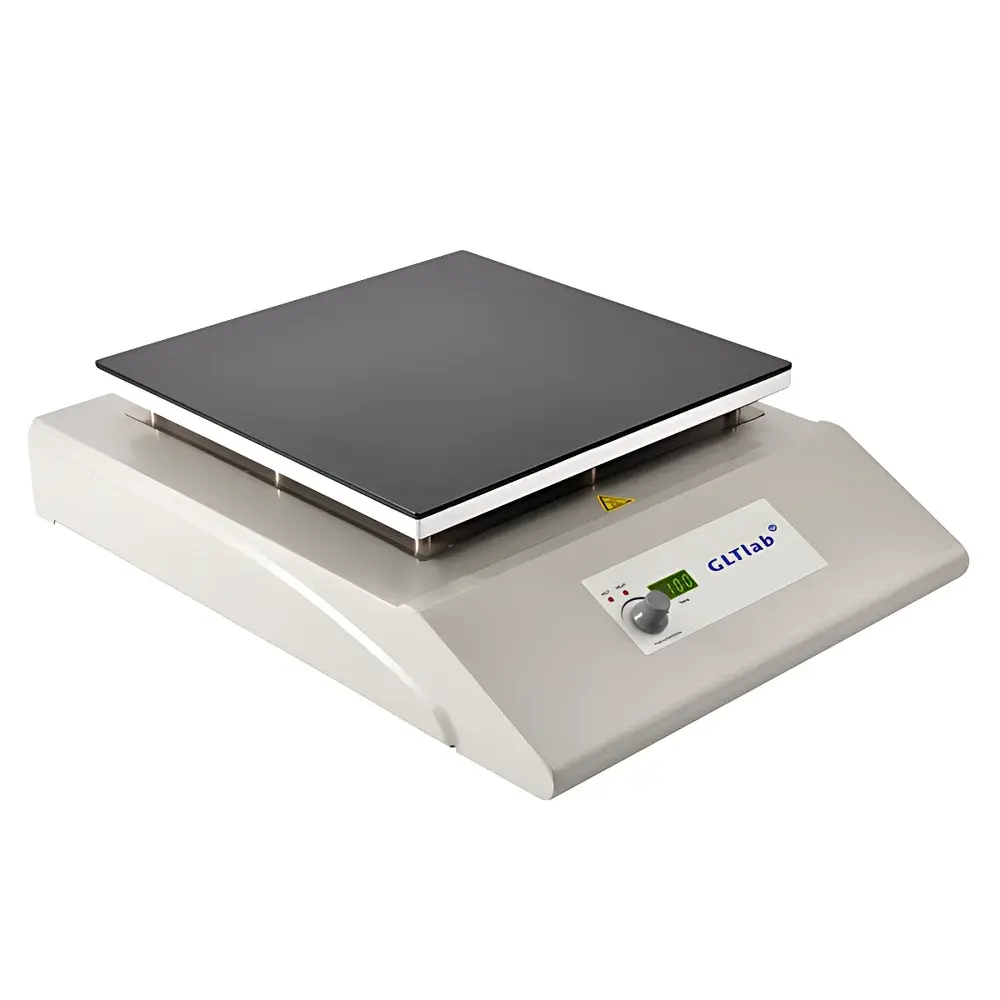
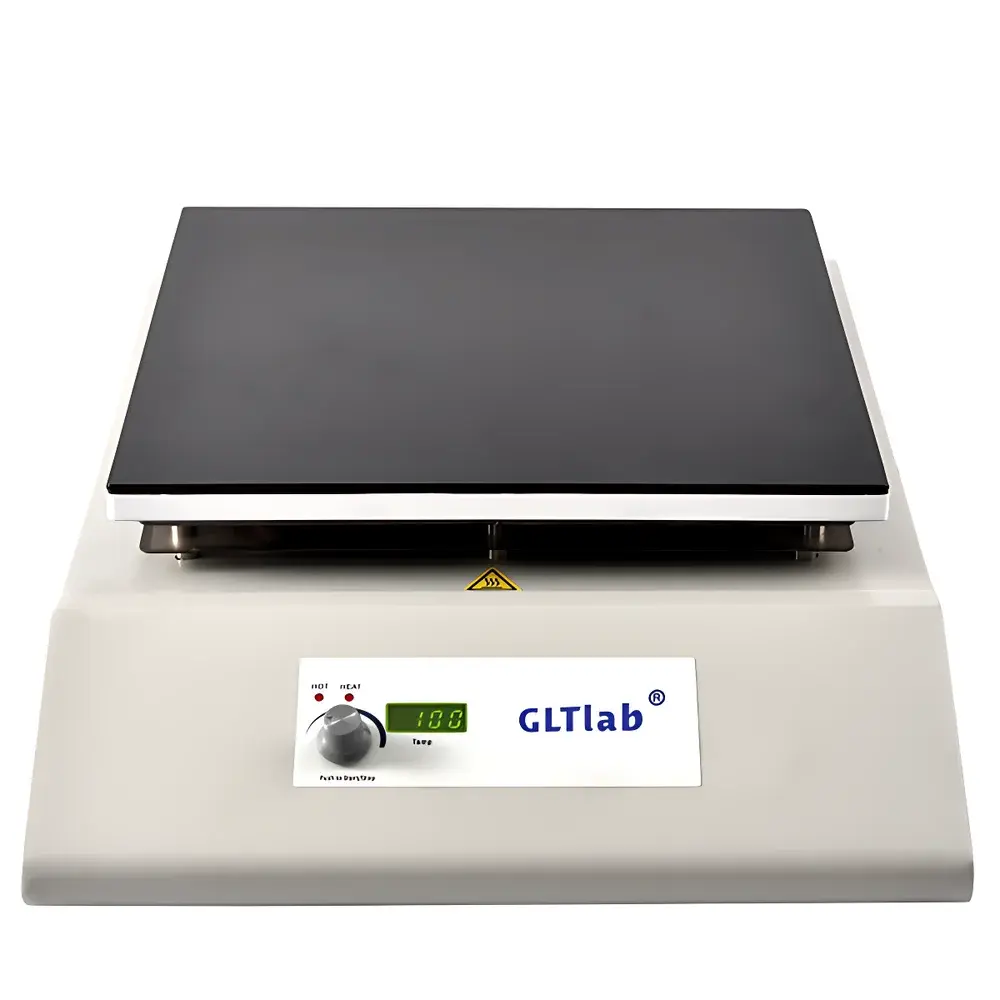
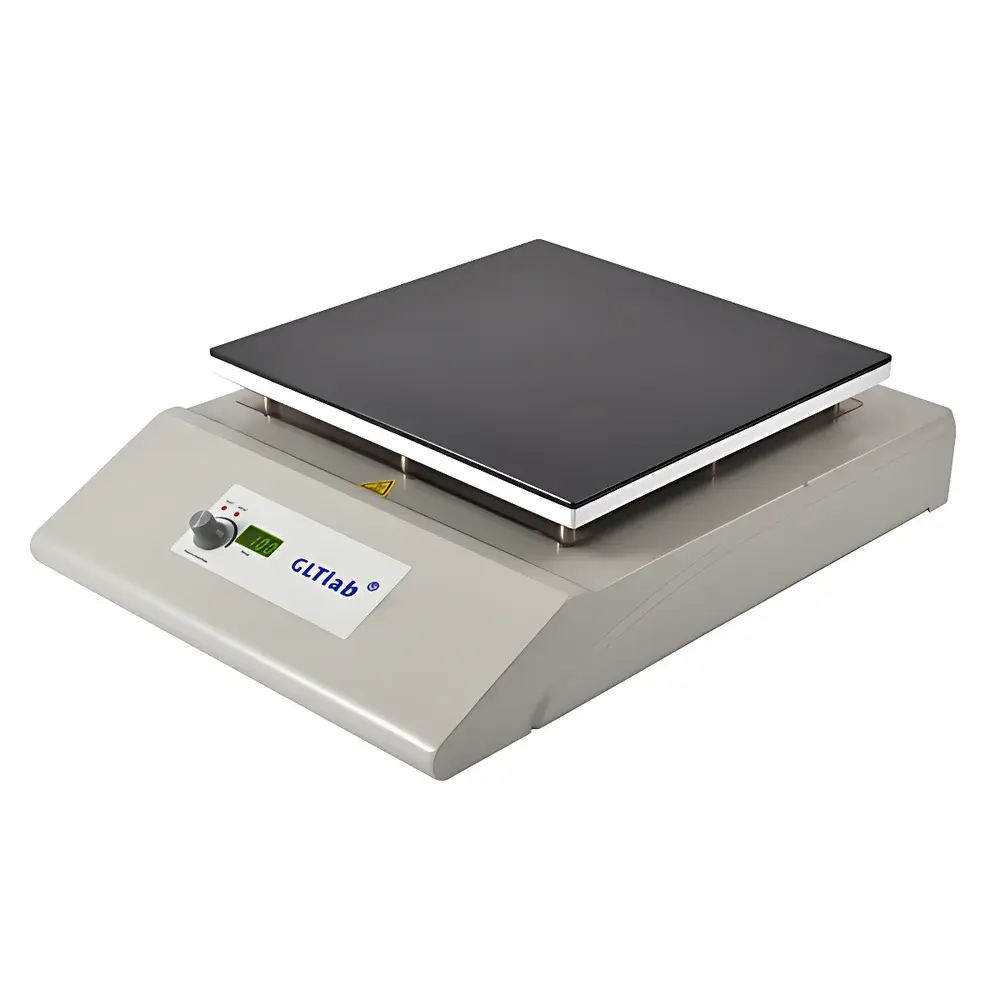
GLTLab SHC-1-2D Ceramic Hotplate with PID Temperature Control and Integrated Stirring
| Brand | GLTLab |
|---|---|
| Model | SHC-1-2D |
| Heating Plate Material | High-Temperature Ceramic |
| Plate Dimensions | 160 × 160 mm |
| Temperature Range (Plate Surface) | 35–550 °C |
| Temperature Range (Liquid Media) | 35–200 °C |
| Temperature Setting Resolution (Plate) | 1 °C |
| Temperature Setting Resolution (Liquid) | 0.1 °C |
| Temperature Stability | ±1 °C |
| PT1000 Sensor Accuracy | ±0.5 °C |
| External Probe Calibration Function | Yes |
| Stirring Position | Single |
| Max Stirring Volume (Water) | 10 L |
| Dimensions (W × D × H) | 190 × 290 × 100 mm |
| Weight | 3 kg |
| Operating Ambient | 5–40 °C, ≤80% RH |
| Ingress Protection | IP21 |
| Input Voltage | 100–130 V / 200–240 V AC |
| Frequency | 50/60 Hz |
| Power Rating | 600 W |
| Display | LED Digital Panel |
| Safety Features | Overheat Warning, Thermal Cut-off |
Overview
The GLTLab SHC-1-2D is a benchtop ceramic hotplate designed for precise, stable, and repeatable heating in analytical, quality control, and synthetic chemistry laboratories. Engineered for applications requiring elevated thermal stability—such as solvent evaporation, sample digestion, reagent preheating, and controlled reaction initiation—the device employs a high-purity alumina-based ceramic heating surface capable of continuous operation up to 550 °C. Its core thermal regulation system utilizes a digital PID (Proportional-Integral-Derivative) algorithm coupled with a calibrated PT1000 resistance temperature detector embedded beneath the plate surface. This architecture ensures minimal overshoot, rapid thermal equilibration (<15 min from ambient to 400 °C), and long-term drift <±0.3 °C over 8-hour continuous operation under load. Unlike metal-surface hotplates, the ceramic plate offers superior chemical inertness, resistance to acid/base splashes, and non-magnetic properties—critical when used adjacent to sensitive instrumentation such as NMR spectrometers or magnetic stirrers.
Key Features
- High-temperature ceramic heating surface (Al₂O₃-based, 160 × 160 mm active area) rated for sustained operation at 550 °C
- Dual-mode temperature control: independent setpoints for plate surface (35–550 °C, 1 °C resolution) and liquid-phase monitoring (35–200 °C, 0.1 °C resolution) via external PT1000 probe
- Integrated magnetic stirring with single-position drive, supporting up to 10 L aqueous volume at speeds up to 1200 rpm (load-dependent)
- LED digital display with intuitive menu navigation, real-time temperature feedback, and visual overheat warning indicator
- Onboard calibration function for external PT1000 probes—enabling traceable adjustment per ISO/IEC 17025 laboratory requirements
- Robust electrical design compliant with IEC 61010-1:2010 safety standards; includes thermal cut-off fuse, grounded chassis, and IP21-rated enclosure
- Universal power input (100–130 V / 200–240 V AC, 50/60 Hz) with internal voltage auto-sensing and 600 W regulated output
Sample Compatibility & Compliance
The SHC-1-2D accommodates standard laboratory glassware—including round-bottom flasks (up to 5 L), beakers (50 mL–5000 mL), and digestion vessels—without risk of thermal shock or surface adhesion. The non-porous ceramic surface resists corrosion from concentrated HNO₃, HCl, and NaOH solutions commonly used in EPA Method 3050B or ASTM D5191 sample preparation workflows. Device firmware supports manual and semi-automated protocols aligned with GLP-compliant documentation practices. While the unit itself does not include 21 CFR Part 11 audit trail functionality, its analog/digital interface architecture permits integration into validated LIMS or SCADA systems via optional RS-485 or 0–10 V analog output modules (sold separately). All electrical components meet RoHS 2 and CE marking directives for laboratory equipment placed on EU markets.
Software & Data Management
The SHC-1-2D operates as a standalone instrument with no proprietary software dependency. Temperature logging is enabled via external data acquisition systems using its analog voltage output (0–10 V = 0–550 °C) or digital serial interface (RS-485 Modbus RTU protocol). Users may configure custom ramp-soak profiles using third-party platforms such as LabVIEW, MATLAB Data Acquisition Toolbox, or Python-based PySerial implementations. For routine QC labs, the built-in external probe calibration routine satisfies ISO 17025 clause 6.4.10 (verification of measurement equipment) when performed against a NIST-traceable reference thermometer. No cloud connectivity or firmware updates are required; all operational logic resides in hardened microcontroller firmware with write-protected memory.
Applications
- Controlled thermal decomposition of polymer samples prior to FTIR or TGA analysis
- Standardized ashing of biological tissues per AOAC 975.04 methodology
- Pre-concentration of environmental water extracts in EPA 8270D workflows
- Heating and stirring of viscous reaction mixtures during Grignard or Suzuki coupling syntheses
- Calibration verification of infrared thermometers and handheld thermal imagers
- Stabilization of reference standards in metrology labs operating under ISO/IEC 17025 accreditation
FAQ
Can the SHC-1-2D maintain 550 °C while stirring?
No. Stirring is only recommended below 200 °C to prevent degradation of PTFE-coated stir bars and ensure motor longevity. At temperatures >200 °C, the unit functions as a static hotplate.
Is the PT1000 sensor included with the unit?
Yes—a calibrated PT1000 probe with 1.5 m PTFE-insulated cable is supplied standard. Additional probes may be ordered with alternative sheath materials (e.g., stainless steel 316L or quartz) for aggressive media.
What is the maximum allowable ambient humidity for continuous operation?
The unit is rated for operation at ≤80 % relative humidity at 30 °C ambient, per IEC 60068-2-30 testing. Condensation must be avoided on control electronics.
Does the device support programmable time-based shut-off?
Not natively. Timer functionality requires optional external relay module (GLT-TRIG-1) or integration into PLC-based lab automation networks.
How often should external probe calibration be performed?
Per ISO/IEC 17025, calibration interval should be determined by usage frequency and criticality of measurement; typical recommendation is quarterly for high-throughput QC labs and annually for research settings.



