
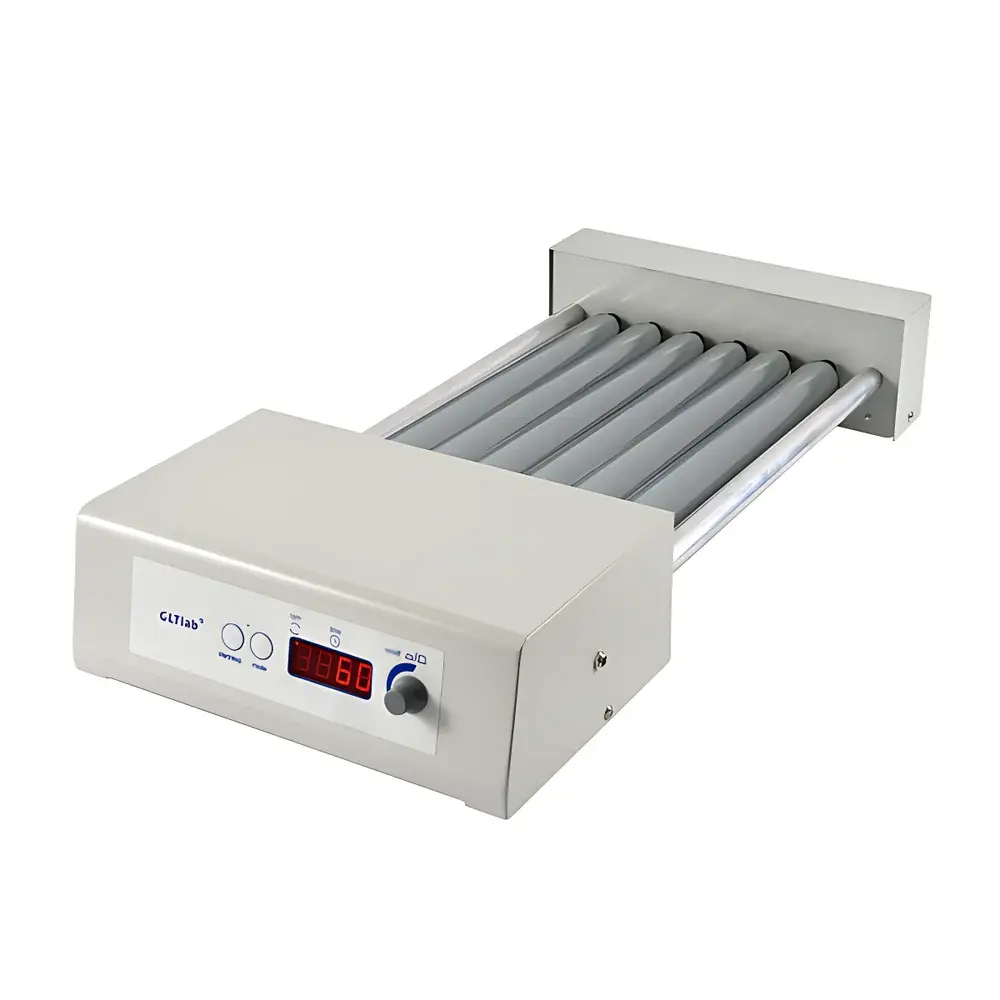
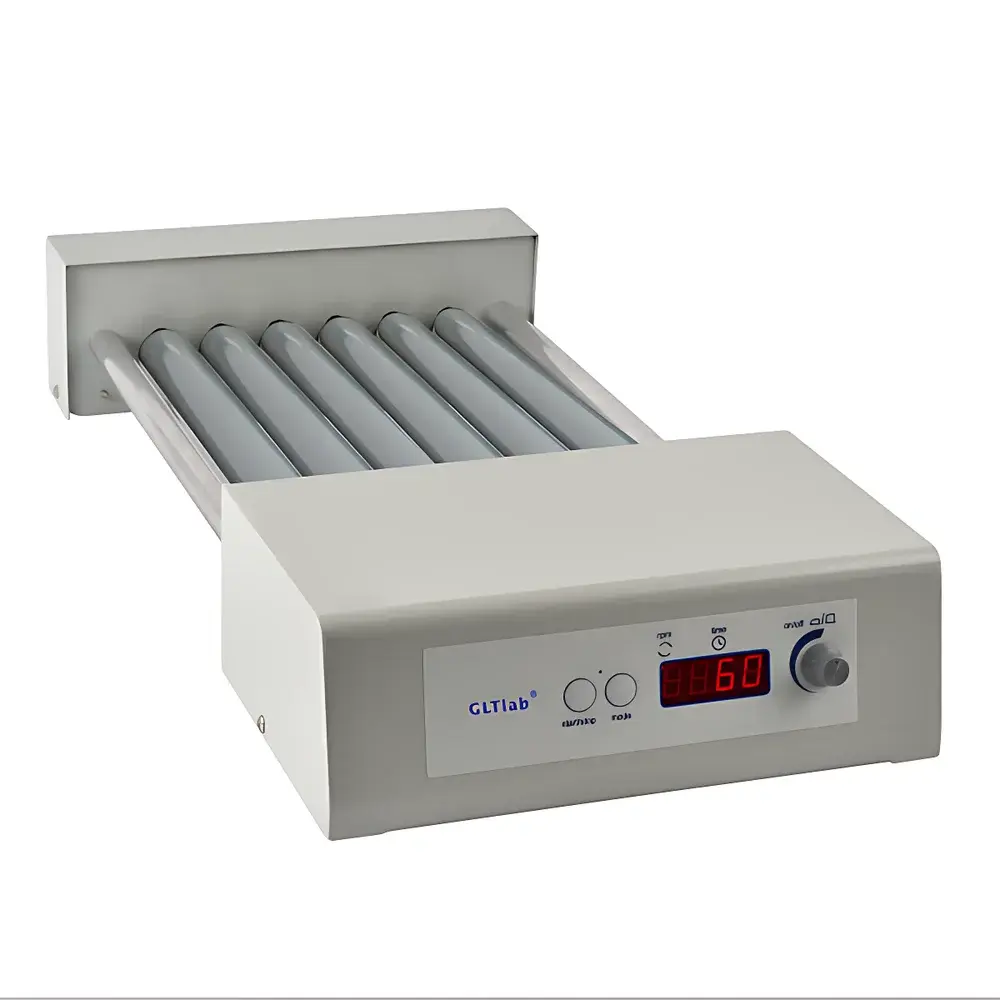
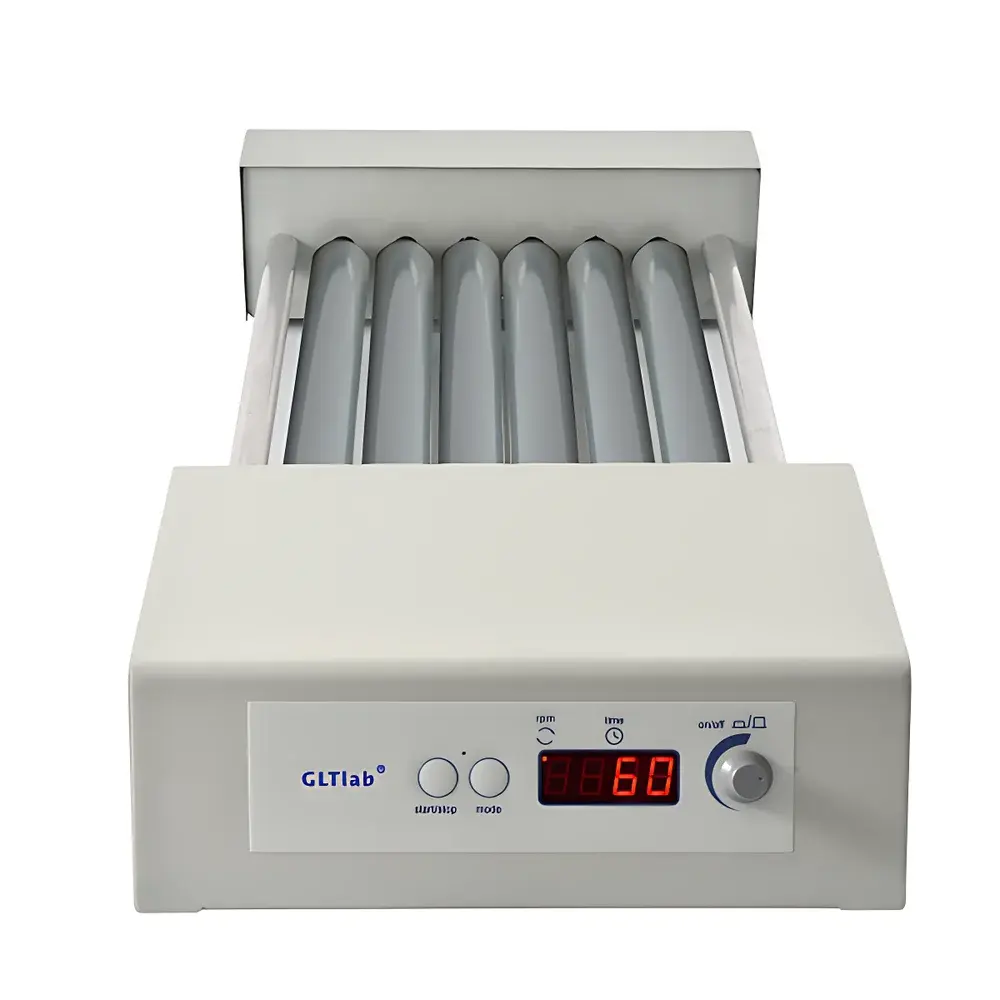
GLTlab MTR-2D-B Digital Orbital Roller Mixer
| Brand | GLTlab |
|---|---|
| Origin | Guangdong, China |
| Manufacturer Type | OEM/ODM Manufacturer |
| Country of Origin | China |
| Model | MTR-2D-B |
| Pricing | Upon Request |
| Roller Count | 6 |
| Roller Dimensions | 340 × 30 mm |
| Control Method | Digital Microprocessor Control |
| Display | LED |
| Timer Range | 1–99 hours (adjustable in 1-min increments) |
| Operating Mode | Rolling + Oscillating |
| Speed Range | 5–1000 rpm (continuous, digitally adjustable) |
| Max Load Capacity | 45 kg |
| Power Supply | 12 V DC, 5 A |
| Construction | Stainless Steel Frame & Housing |
| Compliance | CE-marked design principles, RoHS-compliant components, GLP-aligned operational architecture |
Overview
The GLTlab MTR-2D-B Digital Orbital Roller Mixer is an engineered solution for consistent, low-shear sample homogenization across life science, materials chemistry, and industrial R&D laboratories. Based on orbital rolling kinematics—where cylindrical rollers rotate about a central axis while simultaneously executing a gentle lateral oscillation—the MTR-2D-B ensures uniform agitation of tubes, bottles, flasks, and custom containers without vortexing, foaming, or sediment disruption. Its dual-motion profile (rolling + oscillating) enhances mass transfer efficiency in viscous or particulate-laden suspensions, making it particularly suited for cell culture maintenance, antibody conjugation, polymer dispersion, battery slurry conditioning, and reagent reconstitution. Designed for continuous-duty operation in ambient, refrigerated (4 °C), or high-humidity environments (up to 85% RH, non-condensing), the unit maintains mechanical stability and speed fidelity across thermal gradients—a critical requirement for long-duration incubation protocols.
Key Features
- Stainless steel structural frame and housing—corrosion-resistant, easy to decontaminate, and compliant with ISO 14644-1 Class 7 cleanroom-compatible surface finish standards.
- Digital microprocessor control system with real-time rpm feedback and closed-loop speed regulation—ensures ±2 rpm repeatability over full 5–1000 rpm range.
- Six independently aligned 340 mm × 30 mm rollers with hardened alloy shafts and self-lubricating polymer bearings—eliminates gear wear issues present in legacy designs and extends service intervals beyond 15,000 operating hours.
- Adjustable timer (1 minute to 99 hours) with auto-shutdown and memory retention—preserves user-defined settings after power interruption.
- Dynamic load compensation algorithm—maintains nominal speed under variable mass distribution up to 45 kg total payload, verified per ASTM D4065-22 Annex A3 rotational consistency test protocol.
- Low-noise DC motor drive (≤48 dB at 1 m) and thermally stable 12 V/5 A power architecture—compatible with uninterruptible power supplies (UPS) and mobile lab deployments.
Sample Compatibility & Compliance
The MTR-2D-B accommodates standard laboratory vessels including 15 mL and 50 mL conical tubes, 100–500 mL glass or PET bottles, multi-well plates (with optional adapter), and custom jigs for irregular geometries. All roller surfaces are chemically inert (EPDM-coated) and rated for exposure to common solvents (ethanol, isopropanol, acetone, aqueous buffers). The device conforms to electromagnetic compatibility (EMC) requirements per IEC 61326-1:2023 and electrical safety standards per IEC 61010-1:2010. While not FDA-cleared as a medical device, its operational log structure—including timestamped speed/timer records—supports audit readiness for GLP and GMP environments under 21 CFR Part 11 Annex 11 data integrity guidelines.
Software & Data Management
The MTR-2D-B operates as a standalone instrument with no proprietary software dependency. All configuration and runtime data are retained locally via non-volatile EEPROM. Optional RS-485 serial interface (available upon request) enables integration into LabVantage, STARLIMS, or custom SCADA systems for centralized monitoring. Audit trails include operator ID (via external badge reader integration), start/stop timestamps, duration, average rpm, and thermal event logs—structured to align with ALCOA+ data governance principles (Attributable, Legible, Contemporaneous, Original, Accurate, Complete, Consistent, Enduring, Available).
Applications
- Biopharmaceutical: Gentle resuspension of lyophilized proteins, mixing of ELISA coating buffers, and stabilization of lipid nanoparticle (LNP) formulations prior to extrusion.
- Materials Science: Homogenization of cathode/anode slurries for lithium-ion battery electrode development; dispersion of nanocellulose or graphene oxide in aqueous media.
- Clinical Diagnostics: Uniform mixing of whole-blood samples in EDTA tubes prior to centrifugation; preparation of calibration standards for immunoassay platforms.
- Environmental Testing: Extraction of microplastics from soil matrices using solvent-based agitation protocols per EPA Method 1613B supplementary handling guidance.
- Academic Research: Long-term simulation of sediment transport dynamics in geotechnical flow cells; controlled biofilm formation assays on static vs. agitated substrates.
FAQ
What is the maximum recommended tube diameter for optimal contact with the rollers?
Tubes up to 50 mm in outer diameter achieve full circumferential engagement; larger diameters require custom cradle inserts.
Can the MTR-2D-B operate unattended overnight?
Yes—its thermal cutoff protection, brushless DC motor, and sealed bearing system support continuous 99-hour runs without supervision.
Is calibration certification available?
NIST-traceable speed verification reports (ISO/IEC 17025 accredited) are provided optionally at time of shipment.
Does the unit support remote start/stop via network command?
Not natively; however, the RS-485 interface supports Modbus RTU commands for integration with building management or lab automation systems.
How often does preventive maintenance need to be performed?
Visual inspection every 6 months; roller alignment check and firmware update annually—no lubrication or part replacement required within first 36 months under normal use.



