
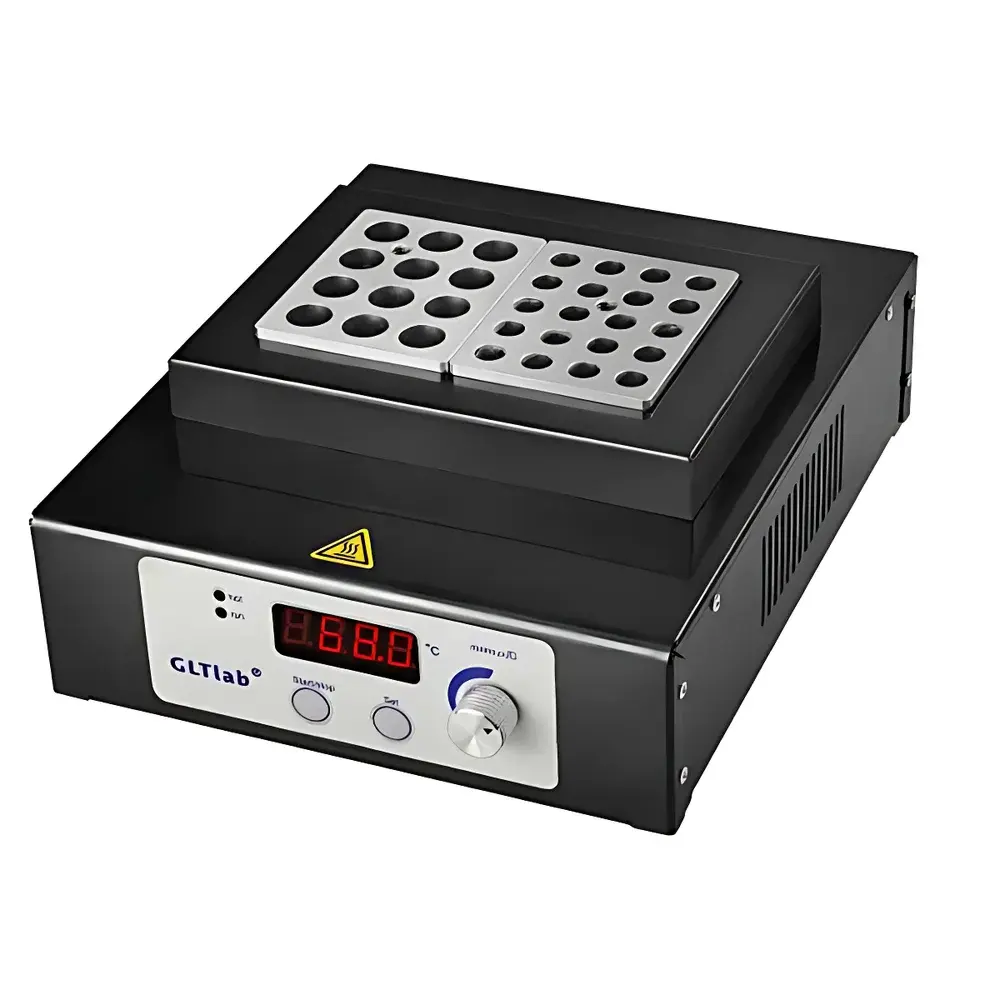
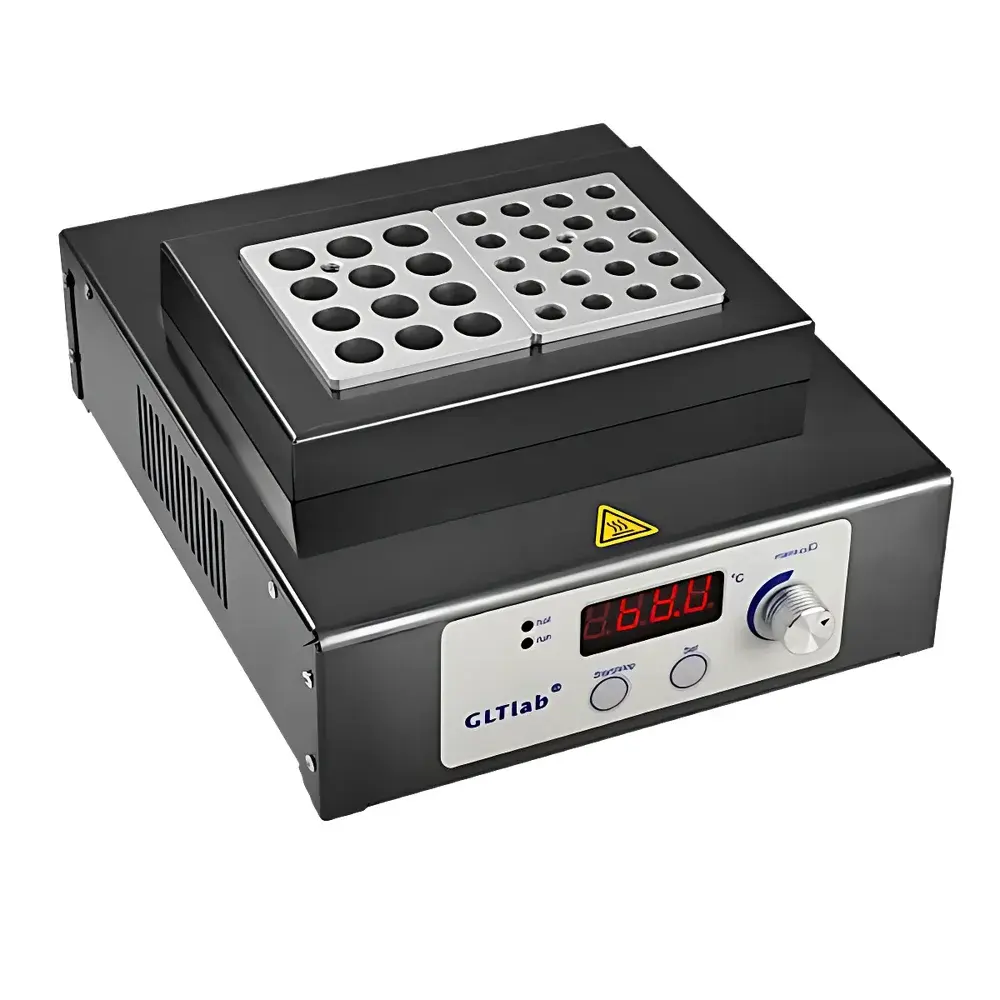
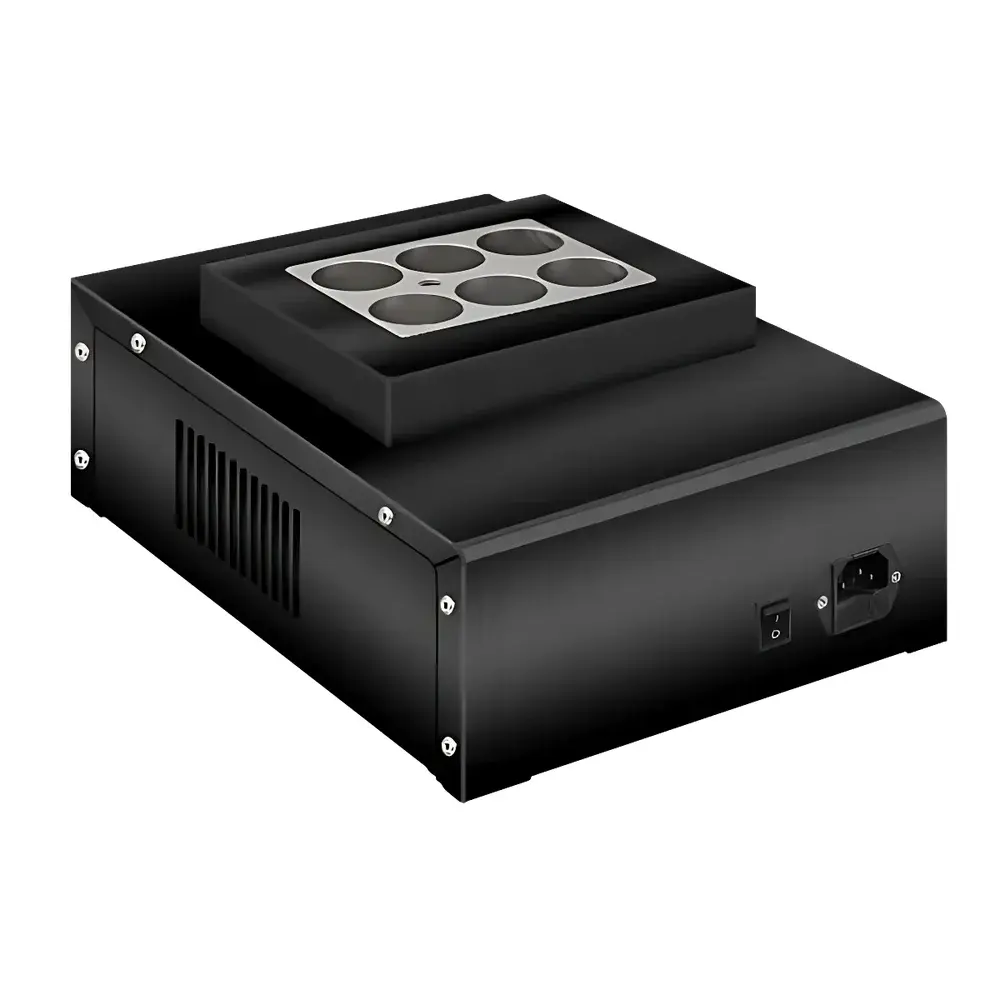
GLTLab DB-02 Digital Constant-Temperature Metal Bath
| Brand | GLTLab |
|---|---|
| Origin | Guangdong, China |
| Manufacturer Type | Direct Manufacturer |
| Model | DB-02 |
| Temperature Range | 35–200 °C |
| Temperature Accuracy | ±1 °C |
| Heating Time to 100 °C | ≤15 min |
| Dimensions (W×D×H) | 230 × 220 × 100 mm |
| Net Weight | 4 kg |
| Control System | PID Digital Temperature Control |
| Timer Function | Built-in |
| Optional Communication Interface | RS485 |
| Standard Aluminum Block Dimensions | 75 × 95 × 50 mm (customizable) |
| Unit Display | °C/°F Switchable |
Overview
The GLTLab DB-02 Digital Constant-Temperature Metal Bath is a compact, high-stability thermal platform engineered for precise and uniform sample heating in life science, clinical diagnostics, molecular biology, and analytical chemistry laboratories. Unlike water baths, the DB-02 employs solid-state aluminum heating blocks to deliver rapid thermal response, minimal evaporation risk, and enhanced contamination control—critical for DNA denaturation, enzyme reactions, cell culture pre-warming, and reagent equilibration. Its core operating principle relies on resistive heating elements embedded beneath a machined aluminum block, regulated by a closed-loop PID controller that continuously monitors surface temperature via a calibrated platinum resistance thermometer (PT100-class sensor). The device maintains setpoint stability within ±1 °C across its full operational range of 35–200 °C, with typical overshoot <2 °C during ramp-up. Designed for benchtop integration, the DB-02 occupies minimal footprint (230 × 220 × 100 mm) and weighs only 4 kg, enabling flexible placement in laminar flow hoods, biosafety cabinets, or near PCR workstations.
Key Features
- PID digital temperature control system with real-time feedback loop ensures consistent thermal performance and reduced drift over extended operation.
- Dual independent block slots accommodate two interchangeable aluminum modules simultaneously—supporting parallel processing of different sample types or temperatures (when used with optional dual-zone configuration).
- Intuitive LED display with tactile keypad enables direct setpoint entry, timer programming (0–999 min), and instant °C/°F unit switching.
- Aluminum heating block (standard 75 × 95 × 50 mm) offers superior thermal conductivity and mechanical durability; custom block geometries—including 0.2 mL, 0.5 mL, 1.5 mL, and 2.0 mL tube configurations—are available upon request.
- Robust anodized aluminum housing provides electromagnetic interference (EMI) shielding and corrosion resistance in humid or reagent-exposed environments.
- Optional RS485 serial interface supports integration into centralized lab automation systems for remote monitoring, logging, and audit-compliant data capture (e.g., compatible with LabVantage, STARLIMS, or custom SCADA platforms).
Sample Compatibility & Compliance
The DB-02 is validated for use with standard microcentrifuge tubes (0.2–2.0 mL), PCR strips, deep-well plates, and small-volume vials. Its uniform thermal gradient (<±0.5 °C across block surface at 70 °C) meets routine requirements for ISO/IEC 17025-accredited testing labs performing temperature-sensitive assays. While not certified to IEC 61010-1 for Class II medical device applications, the unit conforms to general laboratory equipment safety standards including EN 61326-1 (EMC) and GB 4793.1–2007 (Chinese safety standard for electrical lab instruments). For GLP/GMP environments, the optional RS485 interface enables timestamped temperature logging with user authentication—supporting traceability per FDA 21 CFR Part 11 when paired with compliant software infrastructure.
Software & Data Management
The DB-02 operates as a standalone instrument with no mandatory software dependency. However, when equipped with the RS485 option, it communicates via Modbus RTU protocol at 9600 baud, allowing bidirectional command exchange (e.g., SET TEMP, READ ACTUAL, START TIMER, QUERY STATUS). Third-party data acquisition tools—including Python-based PySerial scripts, LabVIEW VIs, or MATLAB Instrument Control Toolbox—can parse and archive temperature profiles. Audit trails generated through such integrations retain operator ID, timestamp, setpoint, actual reading, and deviation alerts—enabling retrospective review for quality assurance documentation.
Applications
- Enzyme activation and inactivation protocols requiring precise thermal transitions (e.g., restriction digests, ligase reactions, alkaline phosphatase treatment).
- Pre-heating of agarose gels, electrophoresis buffers, and staining solutions prior to gel casting or post-run processing.
- Controlled thawing of cryopreserved cells or biofluids to minimize thermal shock and preserve viability.
- Standardization of immunoassay reagents (e.g., antibody dilutions, conjugate incubations) where ambient temperature variability affects binding kinetics.
- Calibration support for thermocouple probes and infrared thermometers using NIST-traceable reference blocks.
FAQ
What is the maximum recommended continuous operating temperature?
The DB-02 is rated for sustained operation up to 200 °C; prolonged use above 180 °C may accelerate thermal aging of internal insulation and reduce long-term calibration stability.
Can the unit be used with non-standard tube formats?
Yes—custom-machined aluminum blocks are available for specialized vessels including 96-well PCR plates, glass capillaries, or microfluidic cartridges; lead time and minimum order quantities apply.
Does the DB-02 support temperature ramping profiles?
No—the device maintains a single user-defined setpoint; multi-step thermal programs require external controller integration via RS485.
Is calibration certificate included with shipment?
A factory calibration report (covering 3 points: 37 °C, 70 °C, and 100 °C) is provided; ISO/IEC 17025-accredited calibration is available as an add-on service.
How often should periodic verification be performed?
We recommend quarterly verification using a traceable reference thermometer for routine QC labs; high-throughput or regulated environments may require daily checks per internal SOP.



