
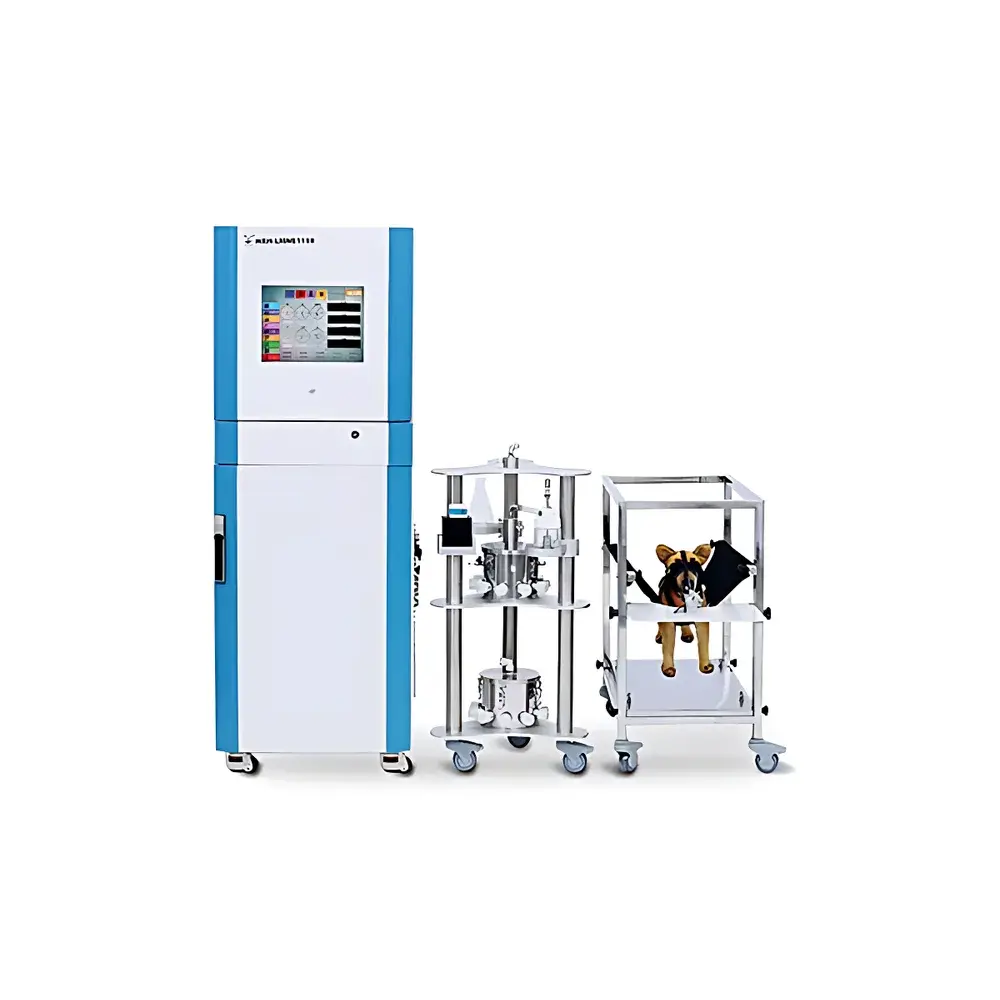
Huironhe HRH-LMNE1168 Canine Oronasal Inhalation Exposure System
| Brand | Huironhe |
|---|---|
| Origin | Beijing, China |
| Manufacturer Type | Authorized Distributor |
| Country of Origin | China |
| Model | HRH-LMNE1168 |
| Pricing | Upon Request |
Overview
The Huironhe HRH-LMNE1168 Canine Oronasal Inhalation Exposure System is a purpose-engineered whole-body–free breathing exposure platform designed specifically for regulatory-compliant inhalation toxicology studies in canine models. It operates on the principle of controlled oronasal inhalation—where test substances (gases, vapors, liquid aerosols, dusts, nano-aerosols, and smoke) are delivered directly to the animal’s respiratory tract via precisely fitted, species-specific face masks, minimizing extrapulmonary deposition and maximizing physiological relevance. Unlike traditional whole-body chambers, this system isolates respiratory intake while maintaining natural breathing patterns, thereby improving dose accuracy, reducing systemic confounding, and enhancing interspecies extrapolation validity for human risk assessment. The system supports acute, subacute (28-day), subchronic (90-day), and chronic exposure regimens per OECD and Chinese national standards, making it suitable for GLP-compliant safety pharmacology, toxicokinetic, and hazard characterization studies.
Key Features
- Stainless-steel dual static-pressure chamber architecture ensures structural integrity, corrosion resistance, and long-term operational stability under repeated sterilization and chemical exposure.
- Species-optimized oronasal face masks engineered for anatomical fit across standard beagle and hound breeds, enabling simultaneous exposure of 6–10 animals with minimal restraint stress.
- Real-time exposure uniformity control: gas/vapor concentration variability ≤ ±8%; liquid aerosol mass concentration variability ≤ ±10%; dust/nanoparticle aerosol mass concentration variability ≤ ±20%—validated per OECD TG 403, TG 412, and GB/T 15670 series protocols.
- Integrated high-efficiency filtration cascade (HEPA + activated carbon + optional scrubber modules) treats exhaust air to meet China’s GB 16297–1996 Emission Standards for Air Pollutants from Industrial Sources.
- Redundant safety monitoring system continuously tracks chamber temperature, differential pressure across mask interfaces, and trace gas leakage; triggers audible/visual alarms and automatic shutdown upon deviation beyond pre-set thresholds.
- Modular airflow management with laminar flow design and calibrated mass flow controllers enables precise dilution ratio adjustment and reproducible aerosol generation coupling (e.g., with jet nebulizers, fluidized bed dust generators, or thermal vaporizers).
Sample Compatibility & Compliance
The HRH-LMNE1168 accommodates a broad spectrum of inhalable test agents including volatile organic compounds (VOCs), pharmaceutical aerosols (e.g., inhaled corticosteroids, bronchodilators), pesticide formulations, combustion-derived particulates, engineered nanomaterials (e.g., TiO₂, SiO₂ nanoparticles), and radiolabeled tracers. All exposure protocols align with internationally recognized regulatory frameworks: OECD Test Guidelines 403, 412, 413, and 436; Chinese National Standards GB/T 15670.6–2017, GB/T 15670.12–2017, GB/T 15670.13–2017, and GB/T 15670.26–2017; and harmonized methodologies referenced in US EPA OPPTS 870.1300 and EU CLP Annex VI. The system’s design facilitates full audit readiness for GLP inspections—including documented calibration records, maintenance logs, and exposure verification reports.
Software & Data Management
Exposure parameters—including total exposure time, real-time flow rates, chamber temperature/pressure, and upstream/downstream aerosol concentration (via optional integrated photometer or gravimetric sampling ports)—are logged at user-defined intervals (1–60 sec resolution) using the embedded Huironhe Exposure Control Suite (v3.2). Data export is compliant with CSV and ASTM E2500-17 formats. Audit trails record all operator actions, parameter modifications, and alarm events with timestamps and user IDs—supporting 21 CFR Part 11 compliance when deployed with validated electronic signatures and role-based access controls. Raw datasets integrate seamlessly with toxicokinetic modeling platforms (e.g., GastroPlus®, PK-Sim®) via standardized API endpoints.
Applications
- Regulatory safety evaluation of inhaled therapeutics (e.g., monoclonal antibody fragments, mRNA lipid nanoparticles) in large-animal PK/PD models.
- Respiratory disease modeling: COPD, asthma, pulmonary fibrosis, and infectious aerosol challenge (e.g., influenza, SARS-CoV-2 surrogate pathogens).
- Hazard identification and classification of industrial chemicals, agrochemicals, and nanomaterials per GHS criteria.
- Radiation health physics studies involving alpha-emitting radionuclides (e.g., 210Po, 239PuO₂) delivered as insoluble aerosols.
- Inhalational vaccine development and mucosal immunogenicity assessment.
- Environmental health research on urban PM2.5, wildfire smoke, and occupational dust exposures.
- Military and aerospace medicine applications: hypobaric/hyperbaric inhalation toxicology, countermeasure screening for chemical warfare agent simulants.
FAQ
What species and weight ranges are supported?
The system is optimized for adult beagles (8–15 kg) and other medium-sized canines with craniofacial dimensions matching the proprietary mask interface geometry. Custom mask sets are available for juvenile or oversized subjects.
Can the system be integrated with real-time aerosol characterization tools?
Yes—standardized ports accommodate SMPS, APS, FMPS, and GRIMM spectrometers for in-line particle size distribution monitoring; gas analyzers (e.g., FTIR, PID) may be coupled via heated sample lines.
Is validation documentation provided for GLP studies?
Huironhe supplies IQ/OQ documentation packages, including chamber leak testing reports, flow calibration certificates traceable to NIM (China), and exposure uniformity verification data per OECD TG 412 Annex 2.
How is animal welfare maintained during prolonged exposures?
The system incorporates scheduled rest intervals, ambient humidity control (40–60% RH), temperature regulation (20–24°C), and behavioral observation windows. All protocols adhere to AAALAC International and China’s GB/T 35823–2018 guidelines for laboratory animal care.
Does the system support Good Manufacturing Practice (GMP) environmental monitoring integration?
While primarily a research tool, its stainless-steel construction, cleanable surfaces, and HEPA-filtered supply air enable adaptation for ISO Class 7/8 cleanroom-compatible inhalation challenges in early-phase biomanufacturing process validation.
Related Products



