
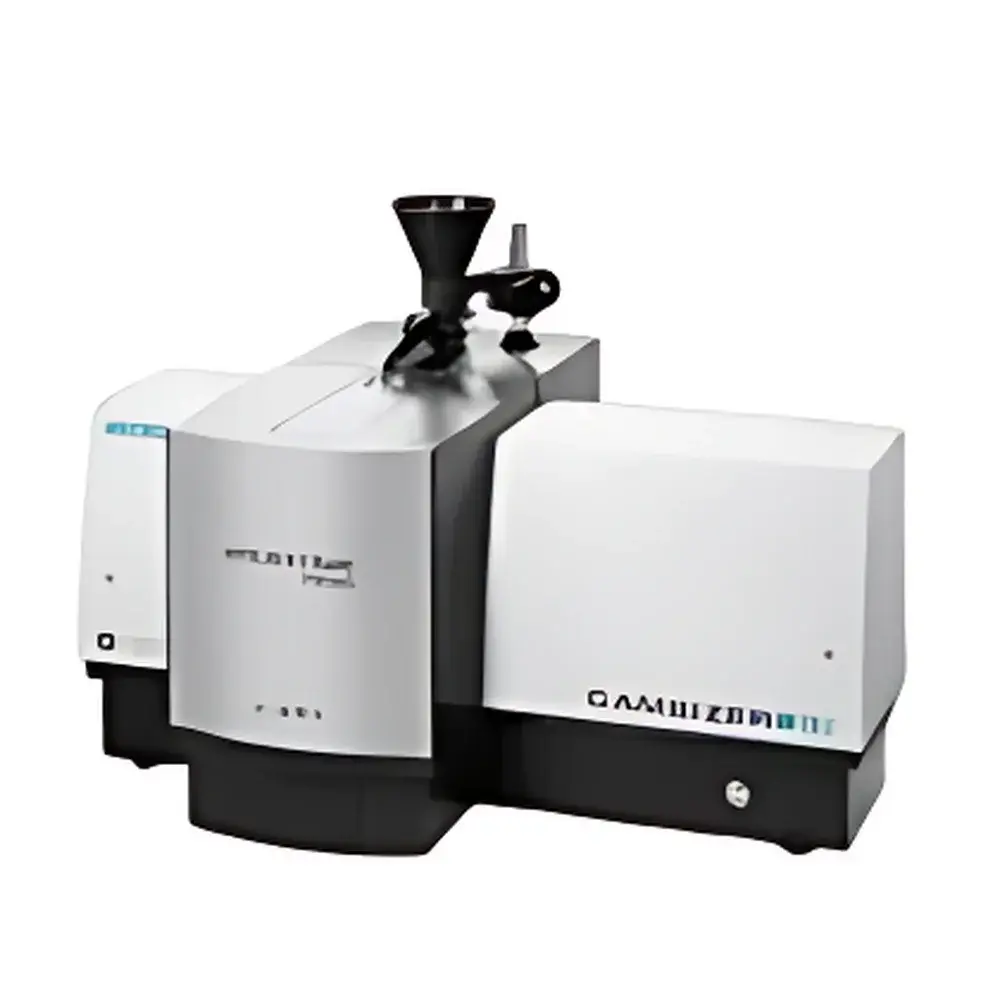
Microtrac MRB CAMSIZER X2 Dynamic Image-Based Particle Size and Shape Analyzer
| Brand | Microtrac MRB |
|---|---|
| Origin | Germany |
| Model | CAMSIZER X2 |
| Measurement Principle | Dynamic Image Analysis (ISO 13322-2) |
| Measurement Range | 0.8 µm to 8 mm (overall) |
| Dual CCD Imaging System | 2 lenses (blue reference lens + red high-magnification lens) |
| Dispersion Modes | Dry (free-fall & pneumatic) and Wet (liquid suspension) |
| Sample Throughput | <20 mg – 500 g per measurement |
| Frame Rate | >300 fps |
| Image Resolution | ~4.2 MPixel per frame |
| Pixel Resolution | 0.8 µm/pixel |
| Measurement Area | ~20 × 20 mm |
| Shape Parameters | Aspect Ratio, Circularity, Convexity, Symmetry, Compactness, Sphericity (per ISO 9276-6) |
| Size Parameters | Equivalent Circle Diameter, Length, Width, Feret Diameter, Minimum Bounding Rectangle, etc. |
| Measurement Time | 1–3 minutes |
| Dimensions (W×H×D) | 850 × 580 × 570 mm |
| Weight (Analyzer Unit) | ~50 kg |
| Operating PC | Integrated quad-core Windows 10 system with dedicated hardware interface card, monitor, keyboard, mouse, and Microtrac’s proprietary evaluation software |
Overview
The Microtrac MRB CAMSIZER X2 is a high-performance, dual-lens dynamic image analysis system engineered for comprehensive particle size and shape characterization across an exceptionally broad range—from 0.8 µm to 8 mm. Unlike static or single-field imaging instruments, the CAMSIZER X2 implements true dynamic analysis in accordance with ISO 13322-2, capturing particles in motion under controlled dispersion conditions. Its dual-CCD optical architecture—comprising a blue-reference lens for macro-scale resolution and a red high-magnification lens for micro-detail—enables simultaneous, optimized imaging of both coarse and fine fractions within the same measurement cycle. This eliminates compromises inherent in single-lens systems and ensures full-range fidelity without manual reconfiguration or post-hoc data stitching. The instrument is particularly suited for materials where shape-driven functional behavior is critical: metal powders for additive manufacturing, abrasive grits, pharmaceutical granules, construction aggregates, catalyst supports, and geological sediments. Because it delivers both quantitative size distributions and multidimensional shape descriptors—including Circularity (calculated from area-perimeter ratio), Aspect Ratio (length/width), Convexity (area/convex-hull-area), and Compactness—it supports predictive modeling of bulk properties such as flowability, packing density, surface reactivity, and mechanical interlocking.
Key Features
- Dual-lens dynamic imaging platform compliant with ISO 13322-2, enabling concurrent capture of coarse and fine particles at optimal magnification.
- Modular dispersion system (“X-Change”) supporting rapid, tool-free switching between dry free-fall, compressed-air, and wet dispersion modes—each calibrated for defined size ranges and material classes.
- High-speed imaging at >300 frames per second, with each frame resolving ~4.2 megapixels and sub-micron pixel resolution (0.8 µm/pixel) over a 20 × 20 mm field of view.
- Integrated LED illumination system delivering uniform, shadow-free backlighting—critical for accurate edge detection and shape parameter extraction.
- Automated sample handling with gravimetric feed control; accommodates sample masses from <20 mg (for trace fines) up to 500 g (for coarse aggregates), depending on dispersion mode and material density.
- Robust industrial-grade analyzer unit (~50 kg), housed in a compact footprint (850 × 580 × 570 mm), designed for laboratory integration and long-term operational stability.
Sample Compatibility & Compliance
The CAMSIZER X2 accommodates diverse particulate systems—including cohesive metal powders (e.g., Ti-6Al-4V, Inconel 718), friable ceramics, polymeric beads, mineral ores, and biological granules—via its three validated dispersion pathways. Dry free-fall is ideal for non-static, free-flowing materials ≥10 µm; pneumatic dispersion enhances deagglomeration of finer, electrostatically bound powders down to 0.8 µm; and wet dispersion enables stable suspension analysis of hydrophilic or dense particles in aqueous or organic media. All shape metrics—including Sphericity, Convexity, and Symmetry—are calculated per ISO 9276-6, ensuring metrological traceability and cross-platform comparability. The system supports audit-ready operation under GLP and GMP environments: raw image archives, metadata logging (including exposure time, lens configuration, dispersion pressure, and environmental temperature/humidity), and full operator traceability are embedded in the software architecture. While not FDA-certified as standalone hardware, the evaluation software complies with 21 CFR Part 11 requirements for electronic records and signatures when deployed on validated IT infrastructure.
Software & Data Management
The CAMSIZER X2 operates with Microtrac’s proprietary evaluation software, running on an integrated quad-core Windows 10 PC with dedicated hardware interface card. The software provides real-time visualization of particle streams, automated threshold-based segmentation, and customizable classification rules based on size thresholds, shape filters, or combined criteria. It generates ISO-compliant reports with cumulative/differential distributions, statistical summaries (D10, D50, D90, span), and multivariate scatter plots (e.g., Circularity vs. Equivalent Circle Diameter). Users can access a searchable particle image library, perform single-particle morphology analysis, apply batch processing across multiple measurements, and export ASCII, CSV, or PDF formats. Raw image data is stored losslessly with timestamped metadata, supporting retrospective reanalysis and method validation. Software updates are delivered via secure HTTPS channels, with version-controlled release notes aligned to ICH Q5A and ASTM E2917 guidelines for analytical instrument qualification.
Applications
- Additive manufacturing: Quantifying sphericity and surface convexity of metal and polymer powders to predict powder bed density and layer uniformity.
- Pharmaceutical solid dosage: Correlating aspect ratio and circularity of granules with tablet compressibility and dissolution kinetics.
- Construction materials: Assessing roundness and surface texture of sand particles to determine suitability as proppants or concrete aggregates per ASTM C117 and EN 933-4.
- Catalysis: Identifying fragmented vs. intact catalyst pellets via convexity and edge roughness metrics to infer mechanical degradation history.
- Geosciences: Classifying sediment grain morphology (e.g., angularity, sphericity, symmetry) for provenance studies and transport mechanism inference.
- Quality control labs: Validating laser diffraction or sieve results through orthogonal image-based measurement, especially for multimodal or highly irregular distributions.
FAQ
What standards does the CAMSIZER X2 comply with?
It adheres to ISO 13322-2 for dynamic image analysis methodology and ISO 9276-6 for shape parameter definitions. Optional calibration protocols align with ASTM E2917 for instrument qualification.
Can the system analyze agglomerated or clustered particles?
Yes—when combined with optimized dispersion (e.g., ultrasonic bath for wet mode or pulsed air shear for dry mode), the software includes cluster-splitting algorithms based on watershed segmentation and intensity gradient analysis.
Is raw image data export supported?
Yes—full-resolution TIFF or PNG sequences, along with annotated measurement metadata (lens ID, exposure settings, timestamp, dispersion parameters), are exportable for independent verification or third-party analysis.
How is measurement reproducibility ensured?
Through automated focus calibration, LED intensity stabilization, frame-rate synchronization, and statistical sampling of ≥10,000 particles per measurement—validated per ISO 13322-2 repeatability requirements (RSD ≤3% for D50 in homogeneous samples).
Does the system support regulatory submissions?
When deployed within a validated IT environment and operated under documented SOPs, the software’s audit trail, electronic signature, and data integrity features meet expectations for GLP, GMP, and 21 CFR Part 11 compliance.



