
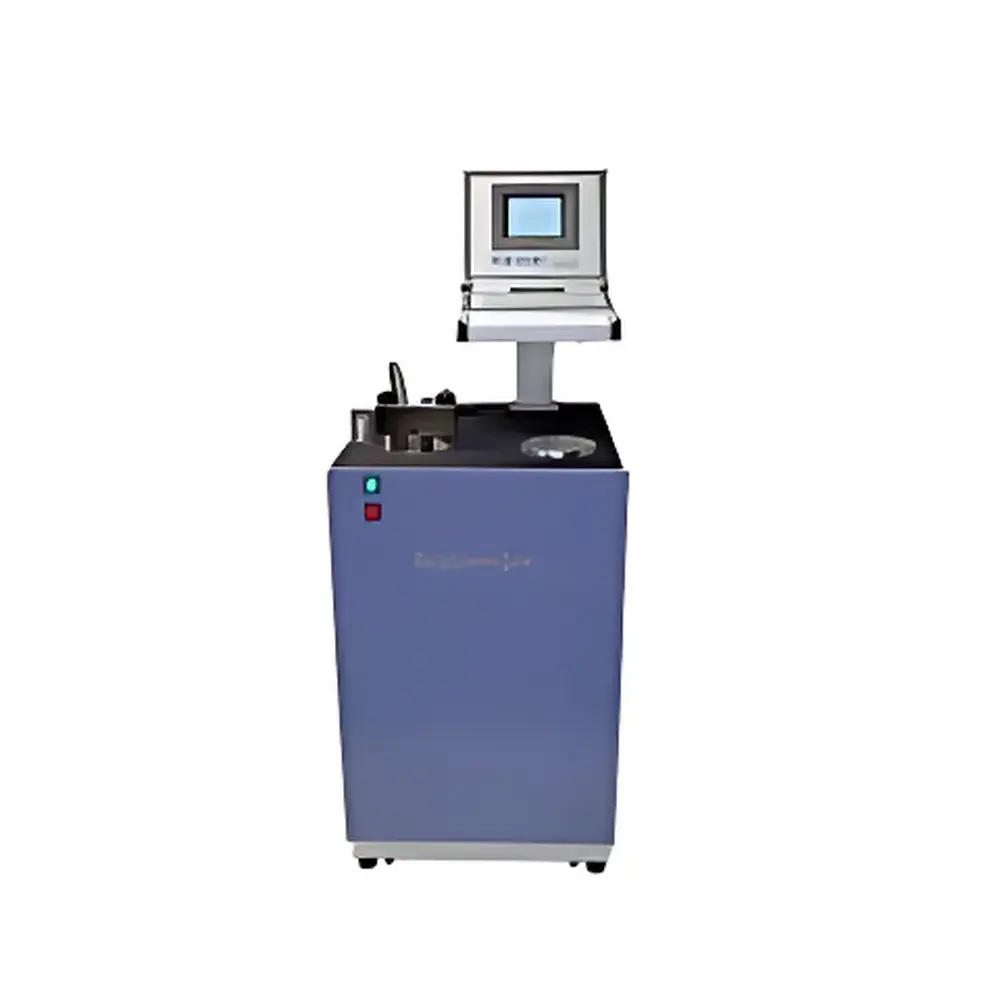
Brabender ELATEST Automatic Compaction Density Analyzer
| Brand | Brabender |
|---|---|
| Origin | Germany |
| Model | ELATEST |
| Power Supply | 230 V, 50/60 Hz, 1 A |
| Measuring Range | 0.8–2.6 g/cm³ (customizable) |
| Sample Volume | 40–120 cm³ |
| Integrated Precision Balance | 0–300 g |
| Repeatability | ±0.03% |
| Absolute Accuracy | ±0.0008 g/cm³ |
| Compressed Air Supply | 6–8 bar |
| Dimensions (W×H×D) | 510 × 1400 × 510 mm |
| Weight | ~130 kg |
Overview
The Brabender ELATEST Automatic Compaction Density Analyzer is a precision-engineered instrument designed specifically for the reliable and repeatable determination of bulk density in uncured rubber compounds, elastomeric polymers, and related viscoelastic materials. Unlike conventional pycnometry or immersion-based methods, the ELATEST employs controlled mechanical compaction—applying defined pneumatic pressure to a sample confined within a calibrated cylindrical chamber. As the piston compresses the material, entrapped air is expelled, enabling measurement of the true compacted volume at equilibrium under standardized load. This principle aligns with ASTM D1647 (Standard Test Method for Density of Uncured Rubber Compounds) and supports GLP-compliant workflows in R&D laboratories and production QA/QC environments. The system integrates force-controlled compression, high-resolution displacement sensing, and real-time mass acquisition to deliver density values traceable to SI units with minimal operator intervention.
Key Features
- Fully automated operation via integrated touch-screen PC—no manual calibration or iterative adjustments required.
- Pneumatically actuated compaction system with precise pressure regulation (6–8 bar), ensuring consistent mechanical loading across batches.
- High-accuracy built-in analytical balance (0–300 g, resolution ≤0.001 g) synchronized with linear displacement transducers for simultaneous mass/volume acquisition.
- Repeatability of ±0.03% and absolute accuracy of ±0.0008 g/cm³—validated per ISO/IEC 17025-accredited internal protocols.
- Modular sample chamber accommodating volumes from 40 to 120 cm³; optional custom tooling available for specialized geometries or high-viscosity formulations.
- Robust stainless-steel construction and vibration-damped base ensure stability during dynamic compression cycles, critical for low-density elastomers prone to creep effects.
Sample Compatibility & Compliance
The ELATEST is optimized for raw and compounded elastomers—including natural rubber (NR), styrene-butadiene rubber (SBR), ethylene propylene diene monomer (EPDM), nitrile rubber (NBR), and thermoplastic elastomers (TPEs)—in both crumb and sheet form. It accommodates fillers (e.g., carbon black, silica), plasticizers, curatives, and processing oils without compromising measurement integrity. All operational parameters—including dwell time, pressure ramp rate, and final hold pressure—are programmable to match material-specific relaxation behavior. The analyzer complies with key regulatory frameworks: data audit trails meet FDA 21 CFR Part 11 requirements when used with validated software configurations; test reports include timestamped metadata, user ID, instrument ID, and environmental conditions (optional ambient temperature/humidity logging). Routine verification follows ASTM D1647 Annex A1 (compaction method) and ISO 2781 (rubber—determination of density).
Software & Data Management
Control and analysis are executed through Brabender’s proprietary ELATEST Touch OS—a Windows-based interface with intuitive workflow navigation, multi-language support (EN/DE/FR/ES), and configurable report templates. Raw sensor data (force, displacement, mass) are logged at ≥100 Hz and stored in encrypted .csv and .brd binary formats. Batch-level statistics (mean, SD, CV%, min/max) are auto-generated; outliers trigger visual alerts and optional retest prompts. Export options include PDF reports compliant with ISO 10012 (measurement management systems), Excel-compatible datasets for SPC charting (e.g., X̄-R charts), and direct integration with LIMS via OPC UA or RESTful API. Audit trail functionality records all user actions—including parameter changes, calibration events, and report generation—with immutable timestamps and digital signatures.
Applications
- Formulation development: Quantifying density shifts induced by filler loading, oil absorption, or polymer blending to optimize compound design.
- Production process control: Monitoring batch-to-batch consistency in mixing, extrusion, and calendering lines—especially where density correlates with Mooney viscosity or scorch time.
- Quality assurance: Final release testing of masterbatches and pre-dispersed compounds per customer specifications (e.g., OEM automotive material standards).
- Research on structure–property relationships: Correlating compacted density with crosslink density (via swelling tests), filler dispersion homogeneity (via SEM/EDS), or rheological hysteresis.
- Regulatory documentation: Generating auditable density records for ISO/TS 16949, IATF 16949, or FDA-regulated medical-grade elastomer dossiers.
FAQ
What standards does the ELATEST comply with for rubber density measurement?
ASTM D1647 (compaction method), ISO 2781, and DIN 53521—fully supported through preconfigured test templates and certified reference materials.
Can the ELATEST measure filled thermoplastics or TPU pellets?
Yes—within the specified density range (0.8–2.6 g/cm³) and sample volume constraints; pelletized samples require pre-conditioning to minimize interstitial air entrapment.
Is compressed air supply mandatory, or can hydraulic actuation be used?
Pneumatic actuation is integral to the ELATEST architecture; external hydraulic systems are incompatible due to control loop design and safety interlocks.
How often does the system require recalibration?
Annual calibration is recommended; daily verification using NIST-traceable density standards (e.g., fused quartz, stainless steel) is advised per ISO/IEC 17025 clause 7.7.
Does the software support multi-user role-based access control?
Yes—administrator, analyst, and reviewer roles with configurable permissions for method editing, result approval, and audit trail viewing.






