
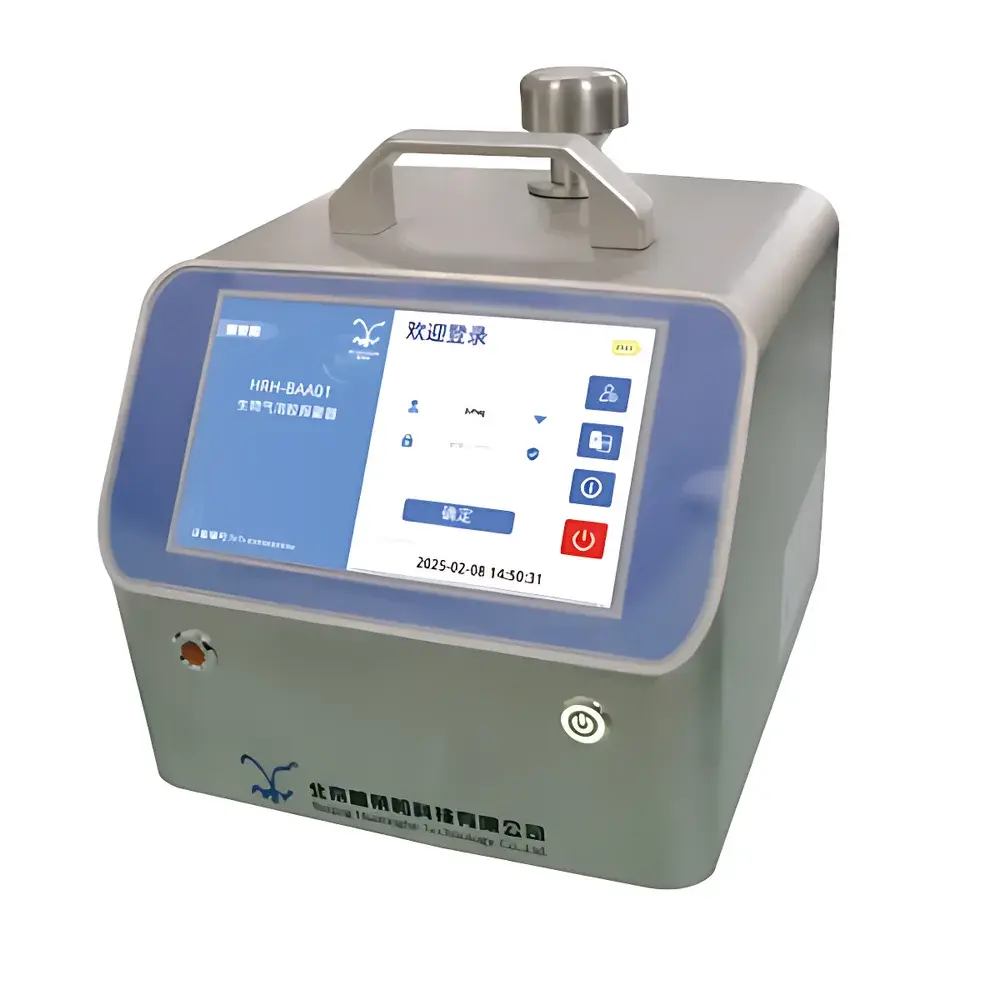
Huiron HRH-BAA01 Biological Aerosol Alarm System
| Brand | Huiron |
|---|---|
| Model | HRH-BAA01 |
| Origin | Beijing, China |
| Detection Principle | Laser-Induced Intrinsic Fluorescence (LII-F) |
| Detection Targets | Bacterial & Fungal Bioaerosols |
| Response Time | ≤30 s |
| Sensitivity | ≤50 ACPLA/L (Airborne Count of Pathogenic-Like Agents per Liter) |
| Particle Size Range | 0.3–10 µm (with ≤±30% FS error at 0.3 µm and 0.5 µm channels) |
| Sampling Flow Rate | >2 L/min |
| Interference Rejection | Confirmed immunity to wood smoke, cigarette smoke, moxa smoke, automotive exhaust, and fluorescent dyes |
| Data Storage Capacity | ≥500,000 records (each including multi-channel total particle counts and fluorescence-positive particle counts) |
| Display | 7-inch capacitive touchscreen LCD |
| Operating Temperature | −20 °C to +50 °C |
| Storage Temperature | −40 °C to +60 °C |
| Relative Humidity | 0–95% RH (non-condensing) during operation |
| Dimensions | 228 × 220 × 225 mm (L × W × H) |
| Weight | 6.7 kg (main unit) |
| Compliance | Designed for ISO 14644-1 Class 5–8 environments |
Overview
The Huiron HRH-BAA01 Biological Aerosol Alarm System is an engineered real-time bioaerosol surveillance instrument designed for continuous, non-culture-based detection of airborne microorganisms—including bacteria and fungal spores—in critical indoor environments. It operates on the principle of laser-induced intrinsic fluorescence (LII-F), where ultraviolet excitation (typically 280 nm and/or 355 nm) triggers native fluorophores (e.g., NAD(P)H, tryptophan, riboflavin) present in viable or metabolically active biological particles. Unlike passive collection methods, the HRH-BAA01 performs in-situ optical interrogation of aerosolized particles as they pass through a laminar flow cell, enabling rapid discrimination between biological and non-biological particulates based on spectral intensity, decay kinetics, and size-correlated fluorescence yield. Its primary deployment contexts include cleanrooms in pharmaceutical manufacturing, aseptic processing suites, hospital isolation wards, biosafety laboratories (BSL-2/3), public transportation hubs, and emergency response settings requiring early warning of potential biological threats.
Key Features
- Real-time monitoring with ≤30-second system response time from particle ingress to alarm activation
- Dual-channel photomultiplier tube (PMT) detection architecture optimized for high signal-to-noise ratio and low dark-current drift
- Proprietary interference-rejection algorithm trained against common non-biological fluorescent interferents—including combustion-derived aerosols (wood smoke, cigarette smoke, moxa smoke), engine exhaust particulates, and commercial fluorescent dyes—minimizing false positives without compromising sensitivity
- 7-inch high-resolution capacitive touchscreen interface supporting intuitive configuration, live parameter visualization, and contextual status feedback
- Integrated dual-stage user access control (operator and administrator levels) with password protection and role-based permissions
- Acoustic and visual alarm outputs (LED strobe + audible tone) triggered upon exceedance of configurable fluorescence-count thresholds
- Automated relay output to initiate external bioaerosol samplers (e.g., impactors, liquid impingers) upon alarm event for downstream molecular or culture-based identification
Sample Compatibility & Compliance
The HRH-BAA01 is validated for detection of naturally occurring and weaponized-relevant bioaerosol particles within the aerodynamic diameter range of 0.3–10 µm—encompassing respirable bacterial cells (e.g., Bacillus anthracis simulants), fungal conidia (e.g., Aspergillus, Penicillium), and fragmented microbial debris. It meets functional requirements aligned with ASTM E2997–22 (Standard Guide for Real-Time Bioaerosol Detection) and supports environmental monitoring protocols referenced in EU GMP Annex 1 (2022) and ISO 14644-2:2015. While not certified under FDA 21 CFR Part 11 out-of-the-box, its embedded firmware enables secure, time-stamped, and immutable logging—providing foundational traceability for GLP/GMP audits when deployed with controlled change management procedures.
Software & Data Management
Data acquisition and system configuration are managed locally via the onboard embedded Linux OS. Each recorded event captures timestamp, ambient temperature/humidity (via internal sensors), all 16 optical channel counts (including total particles and fluorescence-positive subsets per size bin), and operational mode metadata. The system stores ≥500,000 full-resolution records in non-volatile flash memory. Historical datasets—including raw fluorescence waveforms, alarm logs, and user activity traces—can be exported in CSV format via USB 2.0 port using standard FAT32-formatted drives. No cloud connectivity or remote telemetry is implemented, preserving data sovereignty and reducing cybersecurity attack surface—a requirement in many government and defense-sensitive installations.
Applications
- Pharmaceutical aseptic manufacturing: Continuous verification of air quality during filling line operations and isolator interventions
- Hospital infection control: Monitoring airborne pathogen load in immunocompromised patient zones and negative-pressure rooms
- Biosafety laboratory oversight: Supplemental real-time verification of HEPA filtration integrity and containment performance
- Public infrastructure resilience: Early warning capability in subway stations, airports, and government buildings under CBRN preparedness frameworks
- Food production hygiene assurance: Detection of spoilage-related molds and enteric bacteria in ambient air of processing and packaging areas
- Research-grade environmental bioaerosol profiling: Long-term trend analysis in indoor microbiome studies and HVAC system validation
FAQ
Does the HRH-BAA01 require consumables or calibration gases?
No. The system is entirely consumable-free: no reagents, filters, or carrier gases are needed. Optical alignment is factory-set and mechanically stabilized; periodic verification using NIST-traceable polystyrene latex (PSL) standards is recommended annually.
Can it distinguish between live and dead microorganisms?
It detects intrinsic fluorescence associated with metabolically active cellular components, but cannot definitively confirm viability without orthogonal assays (e.g., culturing, ATP bioluminescence). Elevated fluorescence signals correlate strongly with viable biomass but do not replace colony-forming unit (CFU) quantification.
Is remote monitoring supported?
The device does not include Ethernet, Wi-Fi, or cellular interfaces. Integration into building management systems (BMS) or SCADA networks requires external industrial gateways configured for Modbus RTU or discrete I/O relay signaling.
What maintenance is required?
Routine cleaning of the inlet nozzle and optical window with isopropyl alcohol every 3–6 months; inspection of pump diaphragm integrity annually; and verification of flow rate accuracy using a calibrated mass flow meter at least once per year.
Related Products







