
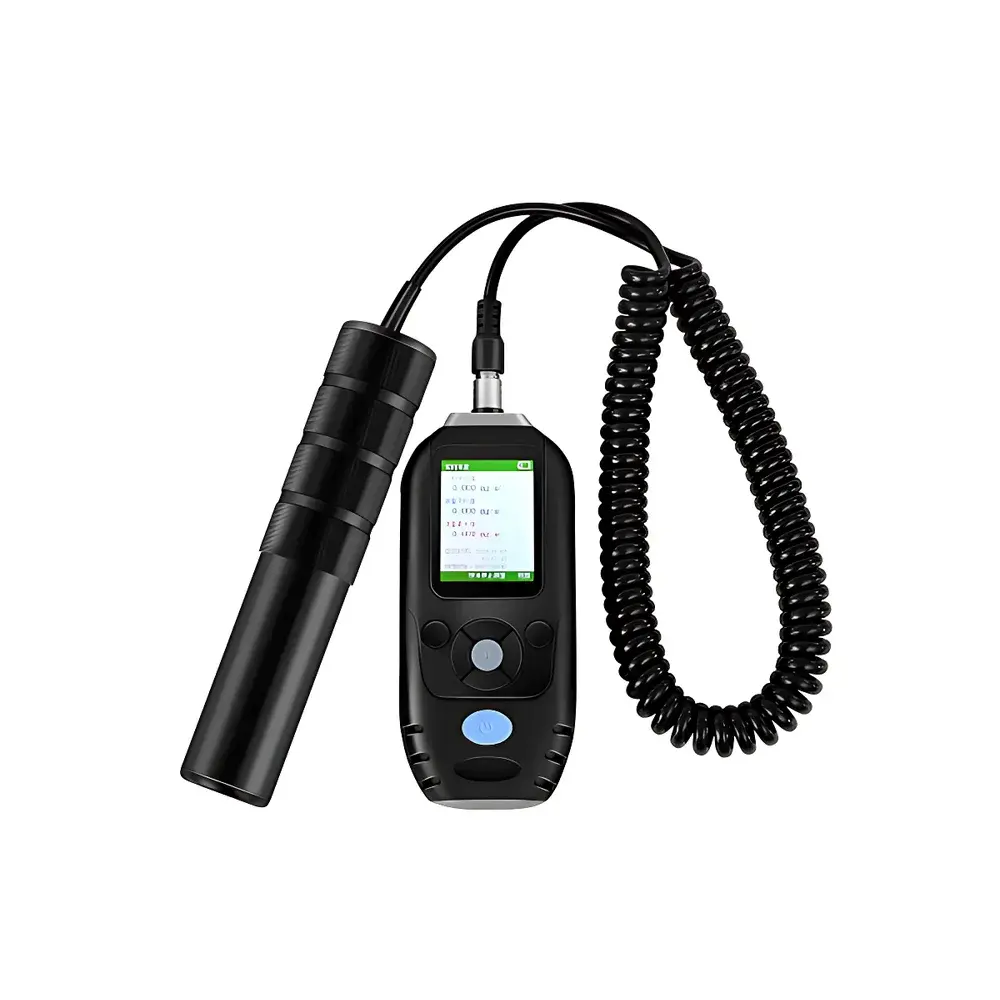
Huiron HRH-AMC01 Aerosol Mass Concentration Monitor
| Brand | Huiron |
|---|---|
| Model | HRH-AMC01 |
| Origin | Beijing, China |
| Measurement Principle | Forward Light Scattering (650 nm) |
| Measurement Range | 1 μg/m³ to 250 g/m³ |
| Resolution | 1 μg/m³ |
| Display | 320 × 240 TFT Color LCD |
| Keypad | 8-key membrane keypad |
| Operating Temperature | 0–50 °C (non-condensing) |
| Power Supply | Three AA 1.5 V alkaline batteries or 5 V DC via USB-C |
| Communication | RS-485, Modbus RTU protocol, daisy-chainable up to 99 units |
| Calibration | Field-calibratable with dedicated calibration plug |
| Compliance | JJG 846–2015 Verification Regulation for Dust Concentration Meters |
| Safety Classification | Non-explosion-proof |
Overview
The Huiron HRH-AMC01 Aerosol Mass Concentration Monitor is an optically engineered instrument designed for real-time, in-situ quantification of airborne particulate mass concentration across a broad dynamic range—from ultra-low ambient background levels (1 μg/m³) to high-concentration industrial environments (up to 250 g/m³). It operates on the principle of near-forward light scattering at a fixed wavelength of 650 nm, where incident laser light interacts with suspended particles; the intensity and angular distribution of scattered photons are correlated to particle size distribution and mass loading via factory-established, traceable calibration functions. Unlike beta attenuation or gravimetric reference methods, this optical approach enables continuous, non-destructive, and response-time-optimized measurement—critical for occupational hygiene monitoring, process control feedback loops, and boundary dust surveillance where second-level temporal resolution is required. The device is not intended for explosive atmospheres and complies with Chinese national metrological verification regulation JJG 846–2015, ensuring measurement traceability to national standards under defined environmental and operational constraints.
Key Features
- Wide dynamic measurement range spanning six orders of magnitude (1 μg/m³ to 250 g/m³), supporting both ambient air quality assessment and heavy-duty industrial dust monitoring.
- Robust mechanical architecture with IP-rated enclosure components, optimized for long-term deployment in high-humidity, dusty, or thermally variable field conditions (0–50 °C, non-condensing).
- Modular probe design enables flexible positioning—including confined, elevated, or hard-to-access sampling points—without compromising optical alignment stability.
- Integrated field calibration interface using a proprietary calibration plug, allowing rapid zero/span verification and sensitivity adjustment without disassembly or external reference aerosols.
- Dual power architecture: operable from three standard AA alkaline cells (typical runtime >12 h at 1 Hz sampling) or continuous 5 V DC input via USB-C port—enabling seamless transition between portable survey and fixed-site installation modes.
- Optimized optical path geometry minimizes Mie scattering artifacts at coarse particle extremes while preserving linearity across PM₁₀, PM₂.₅, and respirable fraction surrogates under representative aerosol refractive index assumptions.
Sample Compatibility & Compliance
The HRH-AMC01 is validated for use with polydisperse, non-volatile, solid-phase aerosols typical of mineral dusts (e.g., silica, limestone), metal oxides, coal fly ash, and construction-related particulates. It is not suitable for volatile organic aerosols, condensable vapors, or hygroscopic particles undergoing rapid water uptake during transit through the sensing zone. Performance validation follows JJG 846–2015, which specifies test protocols for linearity, repeatability (≤±5% RSD at mid-range), zero drift (<2 μg/m³/24 h), and temperature dependence (±0.3% per °C). While not certified to IEC 60079 or ATEX standards, its non-explosion-proof classification requires installation only in Zone 2 or non-hazardous locations per local electrical safety codes. For regulatory reporting in occupational settings, data outputs may be integrated into GLP-compliant logging systems when paired with audit-trail-enabled data acquisition software.
Software & Data Management
Data output is delivered via isolated RS-485 serial interface compliant with Modbus RTU protocol (function code 03/04), enabling direct integration into SCADA, BMS, or centralized environmental monitoring platforms. Up to 99 units can be daisy-chained on a single bus with configurable node addressing and CRC error checking. Local display supports real-time concentration waveform visualization, statistical summaries (min/max/avg over user-defined intervals), and event-triggered logging. Firmware supports over-the-air updates via USB-C connection. Raw output includes timestamped mass concentration (μg/m³), internal temperature/humidity (if equipped with optional sensor module), and diagnostic flags (e.g., optical path contamination warning, low battery, calibration due). All communication payloads are ASCII-encoded and compatible with third-party middleware adhering to ISO/IEC 8824-1 (ASN.1) parsing conventions.
Applications
- Occupational health monitoring: Real-time assessment of respirable dust exposure in mining, foundry, cement production, and woodworking facilities—supporting compliance with OSHA PELs or EU Directive 2004/37/EC.
- Construction site boundary monitoring: Continuous perimeter dust tracking to verify adherence to local emission limits (e.g., UK CDM Regulations, China GB 3095–2012).
- Industrial process optimization: Feedback control of baghouse filter efficiency, scrubber performance, or material handling ventilation rates based on upstream/downstream concentration differentials.
- Environmental baseline studies: Long-term trend analysis of fugitive dust emissions near quarries, landfills, or unpaved haul roads—integrated with meteorological station data for source apportionment modeling.
- Indoor air quality (IAQ) commissioning: Verification of HVAC filtration efficacy and identification of localized resuspension hotspots in cleanrooms, laboratories, and healthcare facilities.
FAQ
What aerosol types are suitable for measurement with the HRH-AMC01?
The instrument is calibrated for solid, non-volatile, low-hygroscopicity particulates such as mineral dusts, metal oxides, and carbonaceous soot. It is not recommended for ammonium nitrate, sea salt, or organic aerosols exhibiting significant volatility or water uptake.
Does the HRH-AMC01 meet international calibration traceability requirements?
Yes—its metrological performance aligns with JJG 846–2015, which references China’s National Institute of Metrology (NIM) standards. For ISO/IEC 17025-accredited calibration, users must engage a CNAS-certified laboratory using NIM-traceable reference aerosols.
Can the device operate continuously in outdoor environments?
It is rated for 0–50 °C non-condensing operation. Extended outdoor deployment requires weatherproof housing (IP65 minimum) and thermal buffering to prevent dew formation on optical windows.
Is Modbus TCP supported?
No—only Modbus RTU over RS-485 physical layer is implemented. Ethernet or WiFi gateways must be added externally if TCP/IP integration is required.
How frequently should field calibration be performed?
Calibration verification is recommended before each critical measurement campaign and after exposure to extreme dust loading (>100 g/m³) or mechanical shock. Full recalibration against reference gravimetric filters is advised annually or per internal QA/QC protocols.







