
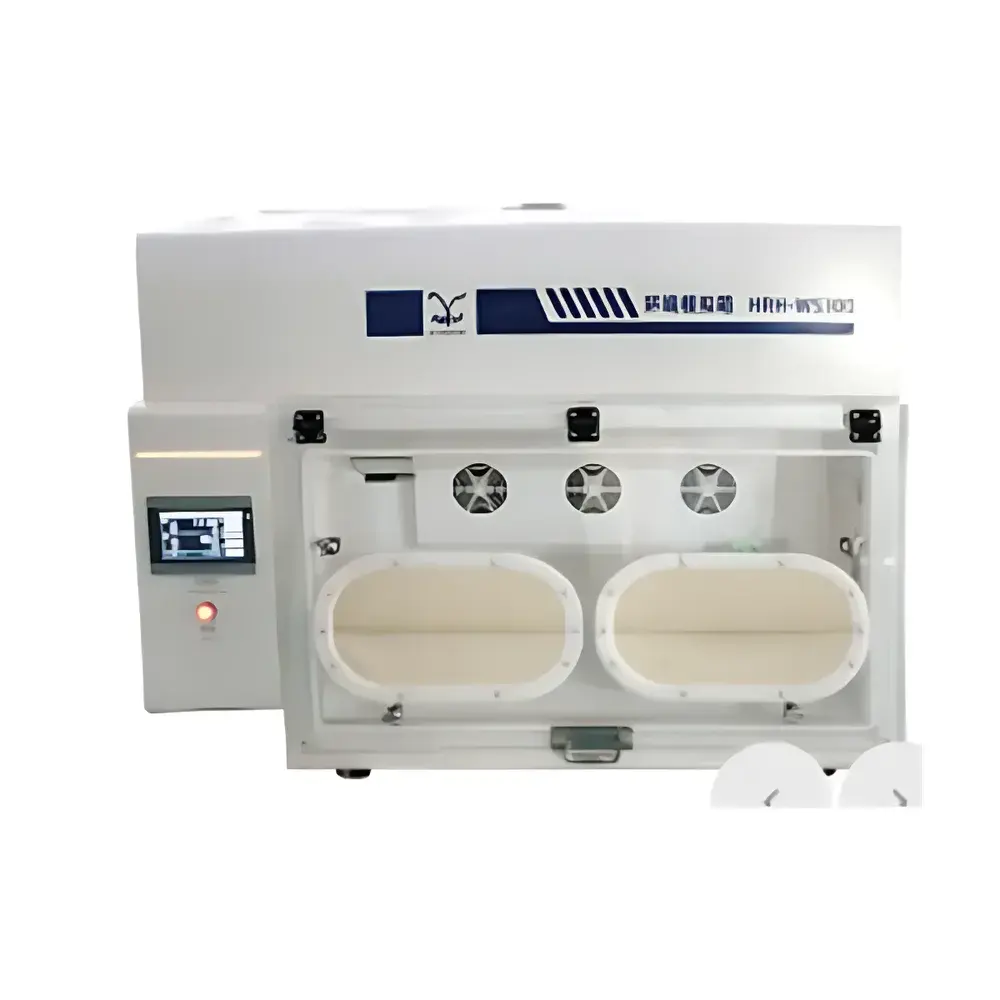
HRH-WS300 Environmental Simulation Chamber for Pharmaceutical Inhalation Testing
| Brand | Huironghe |
|---|---|
| Model | HRH-WS300 |
| Temperature Range | 15–40 °C |
| Temp. Accuracy | ±2 °C (unloaded) |
| Humidity Range | 15–90 % RH |
| Humidity Accuracy | ±5 % RH (unloaded) |
| Internal Chamber Dimensions | 950 × 380 × 520 mm (W×D×H, min.) |
| Overall Dimensions | 1450 × 800 × 1100 mm (W×D×H, max.) |
| Power Consumption | ~5.5 kW |
| Voltage | 220 V AC, 16 A |
| Electrostatic Minimization System | Standard |
| Illumination | Integrated LED Lighting |
| Control Interface | Touchscreen |
| Timed Start/Stop Function | Standard |
| Compliance | USP <601>, Ph. Eur. 2.9.18, ISO 15378:2017 (environmental control clauses) |
Overview
The HRH-WS300 Environmental Simulation Chamber is a benchtop-grade, purpose-engineered climate control system designed exclusively for the physicochemical testing of orally inhaled and nasal drug products (OINDPs). It operates on a dual-parameter feedback-controlled principle—simultaneously regulating temperature and relative humidity within a sealed, electrostatically stabilized workspace—to replicate and maintain pharmacopoeial environmental conditions required during cascade impactor testing, aerodynamic particle size distribution (APSD) analysis, and dose uniformity assessments. Unlike general-purpose environmental chambers, the HRH-WS300 integrates an adaptive electrostatic minimization subsystem that dynamically engages based on real-time humidity and temperature readings, ensuring consistent charge dissipation across test surfaces, inhaler actuators, and collection substrates. This eliminates spurious particle adhesion, deposition bias, and measurement drift commonly observed under uncontrolled static conditions—thereby directly supporting data integrity per ICH Q5C, FDA Guidance for Industry on OINDPs (2022), and EMA CHMP reflection paper on quality of inhalation products.
Key Features
- Pharmaceutical-grade climate control with independent PID loops for temperature (15–40 °C) and humidity (15–90 % RH), validated for spatial uniformity per ISO 14644-3 Annex B protocols;
- Intelligent electrostatic minimization system activated only when ambient conditions exceed predefined tripping thresholds—reducing energy consumption while maintaining sub-100 V surface potential across all interior stainless-steel surfaces;
- High-resolution capacitive touchscreen interface with multi-language support (English, German, Japanese), audit-trail-enabled user session logging, and configurable parameter lockout for GLP-compliant operation;
- Integrated LED illumination with adjustable intensity and UV-free spectrum, enabling visual verification of actuator positioning and filter cassette loading without thermal or photolytic interference;
- No routine maintenance design: self-calibrating humidity sensors, non-condensing refrigeration circuitry, and corrosion-resistant 304 stainless-steel chamber walls eliminate scheduled servicing intervals;
- Modular integration capability: left-side pneumatic and electrical interfaces support direct coupling with controlled-temperature cooling cabinets (e.g., −20 °C auxiliary units) to extend operational range for cold-aerosol stability studies.
Sample Compatibility & Compliance
The HRH-WS300 accommodates standard USP Apparatus A–D cascade impactors (Andersen, Next Generation, OTS), laser diffraction analyzers (e.g., Malvern Mastersizer), and gravimetric sampling trains without modification. Its internal cavity geometry (950 × 380 × 520 mm) permits full insertion of 22-mm filter holders, 47-mm membrane cassettes, and multi-stage impaction plates. The chamber meets environmental control requirements specified in USP “Aerosols, Sprays, and Pump-Actuated Products”, Ph. Eur. 2.9.18 “Aerodynamic Particle Size Distribution”, and supports compliance with FDA 21 CFR Part 11 through optional electronic signature modules and secure audit trail export (CSV/Excel). All calibration certificates are traceable to NIM (National Institute of Metrology, China) and include uncertainty budgets per ISO/IEC 17025:2017.
Software & Data Management
The embedded firmware supports continuous environmental logging at 1-second resolution, with timestamped data export via USB or Ethernet (TCP/IP). Raw datasets include temperature, RH, electrostatic potential (via optional external probe input), and system status flags (e.g., compressor duty cycle, sensor health). Optional PC-based software provides statistical process control (SPC) charts, deviation alerts (±1.5 °C or ±3 % RH), and automated report generation aligned with ALCOA+ principles. Data files are encrypted using AES-256 and retain immutable metadata (operator ID, instrument serial, firmware version), satisfying GMP Annex 11 and EU GMP Annex 15 validation requirements.
Applications
- Stabilization of OINDP dosage forms prior to APSD testing per USP and Ph. Eur. 2.9.18;
- Environmental conditioning of impactor stages, collection filters, and actuation hardware to minimize hygroscopic mass gain/loss artifacts;
- Controlled-humidity storage of reference standards and placebo formulations during method development;
- Supporting ICH Q1A(R2) long-term and accelerated stability protocols where humidity cycling is required;
- Facilitating comparative studies between metered-dose inhalers (MDIs), dry powder inhalers (DPIs), and nasal sprays under identical climatic baselines.
FAQ
Does the HRH-WS300 comply with 21 CFR Part 11 for electronic records?
Yes—when equipped with the optional Audit Trail Module, it provides role-based access control, electronic signatures, and tamper-evident data archiving compliant with FDA 21 CFR Part 11 Subpart B.
Can the chamber be validated for IQ/OQ/PQ per GMP guidelines?
Yes—the manufacturer supplies a qualification protocol template aligned with ASTM E2500-13 and ISPE Good Practice Guide for Environmental Chambers, including mapping procedures and acceptance criteria.
Is remote monitoring supported?
Standard Ethernet connectivity enables SNMP-based network monitoring; optional cloud gateway module allows secure remote viewing via TLS 1.2-encrypted web interface.
What is the recalibration interval for humidity sensors?
Factory-calibrated sensors require no field recalibration for 24 months under normal use; NIM-traceable recalibration services are available annually upon request.
Can the electrostatic minimization system be disabled manually?
No—it operates autonomously based on environmental feedback; manual override is intentionally omitted to prevent operator-induced data integrity risks.
Related Products





