
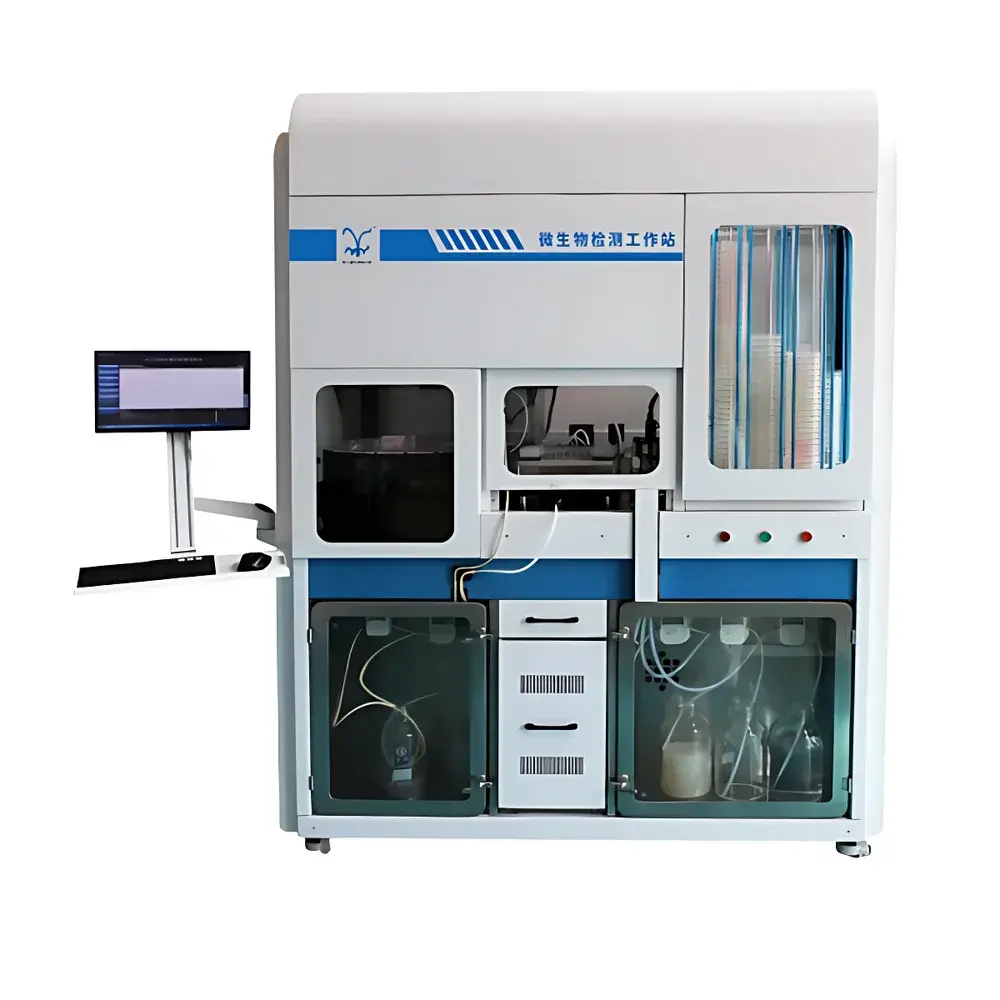
HRH-B20 Microbial Detection Workstation
| Brand | Huironghe |
|---|---|
| Origin | Beijing, China |
| Manufacturer Type | Authorized Distributor |
| Country of Origin | China |
| Model | HRH-B20 |
| Pricing | Available Upon Request |
Overview
The HRH-B20 Microbial Detection Workstation is an integrated, ISO/GB-compliant laboratory automation platform engineered for standardized pre-analytical processing in food microbiology testing. Designed explicitly to meet the procedural requirements of China’s National Food Safety Standard GB 4789 series—covering enumeration and isolation of aerobic mesophilic bacteria, coliforms, Bifidobacterium, Staphylococcus aureus, Bacillus cereus, Clostridium perfringens, lactic acid bacteria, Enterobacteriaceae, Listeria monocytogenes, molds, and yeasts—the system implements a fully traceable, closed-loop workflow based on pour-plate and spread-plate methodologies. Its architecture integrates fluid handling, thermal management, robotic coordination, and environmental control to eliminate manual variability, reduce operator-induced contamination, and ensure analytical reproducibility across high-throughput routine testing environments. The workstation operates under controlled laminar airflow (ISO Class 5 equivalent) with internal positive pressure and UV-C sterilization cycles, fulfilling critical prerequisites for aseptic sample processing in GLP- and GMP-aligned food safety laboratories.
Key Features
- Fully automated workflow execution: Pre-programmed protocols aligned with GB 4789 and SN/T 1538.1–2016 for pour-plate (up to 3 microbial targets) and spread-plate (1 target) assays per batch.
- 20-sample parallel processing capacity with independent gradient dilution (10-, 100-, and 1,000-fold) using disposable 5 mL pipette tips and dedicated liquid pathways to prevent cross-contamination.
- Integrated mechanical arm system: Dual high-precision robotic arms coordinate module sequencing—including plate loading, diluent dispensing, agar pouring, and spreader actuation—with sub-millimeter repeatability.
- Barcode/QR code reader module: Automatically registers sample identity, dilution level, and assay type from sterile sample bag labels, enabling full digital traceability.
- Plate storage carousel: Holds up to 396 Petri dishes; configurable for empty plates or pre-poured agar plates to support both pour- and spread-plate workflows.
- Agar temperature maintenance system: Magnetic stirring + metal-bath heating (maintained at 45–48 °C) prevents premature solidification and phase separation during dispensing; all tubing is removable for autoclaving.
- High-fidelity liquid handling: Precision dispensing up to 5 mL with disposable tips; volumetric accuracy validated per ISO 8655-6 for gravimetric performance.
- Dedicated spreader module: Individual flexible spreader rods per sample; rotational motion ensures uniform distribution without carryover; optional secondary agar overlay capability.
- UV-C chamber sterilization: Automated 30-min cycle between runs; intensity monitored via integrated dosimeter sensor.
- Remote monitoring interface: Real-time video feed and software dashboard accessible via web browser or mobile application (iOS/Android), supporting remote operation verification and audit readiness.
Sample Compatibility & Compliance
The HRH-B20 accommodates standard food matrices including dairy products, meat and poultry, ready-to-eat meals, beverages, and environmental swab eluates. It supports use of commercially available or in-house prepared media compliant with ISO 11133, GB 4789.28, and SN/T 1538.1–2016. All fluid-contact components are constructed from autoclavable stainless steel or medical-grade polymers certified to USP Class VI and ISO 10993-5. The system meets electromagnetic compatibility (EMC) requirements per IEC 61326-1 and electrical safety standards per IEC 61010-1. While not FDA 510(k)-cleared, its operational logic and documentation structure align with principles required for 21 CFR Part 11 compliance when deployed with validated electronic records systems.
Software & Data Management
The embedded control software provides role-based user access, protocol versioning, and full audit trail logging—including timestamped entries for sample registration, dilution steps, plate assignment, and sterilization cycles. Data export is supported in CSV and PDF formats; raw logs include instrument ID, operator ID, and digital signatures where configured. Software updates are delivered via secure HTTPS channel with SHA-256 hash verification. Optional integration with LIMS platforms is available through HL7 v2.5 or RESTful API endpoints, enabling bidirectional transfer of sample metadata and result flags.
Applications
- Routine food safety testing in third-party certification labs and QC departments of food manufacturers.
- Method validation and verification studies requiring high inter-operator consistency.
- Training environments where standardized, repeatable microbiological technique demonstration is required.
- Environmental monitoring programs in cleanrooms and production facilities subject to HACCP or BRCGS audits.
- Research applications involving comparative analysis of microbial load across complex food matrices under standardized dilution and plating conditions.
FAQ
What regulatory standards does the HRH-B20 comply with?
It is designed to meet GB 4789 series, SN/T 1538.1–2016, ISO 11133, and ISO 7218 requirements for microbiological testing procedures and media preparation.
Can the system be validated for GMP use?
Yes—its modular design, deterministic workflow, and comprehensive audit trail support IQ/OQ/PQ protocols; validation documentation templates are provided upon request.
Is the agar dispensing module compatible with all types of culture media?
It supports liquid agar-based media with viscosities ≤ 200 mPa·s at 45 °C; highly viscous or particulate-containing formulations require prior viscosity assessment.
How is cross-contamination prevented during multi-sample processing?
Through disposable tip usage, segregated fluid paths, physical isolation of spreader rods, and UV-C decontamination between batches.
Does the workstation support custom protocol development?
Yes—advanced users may define new dilution schemes, plate layouts, and timing parameters via the configuration editor, subject to built-in safety constraints.
Related Products




