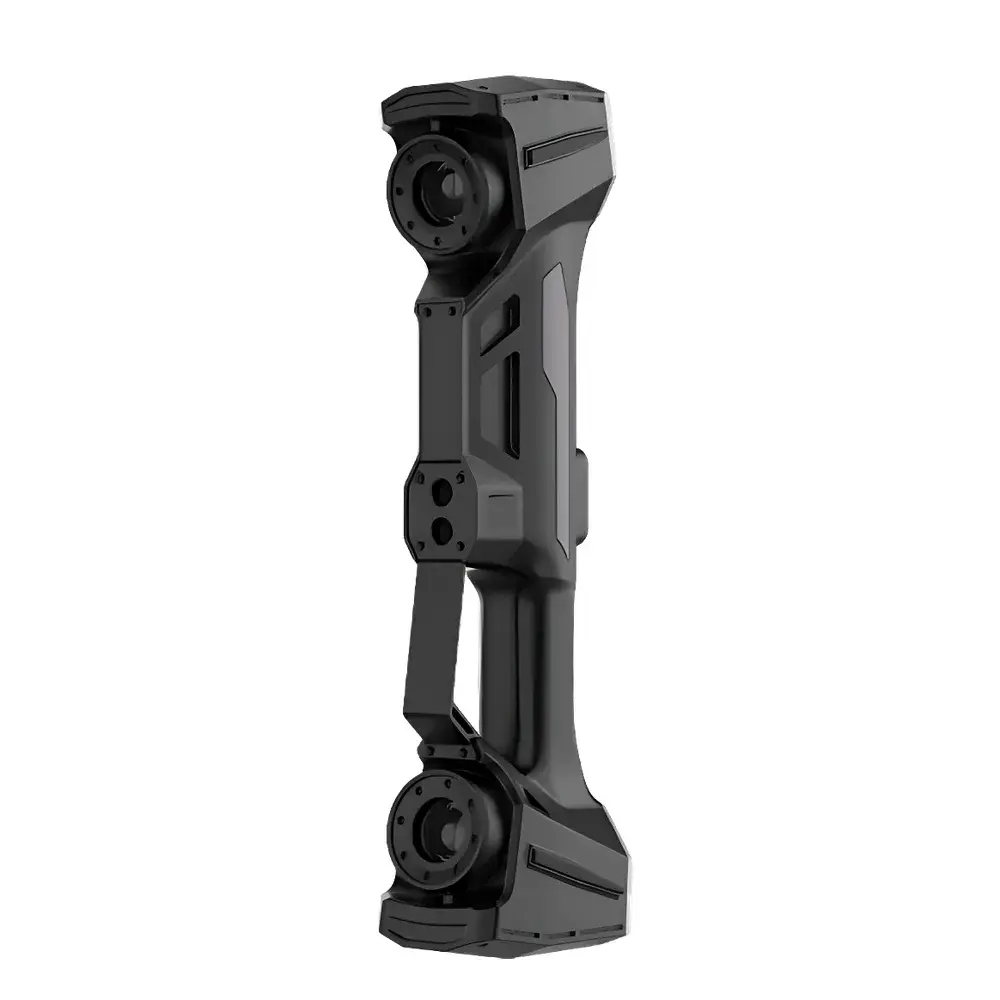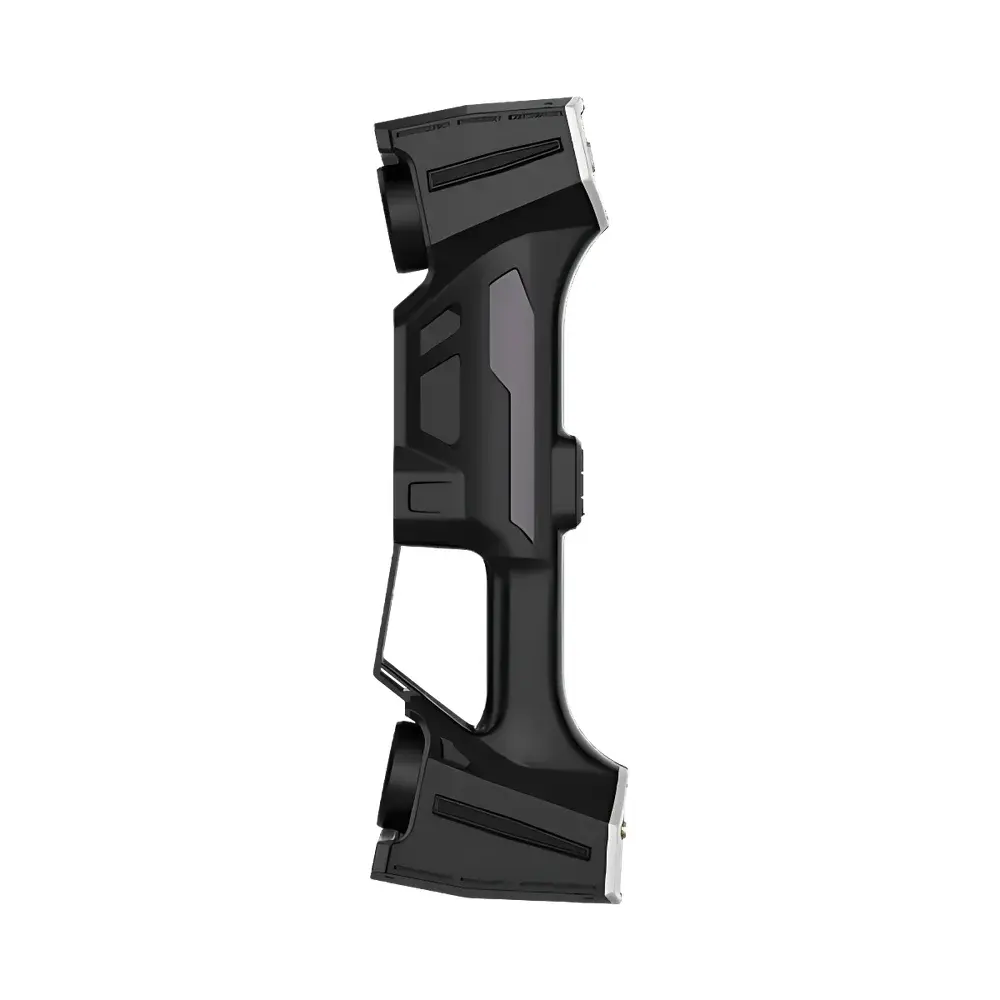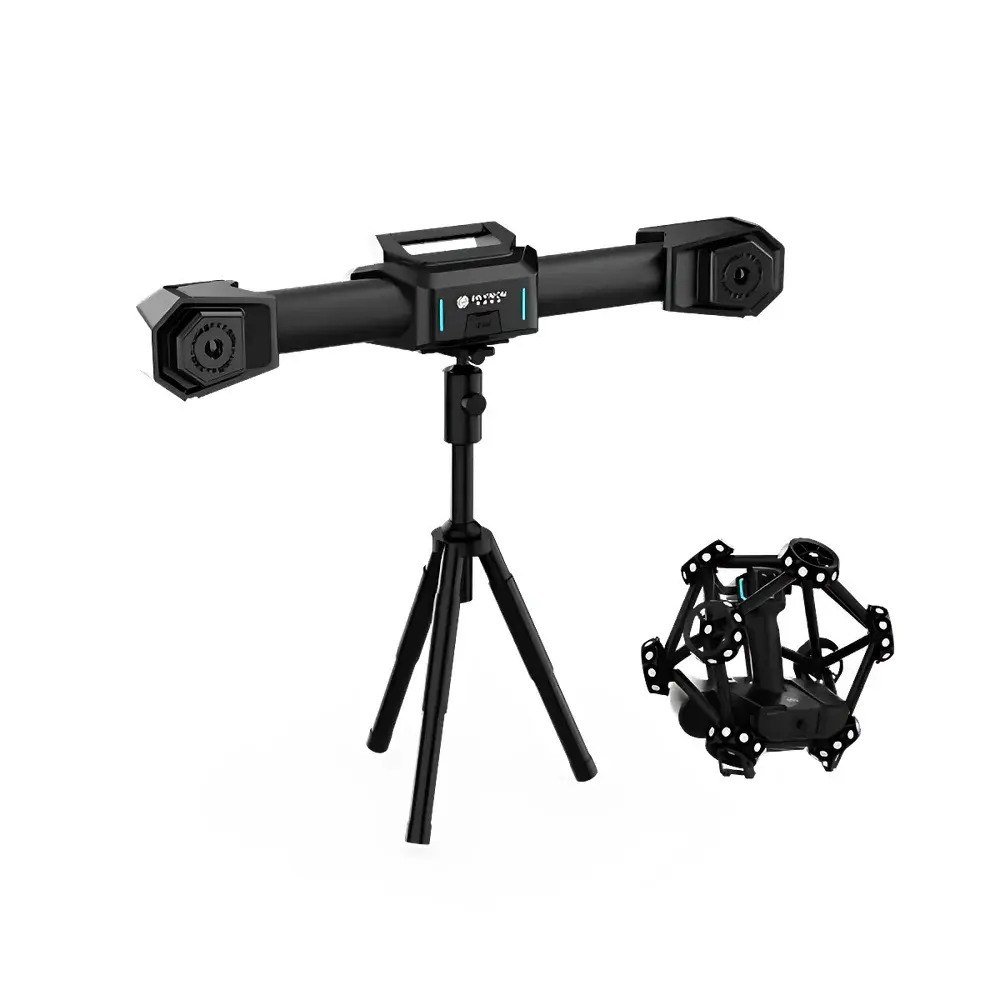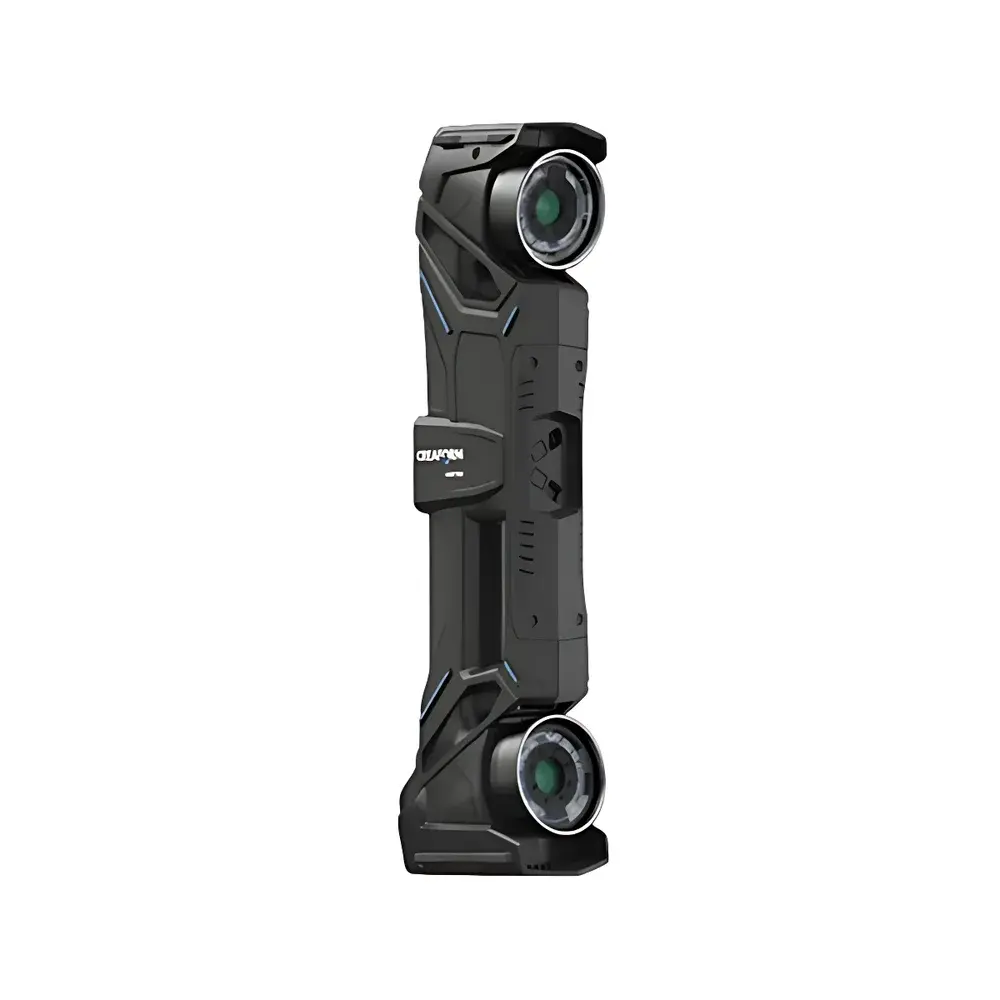
Creaform HandySCAN 3D|MAX Series Metrological-Grade Portable 3D Laser Scanner
| Brand | Creaform |
|---|---|
| Origin | Canada |
| Manufacturer Type | Authorized Distributor |
| Origin Category | Imported |
| Model | HandySCAN 3D |
| Measurement Speed | 2,250,000 measurements/sec |
| Scanning Accuracy | 0.150 mm |
| Maximum Scan Volume | 1 m × 1 m at 1000 mm working distance |
| Working Distance Range | 0.3–2.5 m |
| Depth of Field | 1.15–2.20 m |
| Part Size Range (Recommended) | 1–15 m |
| Laser Source | 38-line blue laser (Class 2M) |
| Resolution | 0.04 mm (point), 0.4 mm (mesh) |
| Volume Accuracy | 0.200 mm + 0.030 mm/m |
| Weight | 1.22 kg |
| Dimensions (L×W×H) | 133 × 79 × 435 mm |
| Interface | USB 3.0 |
| Operating Temperature | 5–40 °C |
| Operating Humidity (non-condensing) | 10–90% |
| Software | VXelements |
| Output Formats | .dae, .fbx, .ma, .obj, .ply, .stl, .txt, .wrl, .x3d, .x3dz, .zpr, .3mf |
| Compliance | ISO/IEC 17025 accredited, VDI/VDE 2634 Part 3 |
Overview
The Creaform HandySCAN 3D|MAX Series is a metrological-grade portable 3D laser scanner engineered for high-precision geometric measurement in industrial environments where mobility, environmental robustness, and traceable accuracy are non-negotiable. Based on triangulation principles using structured blue laser light, the system delivers calibrated, repeatable 3D point cloud data without requiring surface preparation—even on highly reflective, glossy, or low-contrast surfaces. Unlike conventional coordinate measuring machines (CMMs) or fixed optical scanners, the MAX Series integrates dynamic reference tracking and real-time volumetric accuracy optimization to maintain metrological integrity across variable working distances (0.3–2.5 m) and ambient conditions. Its design adheres to international metrology standards—including ISO/IEC 17025 accreditation and VDI/VDE 2634 Part 3—ensuring data validity for first-article inspection, dimensional validation, and regulatory reporting in regulated sectors such as aerospace, energy, and heavy manufacturing.
Key Features
- Metrological-grade performance: Certified accuracy of 0.150 mm (0.075 mm for Elite variant) with volume accuracy specified as 0.200 mm + 0.030 mm/m—traceable to national standards and validated under ISO/IEC 17025.
- 38-line blue laser array: Enables simultaneous capture of up to 2,250,000 measurements per second, significantly reducing scan time for large components while preserving sub-millimeter resolution (0.04 mm point resolution, 0.4 mm mesh resolution).
- Flex Volume technology: Dynamically adapts scanning parameters across a 0.3–2.5 m working distance range—supporting both fine-detail acquisition at close range and rapid coverage of large structures (up to 15 m in length) without hardware reconfiguration.
- Real-time calibration integration: Eliminates manual pre-scan calibration routines; system self-validates alignment and sensor stability continuously during operation via embedded photogrammetric reference tracking.
- Intelligent Surface Algorithm (ISA): Combines adaptive image processing with AI-driven contrast normalization to stabilize tracking on challenging surfaces—including oil-coated, anodized, or specular finishes—without spray or target application.
- Ruggedized portable architecture: Weighing only 1.22 kg with IP52-rated enclosure, the scanner operates reliably in workshop, field, or outdoor environments within 5–40 °C and 10–90% non-condensing humidity.
Sample Compatibility & Compliance
The HandySCAN 3D|MAX Series is validated for direct contactless measurement of metallic, composite, polymer, and ceramic components ranging from 1 m to 15 m in nominal dimension. It requires no surface treatment for parts with reflectivity up to 95% or surface roughness Ra < 0.1 µm. The system complies with laser safety standard IEC 60825-1 (Class 2M), ensuring operator safety during continuous handheld operation. All measurement uncertainties are documented per ISO/IEC 17025 requirements, including environmental influence factors (temperature drift, vibration sensitivity, and air turbulence compensation). For regulated quality systems, the scanner supports audit-ready data provenance through VXelements’ built-in GLP/GMP-compliant reporting engine—including full traceability of calibration events, operator ID, timestamped metadata, and raw point cloud versioning.
Software & Data Management
VXelements serves as the native software platform, providing real-time mesh generation, automatic registration, and metrology-grade deviation analysis against CAD models (GD&T-aware). It exports industry-standard formats (.stl, .ply, .obj, .3mf, .x3d) and natively interfaces with leading metrology and CAD platforms—including PolyWorks, Geomagic Control X, CATIA V5, SOLIDWORKS, Siemens NX, and Autodesk PowerINSPECT. All data pipelines support 21 CFR Part 11-compliant electronic signatures, audit trails, and role-based access control when deployed on validated IT infrastructure. Raw scan data is stored with embedded sensor calibration certificates and environmental logs—enabling retrospective uncertainty budgeting per ISO 14253-1.
Applications
- Quality Control & First-Article Inspection: Validating dimensional conformance of large castings, turbine housings, railcar frames, and offshore structural weldments against ASME Y14.5 or ISO GPS tolerances.
- Reverse Engineering: Capturing as-built geometry of legacy equipment, tooling, or heritage assets where CAD documentation is unavailable—feeding directly into parametric modeling workflows.
- Non-Destructive Inspection (NDI): Integrated with VXintegrity for strain mapping and deformation analysis; reduces reliance on physical targets by >60% compared to legacy photogrammetry-assisted systems.
- Digital Twin Initialization: Generating certified baseline meshes for predictive maintenance, FEA boundary condition assignment, and asset lifecycle management in Industry 4.0 frameworks.
- Tooling & Fixture Verification: On-site validation of jigs, molds, and assembly fixtures prior to production ramp-up—minimizing downtime caused by undetected geometric drift.
FAQ
Does the HandySCAN 3D|MAX require target markers for accurate scanning?
No. The system uses dynamic reference tracking with integrated photogrammetric positioning, eliminating the need for adhesive or magnetic targets on most surfaces. Target-free operation is validated per VDI/VDE 2634 Part 3 for parts with stable geometry and adequate texture contrast.
Can it be used in outdoor environments with ambient sunlight?
Yes—its 450 nm blue laser is spectrally distinct from solar irradiance peaks, and the scanner’s adaptive exposure control maintains signal-to-noise ratio under variable lighting. Performance verification data is available for operation under ISO 8502-2 Class C illumination conditions.
Is the measurement uncertainty budget publicly documented?
Yes. Full uncertainty budgets—including contributions from thermal expansion, laser divergence, camera pixelation, and reference frame instability—are published in the ISO/IEC 17025 scope of accreditation held by Creaform’s metrology laboratory.
How is traceability maintained across multiple operators and sites?
Each scan session embeds a unique digital certificate linking raw data to the scanner’s serial-numbered calibration record, operator credentials, environmental logs, and firmware revision—enabling cross-site reproducibility assessment per ISO 5725.
What is the recommended maintenance interval for metrological validity?
Annual verification against NIST-traceable artifacts is advised. Creaform provides on-site verification kits and remote calibration validation services compliant with ISO 10360-8 for portable optical measuring systems.