
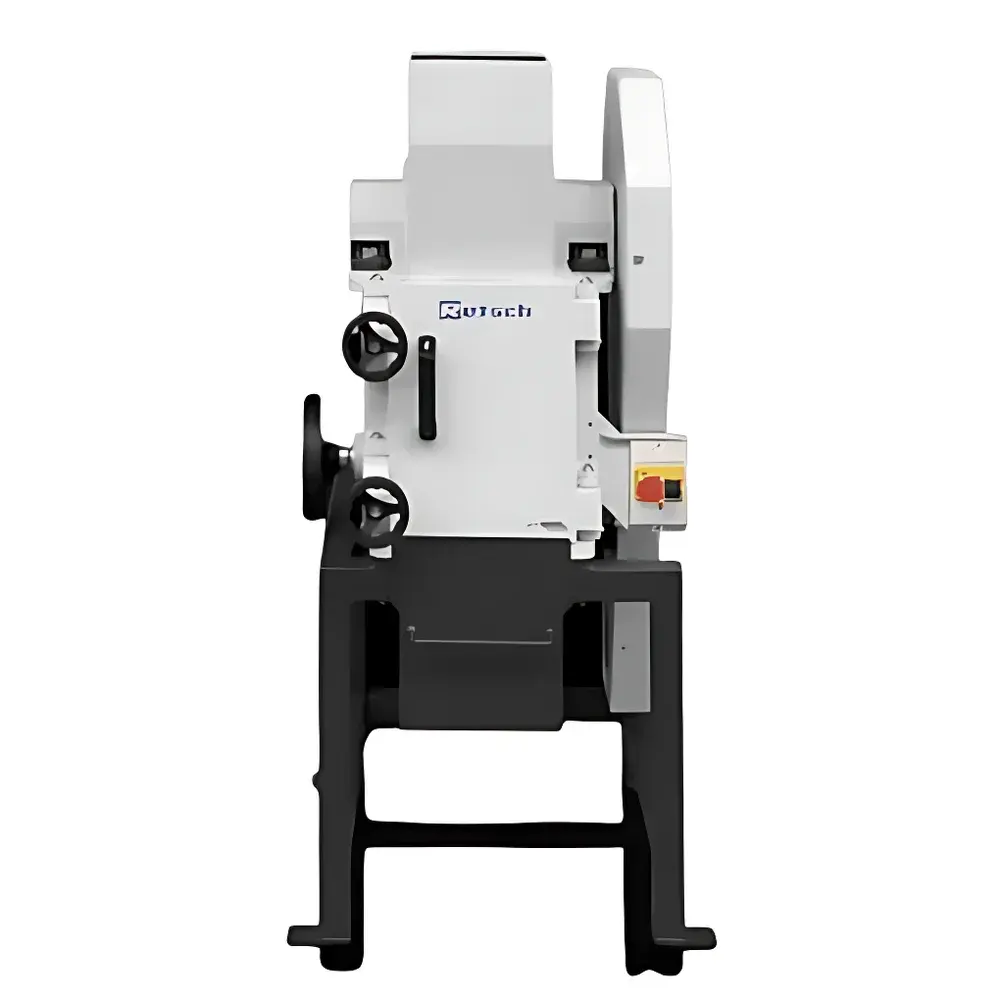
RETSCH BB 400 Jaw Crusher
| Brand | RETSCH |
|---|---|
| Origin | Germany |
| Model | BB 400 |
| Instrument Type | Jaw Crusher |
| Sample Applicability | Hard and Brittle Materials |
| Maximum Feed Size | < 220 × 90 mm |
| Final Particle Size | < 2 mm |
| Crushing Chamber Materials | Manganese Steel, Stainless Steel, Tungsten Carbide, Anti-Heavy-Metal Grinding Steel, NiHard 4 |
| Hopper Options | Standard Hopper, Table-Mounted Feed Hopper (up to 10 L), Bulk Material Hopper with Splash Guard |
| Collection Options | Standard Container (10 L), Continuous-Discharge Funnel, Large-Capacity Container (26 L) |
| Dust Extraction Port | Integrated |
| Jaw Wear Indicator | Calibrated Scale |
| Safety Features | Mechanical Overload Protection, Splash-Protected Hopper, Modular Frame Design |
| Compliance | Designed for GLP-compliant sample preparation workflows |
Overview
The RETSCH BB 400 Jaw Crusher is a heavy-duty, laboratory-scale primary crushing instrument engineered for reproducible size reduction of hard, brittle, and heterogeneous solid materials. Operating on the principle of compressive crushing—where material is fed between two opposing jaws (one fixed, one movable) and subjected to controlled mechanical pressure—the BB 400 delivers consistent pre-grinding performance prior to downstream analysis or further comminution. Its robust cast-iron frame and modular architecture ensure structural stability during high-load operation, while its ergonomic front-access door enables unobstructed visual inspection and rapid cleaning of the crushing chamber—a critical requirement in multi-sample analytical laboratories where cross-contamination must be minimized. Designed and manufactured in Haan, Germany, the BB 400 meets stringent European engineering standards and is widely deployed in geochemical, metallurgical, cement, ceramics, and environmental testing laboratories for compliant sample preparation.
Key Features
- Ergonomic front-opening door at optimal working height for safe, tool-free access to the crushing chamber and simplified maintenance
- Infinitely adjustable jaw gap via precision-machined micrometer screw—enabling fine-tuned control over final particle size distribution without component replacement
- Integrated wear indicator scale on the movable jaw assembly, providing real-time visual assessment of jaw plate degradation and supporting predictive maintenance scheduling
- Dust extraction port (Ø 100 mm) compatible with standard laboratory vacuum systems, minimizing airborne particulate exposure and supporting OSHA and EU Directive 2004/37/EC compliance
- Five interchangeable jaw plate and counter-jaw material options—manganese steel, stainless steel, tungsten carbide, anti-heavy-metal grinding steel, and NiHard 4—to eliminate elemental contamination during sample preparation for ICP-MS, XRF, or leaching analysis
- Mechanical overload protection system automatically halts operation upon excessive feed resistance, safeguarding drive components and ensuring long-term operational reliability
Sample Compatibility & Compliance
The BB 400 is validated for processing a broad spectrum of inorganic and mineralogical matrices, including but not limited to: cement clinker, blast furnace slag, granite, quartzite, alumina and zirconia ceramics, coal, tungsten carbide alloys, ores (e.g., iron, copper, bauxite), catalyst supports, spent nuclear fuel simulants, and geological core samples. Its maximum feed dimension (220 × 90 mm) and throughput capacity support both batch processing (≤10 L per cycle) and continuous operation (via discharge funnel configuration). The instrument conforms to ISO 13320 (laser diffraction particle sizing method prerequisites), ASTM C117 (material fineness testing for aggregates), and USP (particle size distribution requirements for pharmaceutical excipients and raw materials). All contact surfaces are traceable to material certification documents, and jaw plate lot numbers are recorded for full auditability in GLP and GMP environments.
Software & Data Management
While the BB 400 operates as a stand-alone electromechanical unit without embedded firmware or touchscreen interface, it is fully compatible with laboratory information management systems (LIMS) through manual entry of operational parameters—including batch ID, feed mass, jaw gap setting, run duration, and jaw plate serial number—into structured electronic lab notebooks (ELN). Its mechanical design facilitates seamless integration into automated sample prep workflows when paired with robotic sample handlers or conveyor-fed hoppers. For regulatory submissions, users may document jaw wear calibration records, preventive maintenance logs, and cleaning verification reports in accordance with FDA 21 CFR Part 11 requirements using validated ELN platforms. RETSCH provides comprehensive documentation packages—including CE Declaration of Conformity, RoHS compliance statements, and material safety data sheets—for each delivery.
Applications
- Geochemical exploration: Reduction of drill core and rock chip samples to ≤2 mm for XRF fusion bead preparation or acid digestion
- Cement and construction materials testing: Pre-crushing of clinker nodules and slag granules prior to Blaine surface area analysis (ISO 20920)
- Environmental solid waste characterization: Size reduction of contaminated soils, fly ash, and incinerator residues for TCLP or SPLP leaching studies
- Ceramics R&D: Controlled fragmentation of sintered oxide bodies to assess green strength and fracture behavior
- Metallurgical assay preparation: Primary crushing of ore concentrates prior to ring mill or planetary ball milling for homogenization
- Nuclear materials handling: Dry crushing of uranium oxide pellets and zirconium alloy fragments under inert atmosphere glovebox integration (optional hood adaptation)
FAQ
What is the recommended maintenance interval for jaw plates?
Jaw plate replacement frequency depends on cumulative operating hours and sample abrasivity; RETSCH recommends inspecting wear indicators after every 50–100 hours of operation and replacing plates when wear exceeds 3 mm depth deviation from original profile.
Can the BB 400 be used for wet crushing?
No—the BB 400 is strictly designed for dry crushing applications. Introduction of moisture may cause clogging, corrosion of non-stainless components, and inaccurate gap calibration.
Is the BB 400 suitable for food-grade or pharmaceutical sample preparation?
Yes, provided stainless steel or tungsten carbide jaw sets are selected, and the unit undergoes documented cleaning validation per ICH Q5C and USP guidelines prior to use.
How is particle size distribution verified post-crushing?
Final output should be sieved using standardized test sieves (ISO 3310-1) or analyzed via laser diffraction (e.g., RETSCH ANALYSETTE 22) to confirm compliance with target D90 ≤ 2 mm specifications.
Does RETSCH offer IQ/OQ documentation for the BB 400?
Yes—qualified installation and operational qualification protocols, including torque calibration certificates, gap verification templates, and vibration signature reports, are available upon request for regulated laboratory deployment.



