
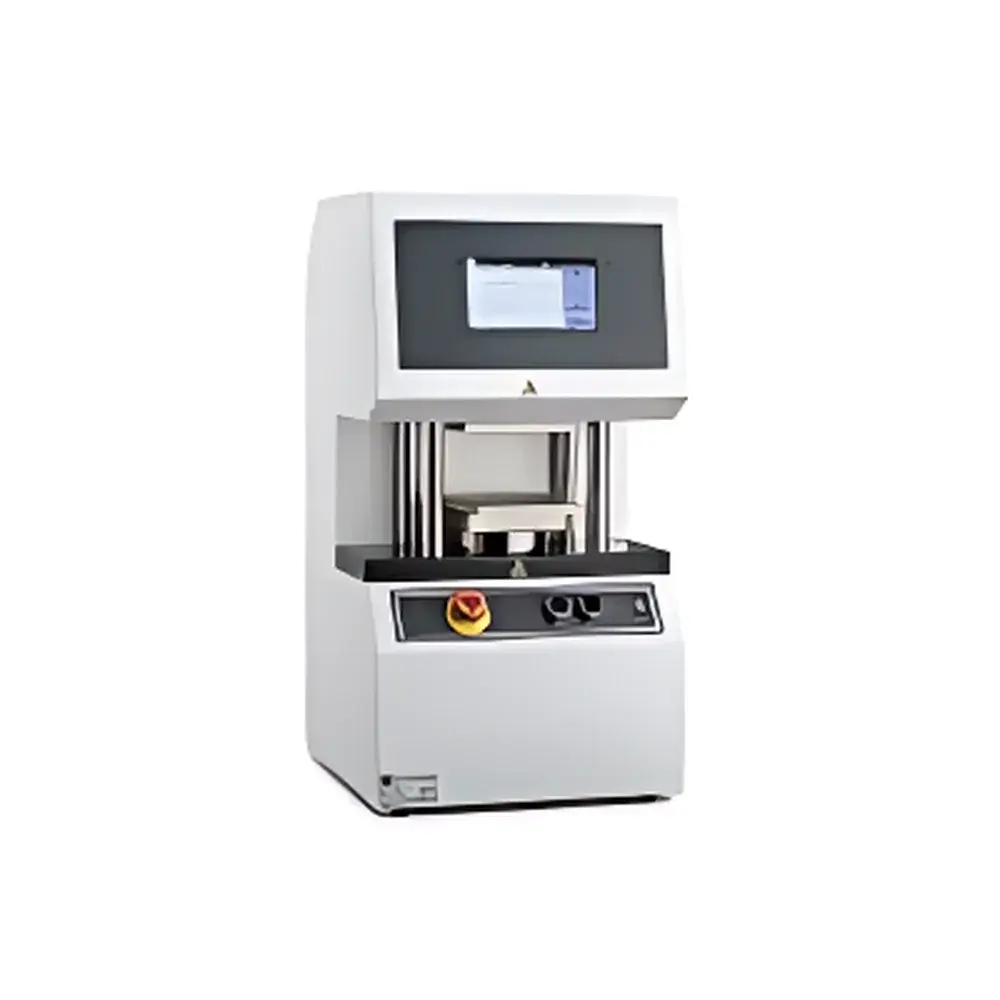
Messmer Büchel 17-56 Crush Resistance Tester
| Origin | Guangdong, China |
|---|---|
| Manufacturer Type | Authorized Distributor |
| Origin Category | Domestic (China) |
| Model | 17-56 |
| Pricing | Available Upon Request |
Overview
The Messmer Büchel 17-56 Crush Resistance Tester is a precision-engineered mechanical compression instrument designed for standardized evaluation of compressive strength properties in corrugated fiberboard materials. It operates on the principle of controlled uniaxial compression under defined geometric constraints, adhering to fundamental physical testing methodologies outlined in ISO 3037 (Corrugated fibreboard — Determination of edge crush resistance), ISO 7263 (Corrugated fibreboard — Determination of ring crush resistance), and GB/T 2679.6–1996 (Paper and board — Determination of flat crush resistance). The system applies a steadily increasing compressive force via motor-driven parallel platens, measuring peak load at specimen failure (crush point) with high reproducibility. Its rigid frame, calibrated load cell, and programmable crosshead speed ensure compliance with international quality assurance protocols required in packaging R&D, QC laboratories, and third-party certification facilities.
Key Features
- Triple-mode mechanical compression capability: Edge Crush Test (ECT), Ring Crush Test (RCT), and Flat Crush Test (FCT) — all performed on a single platform with tool-free accessory exchange.
- Modular test fixture system: Includes standardized ECT clamps (15 mm width), RCT circular sample holders (152 mm circumference), and FCT parallel plates with 100 mm² contact area — all manufactured to ISO/GB dimensional tolerances.
- Precision electromechanical drive: Crosshead speed adjustable from 1.0 to 12.7 mm/min (0.1 mm/min increments), meeting ASTM D642 and ISO 12048 requirements for consistent strain rate application.
- Digital load measurement: Integrated high-stability load cell with ±0.5% full-scale accuracy, auto-zeroing function, and real-time peak-hold capture.
- Robust structural architecture: Cast-iron base, hardened steel platens, and guided linear motion system minimize lateral deflection and ensure axial alignment per ISO 7500-1 Class 1 calibration standards.
- Compliance-ready design: Supports GLP/GMP documentation workflows through optional audit trail logging and user-access control settings.
Sample Compatibility & Compliance
The 17-56 tester accommodates standard specimen geometries defined in global packaging standards: 25 mm × 100 mm strips for ECT (ISO 3037), 152 mm circumference rings for RCT (ISO 7263), and 100 mm × 100 mm squares for FCT (GB/T 2679.6). It supports material thicknesses from 0.2 mm to 8.0 mm without recalibration. All test modes are traceable to national metrological standards (CNAS-accredited calibration certificates available). The instrument meets mechanical safety requirements per EN ISO 12100 and electrical safety per IEC 61000-6-2/6-4. Its operational parameters align with regulatory expectations for packaging validation under FDA 21 CFR Part 11 when paired with compliant software modules.
Software & Data Management
While the base unit operates in standalone analog/digital mode, optional PC connectivity enables integration with proprietary CrushTest Suite v3.x software. This Windows-based application provides automated test sequence execution, real-time force-displacement curve visualization, statistical reporting (mean, SD, CV%), and export to CSV/PDF formats. Data files include embedded metadata: operator ID, timestamp, environmental conditions (optional hygrometer input), and calibration status flags. Audit trail functionality records all user actions (test start/stop, parameter edits, result overrides) with tamper-proof timestamps — satisfying FDA 21 CFR Part 11 electronic record requirements when configured with digital signature authentication.
Applications
- Quality control of linerboard and corrugating medium during paper mill production.
- Pre-shipment validation of corrugated board specifications for e-commerce packaging suppliers.
- Root-cause analysis of field failures in distribution cycles (e.g., pallet collapse, corner crushing).
- Development of high-performance recycled fiber blends where RCT/ECT correlation modeling is critical.
- Third-party certification testing for ISTA 3A/6AM and ASTM D4169 transport simulation protocols.
- Academic research on fiber network mechanics, adhesive bond integrity, and moisture-dependent compression hysteresis.
FAQ
What standards does the Messmer Büchel 17-56 comply with?
It is engineered to meet ISO 3037 (ECT), ISO 7263 (RCT), GB/T 2679.6 (FCT), and ASTM D642 test method requirements.
Can the instrument be calibrated externally?
Yes — it features NIST-traceable load cell interfaces and accepts third-party calibration services accredited to ISO/IEC 17025.
Is operator training included with purchase?
Standard commissioning includes on-site setup verification and two-hour procedural training; advanced metrology workshops are available separately.
Does the system support automatic pass/fail judgment against specification limits?
When used with CrushTest Suite software, users can define upper/lower tolerance bands and generate immediate compliance flags per test result.
What maintenance is required for long-term accuracy?
Annual verification of platen parallelism and load cell linearity is recommended; no routine lubrication or consumable parts are required.



