
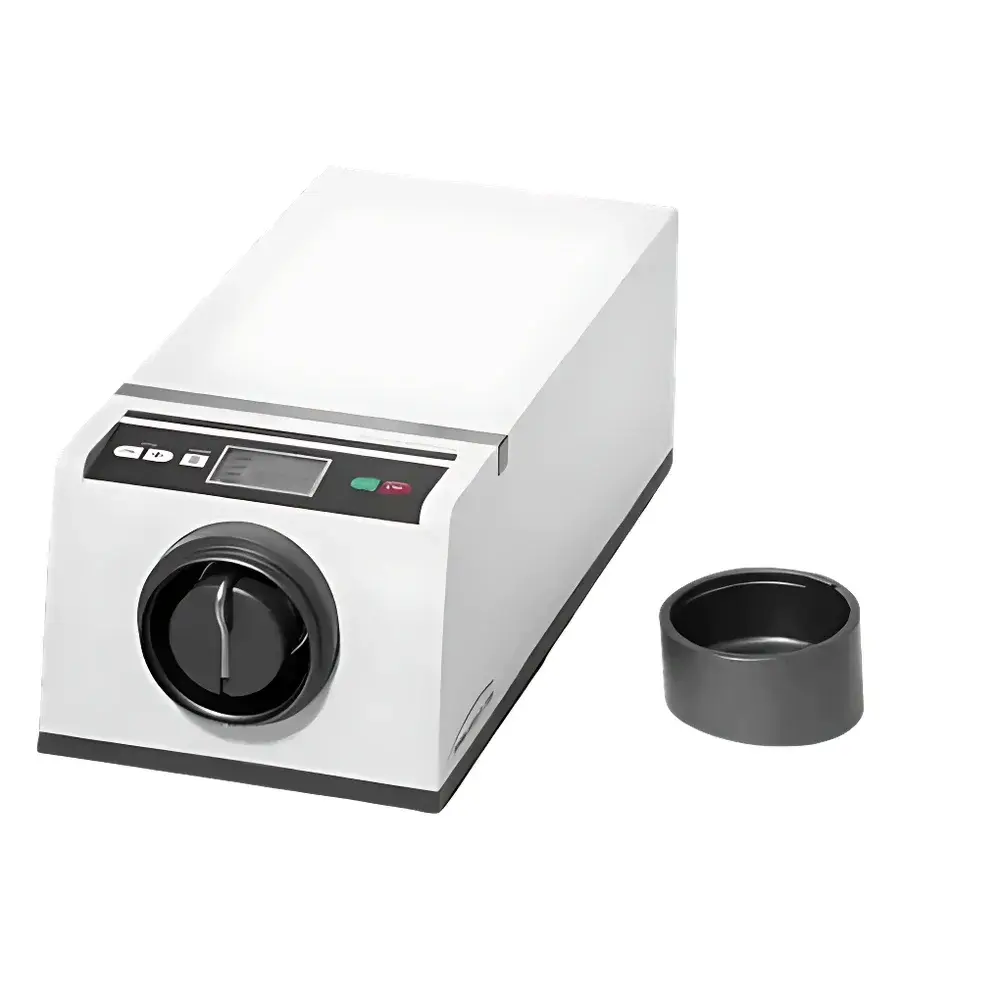
RETSCH XRD-MILL McCrone
| Brand | RETSCH |
|---|---|
| Origin | Germany |
| Model | XRD-MILL McCrone |
| Instrument Type | Vibratory Micro-Mill |
| Sample Applicability | Hard and Brittle Materials |
| Feed Size | < 0.5 mm |
| Final Particle Size | < 1 µm |
| Grinding Principle | Vibratory Ball Milling with Controlled Energy Input |
| Compliance | Designed for X-ray Diffraction (XRD) Sample Preparation per ASTM E1361, ISO 13320, and USP <429> |
| Operation Mode | Dry and Wet Grinding |
| Maintenance | Maintenance-Free Design |
| Noise Level | ≤ 65 dB(A) |
| Footprint | Benchtop, Compact Housing |
Overview
The RETSCH XRD-MILL McCrone is a high-precision vibratory micro-mill engineered specifically for the preparation of crystalline samples intended for X-ray diffraction (XRD) analysis. Unlike conventional planetary or centrifugal mills, the XRD-MILL McCrone employs controlled high-frequency vibration—rather than rotational motion—to induce impact and shear forces between grinding media and sample material. This vibratory principle minimizes amorphization and preserves crystal lattice integrity, making it indispensable for phase identification, quantitative Rietveld analysis, and structural characterization where crystallinity must remain uncompromised. Its design adheres to the fundamental requirement of XRD sample preparation: homogeneous particle size distribution without induced lattice strain or polymorphic transformation. The mill is widely deployed in geological laboratories, materials science departments, cement and ceramics R&D centers, and pharmaceutical quality control units where regulatory-grade sample homogeneity and phase fidelity are mandatory.
Key Features
- Vibratory grinding mechanism delivering reproducible, low-energy mechanical comminution—critical for preserving crystalline structure during milling.
- Four-step adjustable grinding power setting (1–4), enabling precise control over energy input to match sample hardness and desired fineness.
- Benchtop footprint (W × D × H: 220 × 300 × 340 mm) with robust cast-aluminum housing and vibration-damped base for stable operation on standard laboratory workbenches.
- Hermetically sealed grinding vial system (standard 3.5 mL agate or stainless steel vials) prevents cross-contamination and enables inert-atmosphere grinding when coupled with glovebox integration.
- No lubrication or scheduled maintenance required; gear-free electromagnetic drive ensures long-term operational reliability and compliance with GLP audit requirements.
- Acoustic enclosure-compatible design achieving ≤ 65 dB(A) sound pressure level—suitable for shared analytical labs without dedicated acoustic isolation rooms.
- Compatible with both dry grinding and wet dispersion protocols using solvents such as ethanol, isopropanol, or aqueous surfactant solutions.
Sample Compatibility & Compliance
The XRD-MILL McCrone is validated for hard, brittle, and moderately abrasive materials including oxides (e.g., Al2O3, SiO2), nitrides (Si3N4, TiN), carbides (SiC, WC), borides (TiB2), minerals (mica, quartz, feldspar), cements, clays, glasses, sintered ceramics, metallurgical alloys, and calcined bone ash. Feed particles must be pre-sieved to ≤ 0.5 mm to ensure uniform loading and avoid vial imbalance. Final particle size distributions consistently achieve d90 < 1 µm with narrow span values (d90/d10 < 3.5), satisfying ISO 13320 laser diffraction calibration prerequisites. The instrument supports method validation under FDA 21 CFR Part 11 when paired with RETSCH’s optional GRINDOMAT software, fulfilling documentation traceability for GMP-regulated environments.
Software & Data Management
While the XRD-MILL McCrone operates via intuitive front-panel controls, it integrates seamlessly with RETSCH’s GRINDOMAT digital workflow platform (optional). GRINDOMAT provides electronic batch records, user access levels, timestamped parameter logging (power level, duration, vial ID), and exportable CSV reports compliant with 21 CFR Part 11 Annex 11 requirements. All grinding parameters—including elapsed time, power setting, and vial identification—are retained internally for ≥ 1,000 runs, supporting internal audit trails and laboratory accreditation (e.g., ISO/IEC 17025). No proprietary drivers or OS-specific installations are required; data export occurs via USB 2.0 interface.
Applications
- XRD sample preparation for quantitative phase analysis (QPA) and residual stress evaluation in advanced ceramics and additive manufacturing powders.
- Homogenization of geological core samples prior to whole-rock geochemical analysis (XRF, ICP-MS).
- Particle size reduction of pharmaceutical excipients and active ingredients for polymorph screening and stability studies.
- Routine milling of cement clinker, slag, and fly ash for hydration kinetics modeling and sulfate resistance testing.
- Preparation of reference materials certified under ISO Guide 35, where inter-laboratory comparability depends on consistent crystallite size and lattice preservation.
FAQ
Is the XRD-MILL McCrone suitable for milling soft or fibrous materials?
No—it is optimized for hard, brittle substances. Soft, elastic, or fibrous samples (e.g., polymers, plant tissues without pre-drying) tend to agglomerate or absorb vibrational energy inefficiently, resulting in poor size reduction and potential vial clogging.
Can stainless steel vials be used for all sample types?
Stainless steel vials are recommended for non-magnetic, non-reactive inorganic matrices. For magnetic materials (e.g., Fe, Ni, Co alloys) or XRD-sensitive applications requiring zero elemental contamination, agate or tungsten carbide vials are mandatory.
Does the instrument meet ISO/IEC 17025 calibration requirements?
Yes—the device includes factory-certified performance verification reports (including amplitude calibration and timing accuracy) traceable to DAkkS-accredited standards. Users may perform in-house verification using NIST-traceable reference powders (e.g., SRM 1976b).
What is the typical grinding time to reach <1 µm for quartz?
Under standard conditions (agate vial, 2 × 5 mm agate balls, power level 3), 3–5 minutes achieves d90 < 0.8 µm for pre-crushed quartz (<0.5 mm), verified by laser diffraction and TEM cross-validation.
Is wet grinding compatible with automated dispersion systems?
Yes—grinding vials can be directly transferred to RETSCH’s DYNO-MILL ECM or equivalent inline dispersers for continuous slurry processing, eliminating manual transfer and secondary agglomeration risks.



