
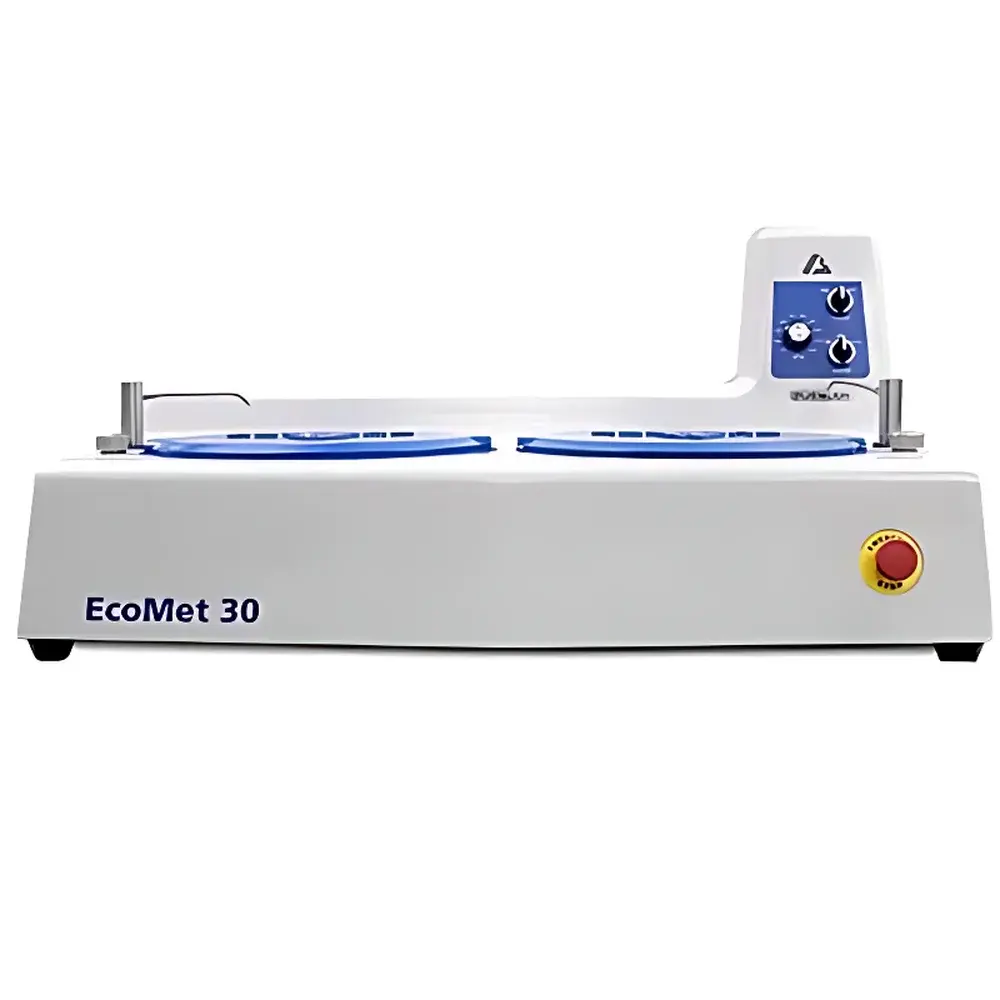
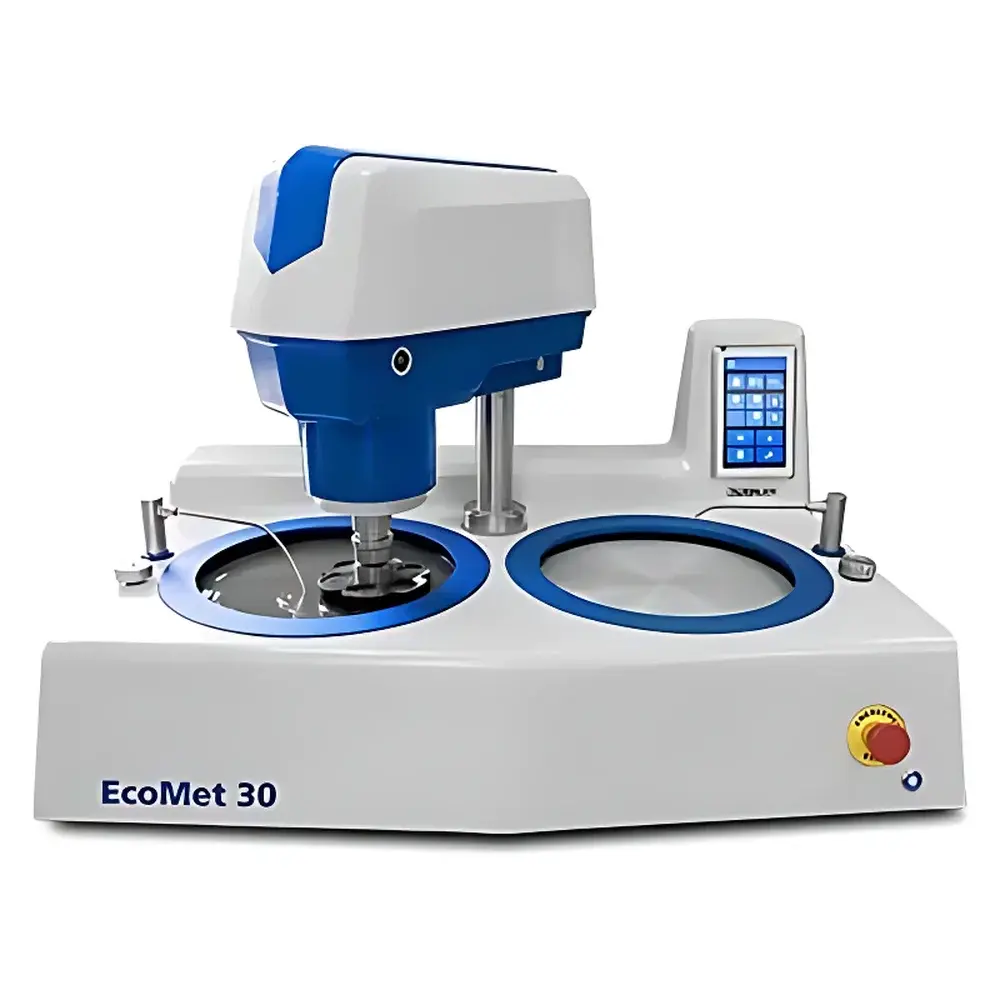
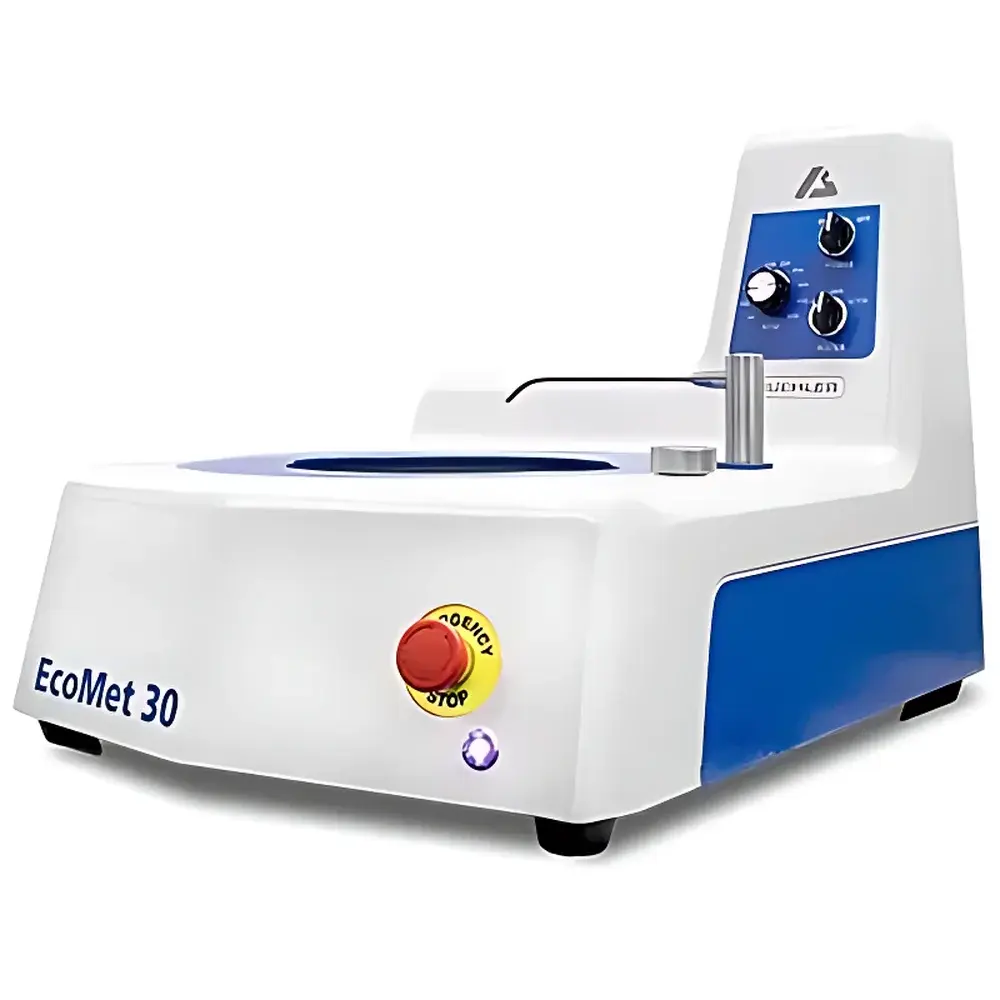
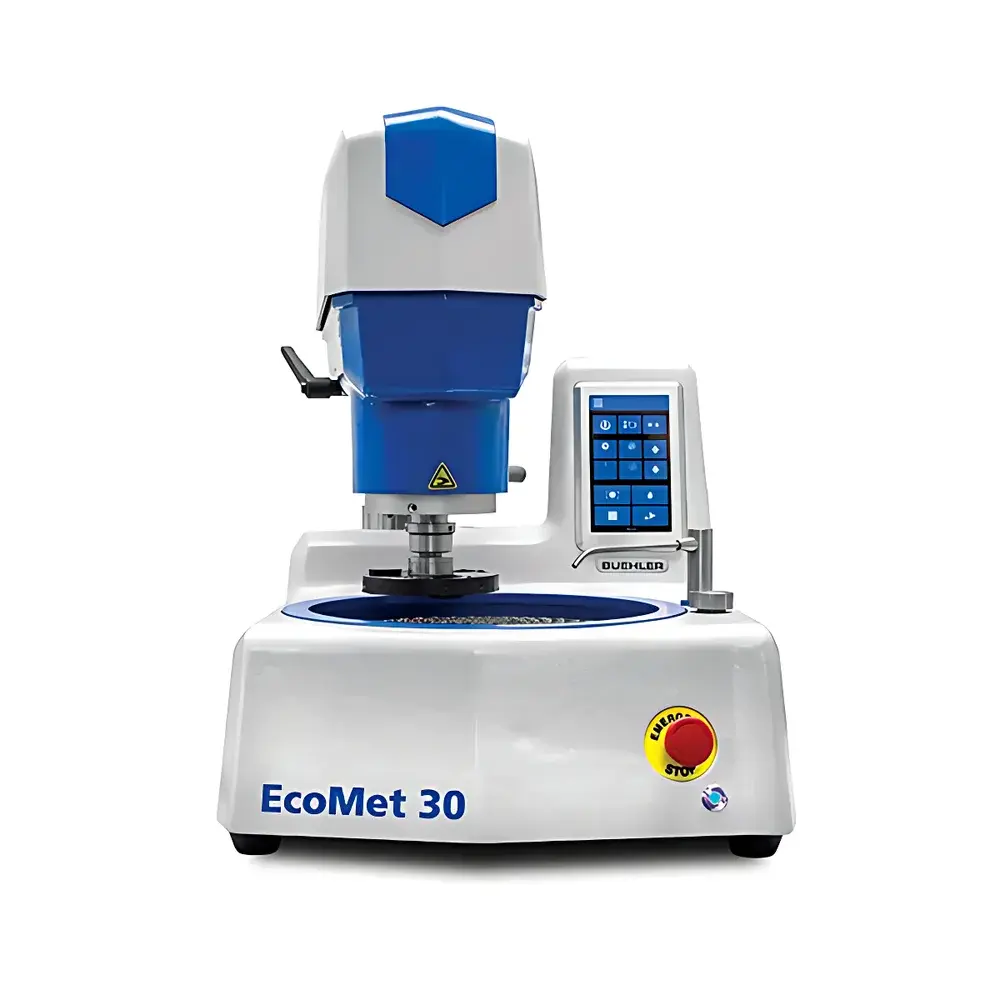
Buehler EcoMet 30 Manual and Semi-Automatic Single- or Dual-Disc Grinding and Polishing System
| Brand | Buehler |
|---|---|
| Origin | USA |
| Model | EcoMet 30 |
| Disc Count | 1 or 2 |
| Disc Diameter | 8 in (203 mm), 10 in (254 mm), 12 in (305 mm) |
| Speed Range | 50–500 rpm, continuously variable (manual) |
| Power Supply | 100–240 VAC, 50/60 Hz, single-phase |
| Motor Power | 300 W (single-disc manual), 440 W (dual-disc manual), 440 W (single-disc auto), 1 kW (dual-disc auto, system total) |
| Center Load Force | 5–40 lbf (25–200 N) |
| Single-Point Load Force | 1–10 lbf (5–40 N) |
| Water Pressure | 40–116 psi (2.7–8 bar) |
| Compressed Air Requirement | ≥0.4 MPa, 6 mm OD tubing |
| Noise Level | ≤65 dB(A) at 500 rpm |
| Weight | 46 kg (101.5 lb) to 105 kg (231.5 lb), depending on configuration |
| Compliance | CE-marked, designed and validated per IEC 61000-6-2/6-4, EN 61000-3-2/3-3 |
Overview
The Buehler EcoMet 30 is a precision-engineered, modular grinding and polishing system designed for reproducible specimen preparation in metallurgical, materials science, geological, and failure analysis laboratories. It operates on the principle of controlled mechanical abrasion—applying consistent rotational motion, precise normal force, and regulated coolant delivery to progressively remove material and achieve planar, artifact-free surfaces suitable for optical microscopy, electron microscopy (SEM/TEM), and microhardness testing. The EcoMet 30 supports both manual operation—ideal for experienced technicians performing iterative, process-sensitive protocols—and semi-automatic mode—with programmable head motion, load application, and step sequencing—for improved inter-operator consistency and traceability. Its dual-disc configuration enables simultaneous coarse grinding and fine polishing, significantly reducing cycle time without cross-contamination between stages.
Key Features
- Modular disc architecture: Interchangeable 8″, 10″, and 12″ (203 mm, 254 mm, 305 mm) grinding/polishing discs—validated for 2,500 hours of continuous operation under nominal load conditions.
- Ergonomic design: Large flat splash guard doubles as a stable hand-rest; disc height optimized for neutral wrist posture and reduced operator fatigue during extended use.
- Tool-free disc removal: Quick-release mounting mechanism enables full disassembly for thorough cleaning and prevents carryover of abrasive residues between sample types.
- Integrated direct-drain system: High-capacity gravity-fed drainage minimizes slurry accumulation, reduces maintenance frequency, and supports compliance with laboratory hygiene standards (e.g., ISO 14644 cleanroom-compatible workflows).
- Intuitive human-machine interface: 7-inch full-color LCD touchscreen (semi-auto models) with context-aware menus, real-time status feedback, and one-touch cleaning cycle activation—including automatic head spin-dry function to expel residual water and abrasive suspension.
- Robust cast-aluminum base and column: Provides structural rigidity, vibration damping, and long-term dimensional stability—critical for maintaining parallelism between disc surface and specimen during high-force grinding.
Sample Compatibility & Compliance
The EcoMet 30 accommodates standard metallurgical specimens up to 40 mm in diameter under center-load configuration and down to 25 mm for single-point loading—supporting common mount sizes (1″, 1.25″, 1.5″, 25 mm, 30 mm, 40 mm). Its programmable force control (5–40 lbf center load; 1–10 lbf single-point) ensures compatibility with brittle ceramics, soft polymers, and hard alloys without edge rounding or pull-out artifacts. All electrical and mechanical subsystems conform to CE marking requirements under the Low Voltage Directive (2014/35/EU) and Electromagnetic Compatibility Directive (2014/30/EU). While not inherently 21 CFR Part 11 compliant, audit-ready operation logs (via optional Buehler OmniMet software integration) support GLP/GMP-aligned documentation practices in regulated environments such as aerospace QA or medical device R&D.
Software & Data Management
Semi-automatic EcoMet 30 systems feature embedded firmware supporting up to 99 user-defined method programs—including disc speed, head speed, dwell time, load profile, and coolant flow parameters. Each method stores timestamped execution metadata (start/end time, operator ID if network-authenticated, error flags). When paired with Buehler’s OmniMet Suite (v5.2+), the instrument exports ASCII-formatted CSV reports compatible with LIMS platforms and statistical process control (SPC) tools. Firmware updates are delivered via USB drive and include version-controlled change logs—facilitating internal validation and regulatory review. No cloud connectivity is enabled by default; all data remains on-device unless explicitly exported.
Applications
- Preparation of metallographic sections for ASTM E3, ISO 643, and EN 10360-1 compliant microstructural evaluation.
- Edge-preserving polishing of semiconductor wafers and thin-film coatings prior to cross-sectional SEM imaging.
- Routine quality control of additive-manufactured (AM) metal parts—removing layer lines while preserving porosity distribution for image analysis.
- Geological thin-section production where mineral hardness differentials demand precise force modulation to avoid differential wear.
- Failure analysis labs requiring rapid turnaround of fracture surfaces for fractography and inclusion mapping.
FAQ
Can the EcoMet 30 be used for both grinding and polishing in a single workflow?
Yes—its dual-disc configuration allows concurrent coarse grinding on one disc and fine polishing on the other, with independent speed and coolant control per station.
Is calibration required before first use?
No factory calibration is needed; however, users must verify disc runout (<0.02 mm TIR) and load accuracy (±2% FS) using traceable metrology tools as part of initial qualification per ISO/IEC 17025.
What consumables are compatible with the EcoMet 30?
All standard Buehler abrasive discs (e.g., SiC, diamond, alumina), lubricants (e.g., MetaDi Supreme, MetaDi Fluid), and polishing cloths (e.g., MicroCloth, TexMet) are supported—no proprietary consumables required.
Does the system support automated endpoint detection?
No—endpoint determination remains operator-dependent via visual inspection or integrated light-intensity monitoring (optional accessory); no built-in optical or acoustic sensors are included.
Can the EcoMet 30 be integrated into a laboratory automation network?
It does not feature native Ethernet or RS-232 ports; integration requires external PLC-level signal bridging or third-party middleware (e.g., LabVantage, Thermo Fisher SampleManager) via digital I/O modules.



