
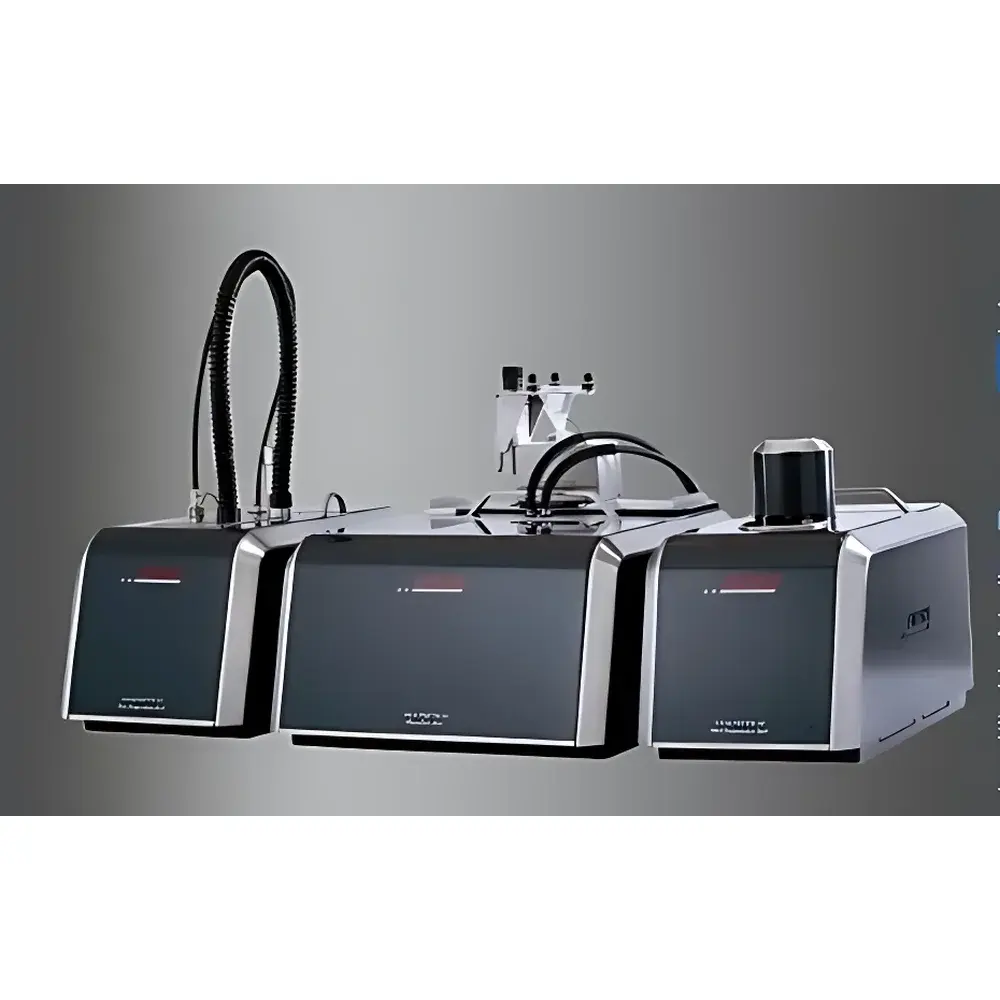
Fritsch Analysette 22 NanoTec Large-Range Nanoparticle Laser Diffraction Particle Size Analyzer
| Brand | Fritsch |
|---|---|
| Origin | Germany |
| Model | Analysette 22 NanoTec |
| Measurement Principle | Laser Diffraction (Dual-Wavelength) |
| Wet Dispersion Range | 0.01–2100 µm |
| Measurement Time (Single) | 5–10 s |
| Full Cycle Time | ≤120 s |
| Sample Loop Volume | 300–500 mL (adjustable via software) |
| Optical Design | Inverse Fourier Configuration with Movable Detection Module (Fritsch Patent) |
| Detection Channels | 108 |
| Repeatability | ±0.5% |
| Light Sources | 532 nm (green) & 940 nm (IR), dual-beam |
| Fourier Lenses | 260 mm (green) & 560 mm (IR) |
| Software | Fritsch MaS v5.x |
| Compliance | ISO 13320:2020 |
Overview
The Fritsch Analysette 22 NanoTec is a high-precision, large-range laser diffraction particle size analyzer engineered for rigorous industrial and research applications requiring simultaneous nanoscale and coarse-particle characterization. It operates on the fundamental principle of Mie and Fraunhofer light scattering theory, where particles suspended in a dispersant interact with collimated laser beams, producing angular intensity distributions that are mathematically inverted to yield volume-based particle size distributions (PSD). Its dual-wavelength optical architecture—comprising a 532 nm green laser and a 940 nm infrared laser—enables enhanced sensitivity across the full 0.01–2100 µm dynamic range, particularly improving resolution in the sub-100 nm region where single-wavelength systems often exhibit reduced signal-to-noise ratios. The instrument features an inverse Fourier optical layout with a patented movable detection module, allowing real-time optimization of focal plane alignment without mechanical recalibration. This design minimizes optical aberrations and ensures consistent measurement fidelity across diverse sample types and refractive indices.
Key Features
- Dual-laser optical system (532 nm + 940 nm) with independent Fourier lenses (260 mm and 560 mm focal lengths) for optimized scattering angle coverage and improved low-concentration nanoparticle detection.
- 108-channel high-resolution photodetector array with automatic beam profiling and real-time background subtraction to ensure robust signal acquisition.
- Modular wet dispersion unit with electronically adjustable loop volume (300 / 400 / 500 mL) and variable-speed radial pump—fully controlled via MaS software for reproducible hydrodynamic conditions.
- Cartridge-style measurement cell design enables rapid, tool-free exchange between wet, dry, and micro-volume configurations—reducing cross-contamination and downtime.
- Integrated ultrasonic probe with programmable amplitude and duration control; eliminates need for external stirrers or mechanical agitators during dispersion.
- Independent dispersion and measurement modules allow parallel system optimization—e.g., sonication energy can be tuned without affecting optical path stability.
- Two-position detector alignment (standard and extended focus) supports both routine QC measurements and method development for challenging materials such as high-aspect-ratio nanoparticles or fragile aggregates.
Sample Compatibility & Compliance
The Analysette 22 NanoTec accommodates a broad spectrum of sample matrices, including aqueous suspensions, polar organic solvents (e.g., isopropanol, ethanol), and non-polar media (e.g., hexane, toluene), provided compatibility with wet dispersion components (e.g., PTFE seals, quartz flow cells). Optional accessories expand capability: the SVA (Small Volume Adapter) enables analysis of precious or hazardous samples using only 50 mL dispersant; the dry dispersion unit employs gravity-fed aspiration and venturi acceleration for free-flowing powders; and the dry feed channel facilitates handling of coarse, abrasive materials without active dispersion. All measurement protocols adhere strictly to ISO 13320:2020 (“Particle size analysis — Laser diffraction methods”), ensuring traceability and regulatory acceptance in pharmaceutical, chemical, and materials science environments. Instrument validation documentation supports GLP/GMP workflows, and audit trails within MaS software comply with FDA 21 CFR Part 11 requirements for electronic records and signatures.
Software & Data Management
Fritsch MaS (Measurement and Analysis Software) v5.x serves as the central interface for instrument control, data acquisition, and statistical evaluation. It provides ISO-compliant reporting templates—including D10, D50, D90, span, and relative width—and supports customizable distribution models (e.g., volume, surface, number-based). Raw scattering patterns are stored in vendor-neutral ASCII format, enabling third-party reprocessing. The software includes automated SOP execution, user-level access controls, and encrypted measurement logs with timestamped operator identification. Batch processing, trend analysis across multiple lots, and export to LIMS-compatible CSV or PDF formats are natively supported. All calibration files, dispersion parameters, and measurement histories are version-controlled and archived with checksum verification to meet long-term data integrity requirements.
Applications
This analyzer is routinely deployed in quality control laboratories for cementitious materials, battery cathode slurries, catalysts, pigments, pharmaceutical excipients, and nanocomposites. Its ability to resolve bimodal distributions—from primary nanoparticles (10 µm)—makes it especially valuable in formulation development for colloidal dispersions and inhalable drug products. In R&D settings, it supports stability studies (e.g., monitoring aggregation kinetics under thermal or pH stress), process optimization of milling and homogenization steps, and raw material qualification against supplier specifications. Academic users apply it to characterize synthetic nanomaterials, environmental particulates, and biopolymer assemblies where reproducible, standards-aligned PSD data are critical for publication and peer review.
FAQ
Does the Analysette 22 NanoTec require annual recalibration?
No scheduled annual recalibration is mandated; however, daily verification using NIST-traceable polystyrene latex standards (e.g., 100 nm, 1 µm, 10 µm) is recommended per ISO 13320 Annex B.
Can the instrument measure samples with high refractive index contrast (e.g., TiO₂ in water)?
Yes—the dual-wavelength configuration and Mie theory inversion algorithm accommodate complex refractive indices (e.g., 2.7 + 0.1i for TiO₂), provided appropriate optical model selection is applied in MaS software.
Is dry dispersion suitable for heat-sensitive polymers?
The dry module operates at ambient temperature with minimal shear; however, for thermolabile materials, wet dispersion with low-energy sonication (via programmable probe) is strongly preferred.
How is data security ensured during remote operation?
MaS supports TLS 1.2-encrypted network communication, role-based authentication, and local database encryption—meeting ISO/IEC 27001-aligned IT infrastructure requirements.
What maintenance intervals are specified for the radial pump and ultrasonic transducer?
The radial pump requires seal inspection every 6 months under continuous use; the ultrasonic probe is rated for 10,000 hours of cumulative operation and includes built-in impedance monitoring for predictive replacement alerts.



