
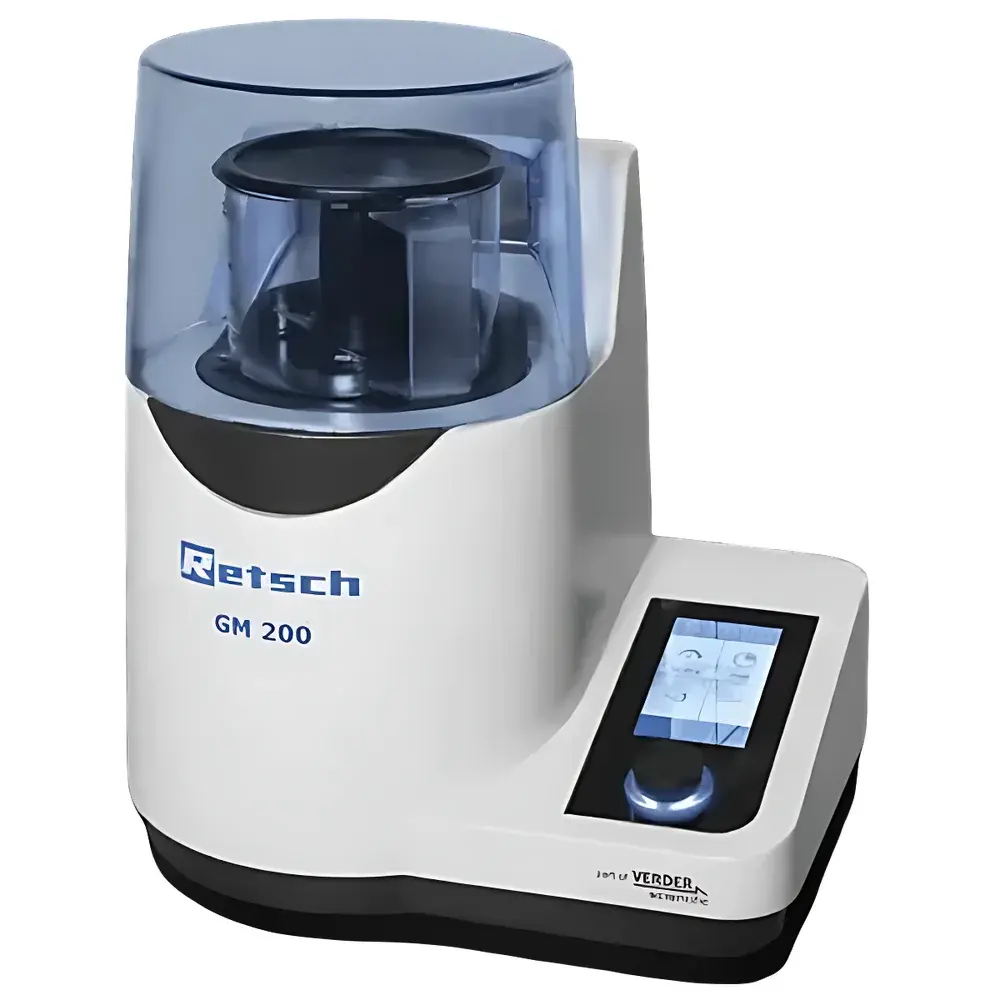
RETSCH GRINDOMIX GM 200 Knife Mill
| Brand | RETSCH |
|---|---|
| Origin | Germany |
| Model | GRINDOMIX GM 200 |
| Instrument Type | Knife Mill |
| Sample Applicability | Soft to Medium-Hard Materials |
| Maximum Feed Size | 40 mm |
| Final Particle Size | < 300 µm |
| Rotational Speed Range | 1,000–10,000 rpm (standard), up to 14,000 rpm (enhanced mode) |
| Sample Capacity | Up to 700 mL |
| Sterilization Compatibility | All wetted parts autoclavable (121 °C, 2 bar) |
| SOP Storage | 8 pre-programmed methods |
| Program Cycles | 4 multi-step sequences |
| Display | 4.3-inch capacitive touchscreen interface |
| Optional Accessories | Gravity lid, volume-reduction lid, stainless-steel grinding vessel with baffle, all-metal 4-blade rotor, cryo kit (dry ice compatible) |
Overview
The RETSCH GRINDOMIX GM 200 is a high-performance, laboratory-scale knife mill engineered for rapid, reproducible comminution and homogenization of soft, fibrous, elastic, and moderately hard materials. Operating on the principle of high-speed rotary cutting—where a precision-machined, multi-blade rotor shears samples against the inner wall of a fixed grinding vessel—the GM 200 delivers consistent particle size reduction in seconds. Its design integrates pre-crushing and fine grinding into a single step, eliminating intermediate sieving or secondary milling. The instrument is widely deployed in food safety laboratories, QC departments of agri-food and feed manufacturers, pharmaceutical R&D units, and academic research facilities where representative sample preparation is critical prior to elemental analysis (e.g., ICP-OES/MS), proximate analysis (AOAC, ISO 6496), or DNA/RNA extraction. Unlike jaw crushers or disc mills, the GM 200 maintains low thermal load during operation—especially when paired with the optional cryo kit—making it suitable for thermolabile matrices such as fresh herbs, frozen meat, or enzymatically active plant tissues.
Key Features
- Variable-speed drive (1,000–10,000 rpm standard; 14,000 rpm enhanced mode) enables precise control over shear energy input, optimizing throughput and fineness for diverse material classes.
- 4.3-inch capacitive touchscreen interface supports intuitive parameter entry, real-time status monitoring, and secure access to MyRETSCH via QR code—facilitating remote method validation and firmware updates.
- Autoclavable wetted components—including grinding vessel, lid, rotor, and insert—comply with GLP/GMP hygiene requirements and enable full traceability across batch processing workflows.
- Gravity lid system dynamically reduces effective grinding chamber volume by descending under its own weight during operation, ensuring continuous sample contact with the rotor and minimizing wall adhesion—particularly beneficial for sticky or high-moisture samples (e.g., tomatoes, sausage, fresh lettuce).
- Volume-reduction lid option permits homogenization of small-volume samples (0.3 L or 0.5 L), enhancing reproducibility for limited or high-value specimens such as clinical tissue biopsies or botanical extracts.
- Cryo kit (dry ice compatible) includes stainless-steel cryo lid with CO₂ venting channels, baffle-equipped grinding vessel, and all-metal 4-blade rotor—enabling safe, low-temperature milling of elastic or viscous materials (e.g., bacon, cheese, fish, frozen berries) without thermal degradation or smearing.
Sample Compatibility & Compliance
The GM 200 accommodates a broad spectrum of organic and semi-organic matrices, including but not limited to: confectionery products, cereal grains, dairy derivatives (cheese, yogurt solids), dietary supplements, dried and fresh fruits/vegetables (tomatoes, raisins, lettuce), meat and processed meats (ham, sausage, bacon), nuts, oilseeds, animal feed pellets, pharmaceutical tablets, herbal materials, and cosmetic raw materials (soap, spices). All grinding vessels and lids conform to FDA-compliant materials (e.g., PP, stainless steel 1.4301/1.4404), and surface finishes meet ISO 8502-3 standards for cleanability. The instrument supports audit-ready data integrity per FDA 21 CFR Part 11 when integrated with validated MyRETSCH software protocols—ensuring electronic signatures, change logs, and user-access controls for regulated environments.
Software & Data Management
The embedded firmware stores up to eight standardized operating procedures (SOPs) and four programmable multi-step cycles—each configurable with speed ramping profiles, dwell times, pause intervals, and automatic shutdown triggers. Method parameters are timestamped and linked to operator ID. Exportable CSV logs include start/stop time, actual rpm, torque load (derived from motor current), and cycle completion status—enabling correlation with downstream analytical results. When connected to MyRETSCH cloud services (via Wi-Fi or Ethernet), users gain access to method libraries, compliance documentation (Declaration of Conformity, CE marking files), and remote diagnostics—supporting ISO/IEC 17025 laboratory accreditation requirements.
Applications
Typical use cases span regulatory testing (e.g., EU Regulation No. 1881/2006 for mycotoxin analysis in cereals), nutritional labeling (AOAC 991.42 for fat determination), contaminant screening (heavy metals in infant formula per EN 15763), and method development for omics workflows (metabolomics sample prep in plant tissues). In feed analytics, the GM 200 ensures homogeneity prior to NIR calibration modeling (ISO 12099). Its ability to process whole, uncut samples—such as intact grapes or raw fish fillets—reduces subsampling bias and improves statistical representativeness compared to manual quartering or mincing.
FAQ
Is the GRINDOMIX GM 200 suitable for grinding fibrous plant material like celery or wheat straw?
Yes—its high-torque motor and baffle-equipped stainless-steel vessel promote turbulent flow and repeated cutting action, effectively disrupting cellulose-rich structures without clogging.
Can I validate grinding methods according to ISO/IEC 17025 requirements?
Yes—method parameters, execution logs, and user authentication records are fully traceable and exportable; combined with MyRETSCH’s validation package, this supports formal method verification.
What maintenance is required for long-term reliability?
Routine cleaning and visual inspection of rotor blades and vessel sealing surfaces are recommended after each use; annual calibration of speed accuracy and torque response is advised per RETSCH Service Protocol SP-GM200-01.
Does the instrument comply with electrical safety standards for international laboratories?
Yes—it carries CE marking per Directive 2014/30/EU (EMC) and 2014/35/EU (LVD), and meets IEC 61010-1:2010 for laboratory equipment safety.
Can I integrate the GM 200 into a LIMS environment?
Yes—CSV log exports are LIMS-compatible; optional OPC UA gateway integration enables real-time data streaming to enterprise systems.



