
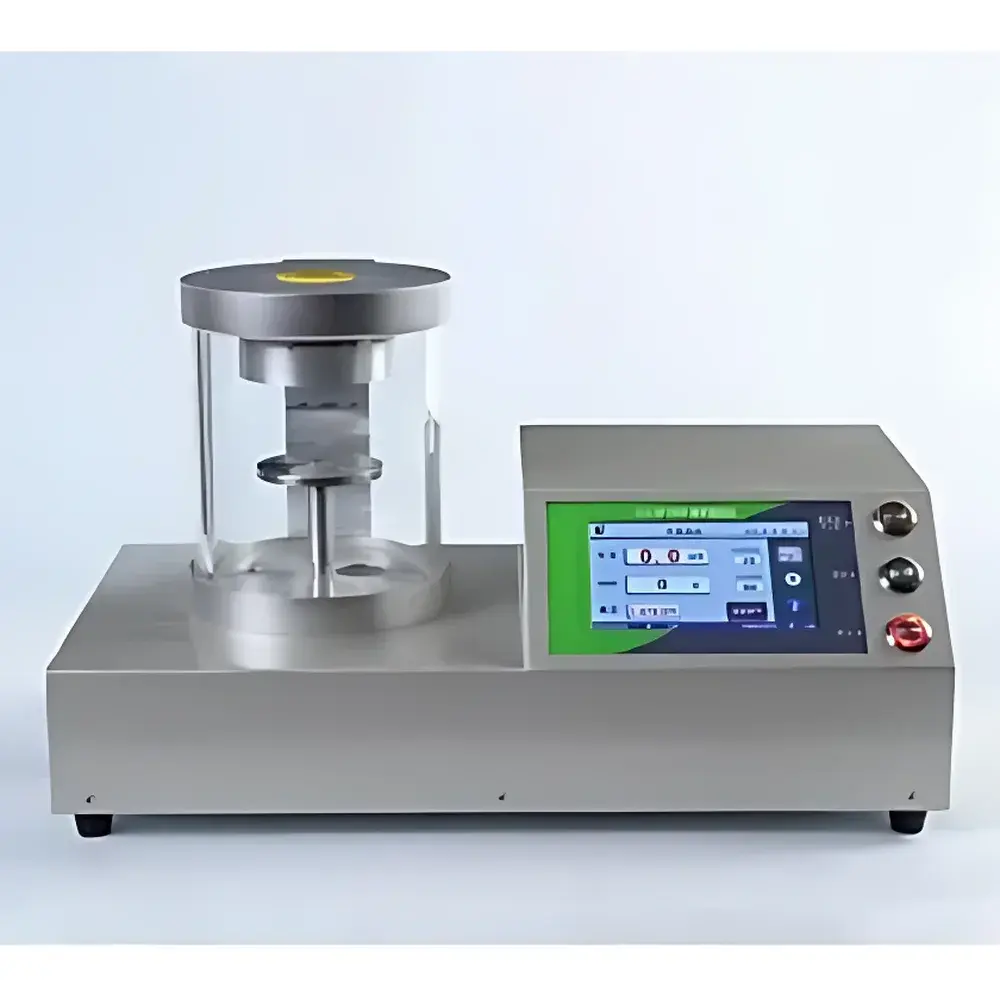
DingHong GU-SP1000 Automated Ion Sputter Coater
| Brand | DingHong |
|---|---|
| Origin | Jiangsu, China |
| Manufacturer Type | Authorized Distributor |
| Country of Origin | China |
| Model | GU-SP1000 |
| Target Materials | Au, Pt, Ag, Cu, Al, Pb (standard metallic targets) |
| Sputtering Gas | Air or Argon (Ar) |
| Input Voltage | AC 220 V ±10%, 50 Hz |
| Operating Voltage | DC 2400 V |
| Total Power Consumption (coater + rotary vane pump) | 500 W |
| Vacuum Pump | Two-stage direct-coupled rotary vane pump, 1 L/s |
| Chamber Dimensions | Ø128 × 130 mm |
| Sample Holders | Ø90 × 1, Ø25 × 4, Ø15 × 6 (mm) |
| Overall Dimensions (L×W×H) | 424 × 271 × 255 mm |
| Net Weight (main unit) | 11 kg |
| Operating Environment | 5–40 °C, <60% RH |
| Storage Environment | −10–60 °C, <80% RH |
| Safety Protections | Overcurrent cutoff, vacuum interlock, grounded chassis, automatic sputtering shutdown, controlled venting |
Overview
The DingHong GU-SP1000 Automated Ion Sputter Coater is a benchtop vacuum deposition system engineered for reproducible, high-fidelity conductive coating of non-conductive specimens prior to scanning electron microscopy (SEM) analysis. It operates on the principle of DC magnetron sputtering: argon (or ambient air, where applicable) is ionized under low-pressure conditions (~1–10 Pa), and accelerated cations bombard a metallic target (e.g., Au, Pt, or Al), ejecting atoms that condense uniformly onto the sample surface. This process yields ultra-thin, continuous, and low-resistivity films—typically 2–15 nm thick—with minimal thermal load and negligible topographic distortion. Designed for routine laboratory use in materials science, geology, biology, and failure analysis labs, the GU-SP1000 integrates hardware-level safety architecture with intuitive automation to reduce operator dependency while maintaining compliance with fundamental vacuum equipment safety standards (IEC 61000-6-2/6-4, GB/T 18268.1–2010).
Key Features
- Integrated dual-protection system: real-time overcurrent detection combined with vacuum interlock ensures automatic sputtering termination if chamber pressure exceeds safe thresholds or electrical load deviates from nominal range.
- Grounded stainless-steel chassis and shielded high-voltage circuitry (DC 2400 V) meet industrial grounding requirements for electrostatic discharge (ESD)-sensitive environments.
- 5-inch capacitive-touch-free LCD interface with physical membrane keys—designed for glove-compatible operation and long-term reliability in shared lab settings.
- Auto-optimized vacuum control: no manual needle-valve adjustment required; the system dynamically regulates pumping speed and gas inflow to stabilize pressure within the optimal sputtering window (typically 3–8 Pa).
- Real-time graphical display: simultaneous time-resolved curves for chamber pressure (Pa) and sputtering current (mA) enable immediate process diagnostics and endpoint estimation.
- Motorized sample stage with height adjustment (±15 mm travel) ensures consistent target-to-substrate distance across diverse specimen geometries—including irregular or multi-tiered mounts.
- Built-in usage logging: cumulative target sputtering time and total instrument runtime are timestamped and stored locally for preventive maintenance planning and GLP-aligned recordkeeping.
Sample Compatibility & Compliance
The GU-SP1000 accommodates standard SEM stubs and proprietary holders (Ø90 mm single-slot, Ø25 mm quad-mount, Ø15 mm hex-mount), supporting flat, tilted, or recessed samples up to 15 mm in height. Its compact chamber (Ø128 × 130 mm) permits rapid pump-down (<90 s to ≤10 Pa with clean system) and uniform film thickness distribution (±8% RSD across Ø50 mm area, verified by quartz crystal microbalance calibration). The coater complies with essential electromagnetic compatibility (EMC) and electrical safety directives for laboratory instrumentation. While not certified to ISO 13485 or FDA 21 CFR Part 11 out-of-the-box, its audit-ready operational logs, deterministic process sequencing, and hardware-enforced interlocks support integration into GMP/GLP workflows when paired with documented SOPs and periodic performance verification (e.g., using certified reference films per ASTM E1558–22).
Software & Data Management
The GU-SP1000 operates via embedded firmware—no external PC or proprietary software required. All parameters (sputtering time, current setpoint, gas type, auto-vent delay) are configured directly on-device and retained across power cycles. Usage data—including individual session timestamps, total target consumption hours, and fault-event codes—is stored in non-volatile memory and exportable via USB port (FAT32-formatted drive) as CSV files for traceability. No cloud connectivity or remote access is implemented, preserving data sovereignty and aligning with institutional IT security policies common in academic and regulated research facilities.
Applications
- Routine SEM sample preparation for insulating ceramics, polymers, biological tissues, and geological thin sections.
- High-resolution imaging of nanoscale features requiring sub-5 nm Au/Pt coatings to suppress charging without obscuring surface detail.
- EDS-compatible coating protocols: low-voltage sputtering with Pt or Cr minimizes X-ray absorption artifacts during elemental mapping.
- Teaching laboratories: integrated step-by-step operation guide reduces onboarding time for new users and supports standardized training modules.
- Quality control labs performing repeatable coating across batches—enabled by parameter locking and automated repeatability checks.
FAQ
What vacuum level is required for stable sputtering?
Optimal operation occurs between 3–8 Pa (20–60 mTorr); the system automatically maintains this range using feedback-controlled gas inlet and pump modulation.
Can non-metallic targets be used?
No—the GU-SP1000 is configured exclusively for conductive metallic targets (Au, Pt, Ag, Cu, Al, Pb) compatible with DC magnetron sputtering. Dielectric or compound targets require RF sputtering capability, which is not supported.
Is argon gas mandatory?
Argon is strongly recommended for consistent film quality and target longevity; air may be used for rapid preliminary coating but introduces oxidation risk and higher background contamination.
How is film thickness estimated?
Thickness is inferred from empirical sputtering rate curves (nm/min) calibrated per target material and operating current; real-time current monitoring allows comparative consistency but does not provide absolute nanometer-scale metrology without independent TEM/ellipsometry validation.
Does the system support remote monitoring or network integration?
No—it is a standalone instrument with local-only HMI interaction and USB-based data export, intentionally omitting network interfaces to meet cybersecurity requirements in sensitive research infrastructure.



