
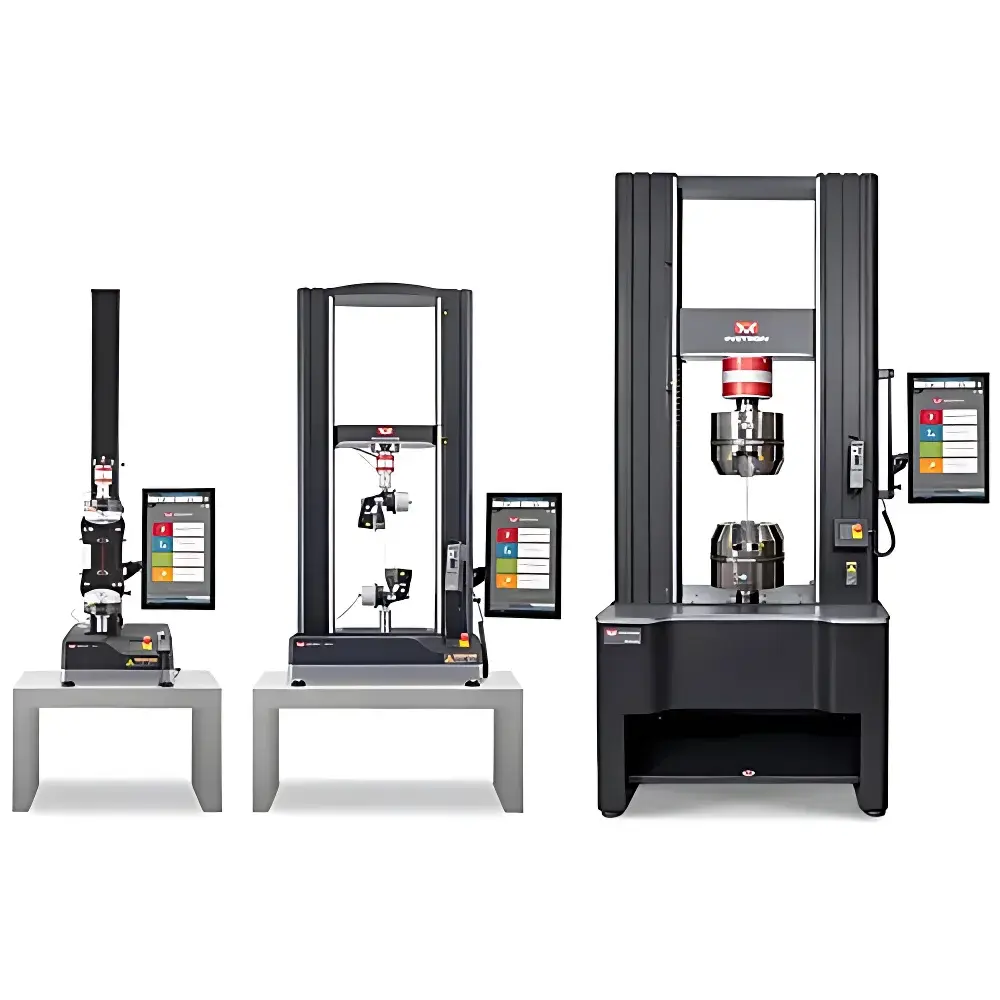
Instron 6800 Series Universal Testing System
| Brand | Instron |
|---|---|
| Origin | USA |
| Model | 6800 Series Universal Testing System |
| Instrument Type | Electromechanical Universal Testing Machine |
| Drive System | Brushless AC Servo Motor with Dual-Belt-Driven Precision Ball Screw |
| Load Frame Stiffness | High-Rigidity Cast Steel Frame with Preloaded Bearings |
| Position Resolution | 4 µm via Tactile Feedback Fine-Adjustment Knob |
| Safety Features | Virtual Interlock Architecture, Specimen Protection Mode, Safe Setup Speed Profile |
| Compliance | Designed to meet ASTM E4, ASTM E8/E8M, ISO 7500-1, ISO 5893, and supports GLP/GMP audit trails per FDA 21 CFR Part 11 when used with Bluehill Universal software |
Overview
The Instron 6800 Series Universal Testing System is an electromechanical materials testing platform engineered for precision, repeatability, and long-term reliability in demanding R&D, quality control, and certification laboratories. Based on a closed-loop servo-controlled architecture, the system applies controlled axial force and displacement to specimens using a high-stiffness load frame, preloaded angular contact bearings, and a dual-belt-synchronized ball screw drive—eliminating backlash and crosshead tilt commonly associated with gear-reduced systems. Its measurement principle relies on real-time feedback from a calibrated load cell (available in ranges from 5 N to 50 kN) and an optical encoder-based displacement transducer, enabling accurate determination of mechanical properties including tensile strength, yield point, modulus of elasticity, elongation at break, compressive yield stress, flexural modulus, and peel adhesion. The system is fundamentally designed for single-axis quasi-static testing under ISO 7500-1 Class 1 or ASTM E4 Class A compliance, with traceable calibration paths aligned to national metrology institutes.
Key Features
- Ergonomic Handheld Controller: Mountable directly on the frame or detachable for flexible operation; includes two programmable function keys assignable per test method in Bluehill Universal software.
- Virtual Interlock Architecture: Patented motion-limiting firmware that restricts crosshead movement outside defined safe zones—preventing unintended loading during setup or specimen alignment.
- Specimen Protection Mode: Automatically engages micro-adjustments to maintain zero-load contact during specimen mounting, eliminating pre-load artifacts and safeguarding delicate or high-value samples.
- Precision Positioning: Tactile-feedback fine-adjustment knob enables 4 µm incremental crosshead positioning—critical for strain-sensitive tests such as low-strain modulus determination or creep initiation.
- High-Rigidity Mechanical Design: Features thick-section crossheads, reinforced base beam, low-elongation timing belts, and hardened guide columns optimized to minimize bending and misalignment during high-force testing of metals, composites, and reinforced polymers.
- Robust Drive System: Brushless AC servo motor with thermal overload protection delivers sustained performance across extended cyclic, creep, and relaxation tests—rated for continuous operation up to 1 Hz at 25°C without maintenance.
Sample Compatibility & Compliance
The 6800 Series accommodates specimens ranging from thin polymer films (<0.1 mm) to structural metal coupons (up to 300 mm gauge length), enabled by Instron’s modular grip and fixture ecosystem—including pneumatic wedge grips, hydraulic tensile grips, bend fixtures, peel testers, and custom-engineered solutions for biomedical devices and automotive components. All configurations support standardized test methods per ASTM D638, D790, D1876, ISO 527, ISO 178, ISO 1133, and USP . When paired with Bluehill Universal software and optional hardware modules (e.g., extensometers, environmental chambers), the system meets data integrity requirements for regulated environments: full electronic signatures, audit trail logging, user access controls, and 21 CFR Part 11 compliance validation packages are available.
Software & Data Management
Controlled exclusively via Bluehill Universal software—a Windows-based platform validated for ISO/IEC 17025 and GxP environments—the 6800 Series supports method-driven workflows, automated pass/fail evaluation against specification limits, and integrated reporting with customizable templates. Raw data is stored in encrypted .udf format with embedded metadata (operator ID, timestamp, calibration status, environmental conditions). Export options include CSV, PDF, XML, and direct integration with LIMS via ODBC or REST API. Optional add-ons include DIC (Digital Image Correlation) synchronization, multi-channel analog input for external sensors (e.g., temperature, humidity), and remote monitoring dashboards for enterprise-wide test fleet management.
Applications
The 6800 Series serves as a primary testing platform across vertically regulated sectors. In biomedical device manufacturing, it validates suture tensile strength per ISO 10993-12 and balloon burst pressure per ASTM F1995. Automotive Tier-1 suppliers use it for seat belt webbing elongation (SAE J209), battery cell compression safety testing (UL 1642), and composite bumper impact simulation. Consumer electronics labs rely on its micro-force capability for flex circuit peel testing (IPC-TM-650 2.4.9) and glass cover lens fracture resistance (ASTM C1424). Raw material producers apply it to ASTM D3039 carbon fiber tensile characterization and ISO 6892-1 metallic sheet tensile mapping—always with documented uncertainty budgets and inter-laboratory reproducibility verification.
FAQ
What load capacities are available for the 6800 Series?
Standard models span 5 N to 50 kN; higher-capacity variants (up to 300 kN) are available as the 6800+ configuration with reinforced frame architecture.
Can the system be upgraded with extensometry after purchase?
Yes—both clip-on and non-contact video extensometers (AVE2) can be retrofitted and fully integrated into existing Bluehill Universal licenses.
Is environmental chamber integration supported?
Fully compatible with Instron’s 3119-600 series chambers (-70°C to +350°C), including seamless thermal compensation and chamber-door interlock protocols.
How does the virtual interlock differ from traditional hardware limit switches?
It operates at the firmware level using real-time position tracking and dynamic zone definition—enabling context-aware restrictions (e.g., limiting speed only during specimen loading phase) without mechanical wear.
What documentation is provided for regulatory audits?
Includes Factory Acceptance Test (FAT) report, Installation Qualification (IQ), Operational Qualification (OQ), Performance Qualification (PQ) templates, and a complete 21 CFR Part 11 readiness package upon request.



