
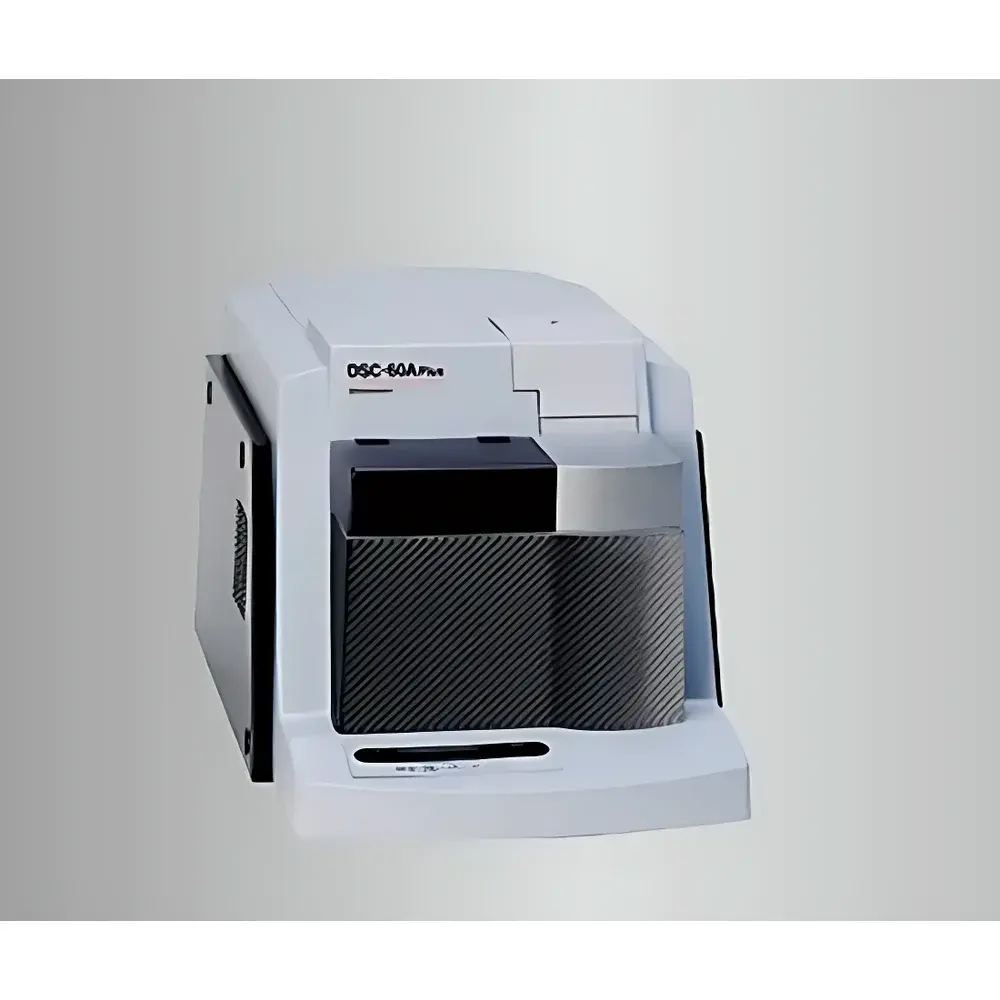
Shimadzu DSC-60 Plus / DSC-60 A Plus Differential Scanning Calorimeter
| Brand | Shimadzu |
|---|---|
| Origin | Japan |
| Model | DSC-60 Plus / DSC-60 A Plus |
| Temperature Range | –140 to 600 °C |
| Temperature Accuracy | ±0.3 °C |
| Heating/Cooling Rate | Up to 9 K/min |
| Integrated Autosampler | Yes (DSC-60 A Plus only) |
| Cooling System | Built-in mechanical cooler |
| Software Platform | TA-50 Series-compatible Windows 32-bit application with OLE-based reporting |
| Data Transfer | Network-enabled (Ethernet) |
| Detector | Enhanced high-sensitivity DSC sensor with improved signal-to-noise ratio |
Overview
The Shimadzu DSC-60 Plus and DSC-60 A Plus are benchtop differential scanning calorimeters engineered for precision thermal characterization of solid and semi-crystalline materials across research, quality control, and production environments. Operating on the heat-flux DSC principle, these instruments measure the difference in heat flow between a sample and an inert reference as both are subjected to a controlled temperature program. This enables quantitative determination of thermal transitions—including glass transition (Tg), melting (Tm), crystallization (Tc), cure exotherms, oxidative induction time (OIT), and specific heat capacity (Cp)—with high reproducibility and baseline stability. Designed for laboratories with spatial constraints, the compact footprint accommodates integration into shared instrumentation suites or regulated QC labs without requiring dedicated HVAC or floor space. The DSC-60 A Plus variant extends functionality with a fully integrated autosampler, eliminating external robotic modules and reducing footprint, calibration overhead, and cross-contamination risk.
Key Features
- Enhanced DSC sensor architecture delivering improved sensitivity and thermal resolution—critical for detecting weak transitions in polymers, pharmaceuticals, and nanocomposites.
- Integrated mechanical cooling system enabling rapid cooling from 600 °C to –140 °C without liquid nitrogen, supporting high-throughput screening and method development under reproducible low-temperature conditions.
- Intuitive detector maintenance design: modular sensor assembly allows tool-free access and cleaning, minimizing downtime and sustaining long-term baseline fidelity.
- Network-capable Ethernet interface for secure, audit-ready data transmission to LIMS or centralized data repositories—compliant with networked lab infrastructure requirements.
- OLE automation support within the TA-50 software environment enables dynamic report generation, macro-driven sequence execution, and seamless integration with third-party analysis tools (e.g., MATLAB, Python via COM interface).
- Full backward compatibility with Shimadzu’s TA-50 Series software suite—including method libraries, calibration protocols, and validation templates—ensuring continuity in GxP-regulated workflows.
Sample Compatibility & Compliance
The DSC-60 Plus/A Plus accepts standard aluminum, gold-plated aluminum, and hermetic pans (50–100 µL volume), supporting solids, powders, films, and viscous pastes. Optional high-pressure cells extend applicability to volatile or reactive samples. Instrument design and software architecture align with foundational regulatory expectations for thermal analysis in regulated industries: temperature calibration traceable to NIST-certified standards; audit trail functionality (user action logging, method versioning, data integrity timestamps); and electronic signature support compatible with FDA 21 CFR Part 11 implementation when deployed with validated TA-50 configurations. While not pre-certified for ISO 11357 or ASTM E794/E1269, the system meets core performance criteria specified in those standards—including temperature accuracy (±0.3 °C), heating rate linearity (≤±2% deviation at 9 K/min), and baseline repeatability (RSD < 1.5% over 10 consecutive empty pan runs).
Software & Data Management
Controlled exclusively via the TA-50 Series software—a Windows 32-bit application built on Microsoft Foundation Classes (MFC) and optimized for deterministic real-time data acquisition—the platform supports multi-user role-based access, method locking, and electronic signature capture. All raw thermograms, metadata, and processing parameters are stored in a proprietary but exportable binary format (.dsc), with ASCII export options (CSV, TXT) for secondary analysis. Dynamic reporting leverages OLE automation to embed processed results directly into Word or Excel documents, preserving traceability while accelerating technical documentation. Data archiving complies with GLP/GMP archival retention policies, including automatic timestamping, user ID association, and immutable record generation upon finalization.
Applications
- Pharmaceutical solid-state characterization: polymorph screening, amorphous content quantification, excipient compatibility studies, and stability-indicating assay development.
- Polymer R&D and QC: melt flow index correlation, degree of crystallinity calculation, degradation onset assessment, and crosslink density estimation in thermosets.
- Food science: fat crystallization profiling, starch gelatinization kinetics, and shelf-life prediction via oxidative stability testing (OIT).
- Electronics materials: thermal reliability evaluation of solder pastes, underfill resins, and encapsulants under thermal cycling profiles.
- Academic and contract research: teaching thermodynamics principles, validating computational models (e.g., Gordon–Taylor, Flory–Huggins), and generating reference datasets for interlaboratory comparison studies.
FAQ
Does the DSC-60 A Plus require liquid nitrogen for subambient operation?
No. It employs a built-in mechanical cooler capable of reaching –140 °C without cryogens, reducing operational cost and safety compliance burden.
Can the DSC-60 Plus be upgraded to include an autosampler?
No. The integrated autosampler is a hardware-differentiated feature exclusive to the DSC-60 A Plus model; it cannot be retrofitted to the DSC-60 Plus.
Is TA-50 software validated for use in FDA-regulated environments?
TA-50 is designed to support validation activities per 21 CFR Part 11; however, site-specific IQ/OQ/PQ execution and documented risk assessment remain the responsibility of the end user.
What is the maximum sample mass recommended for optimal resolution?
For most organic and polymeric materials, 3–10 mg is optimal; larger masses may compromise transition sharpness due to thermal lag and internal temperature gradients.
How frequently should the DSC sensor be recalibrated?
Shimadzu recommends annual temperature and enthalpy calibration using certified indium and zinc standards—more frequent verification is advised after instrument relocation or major maintenance events.



