
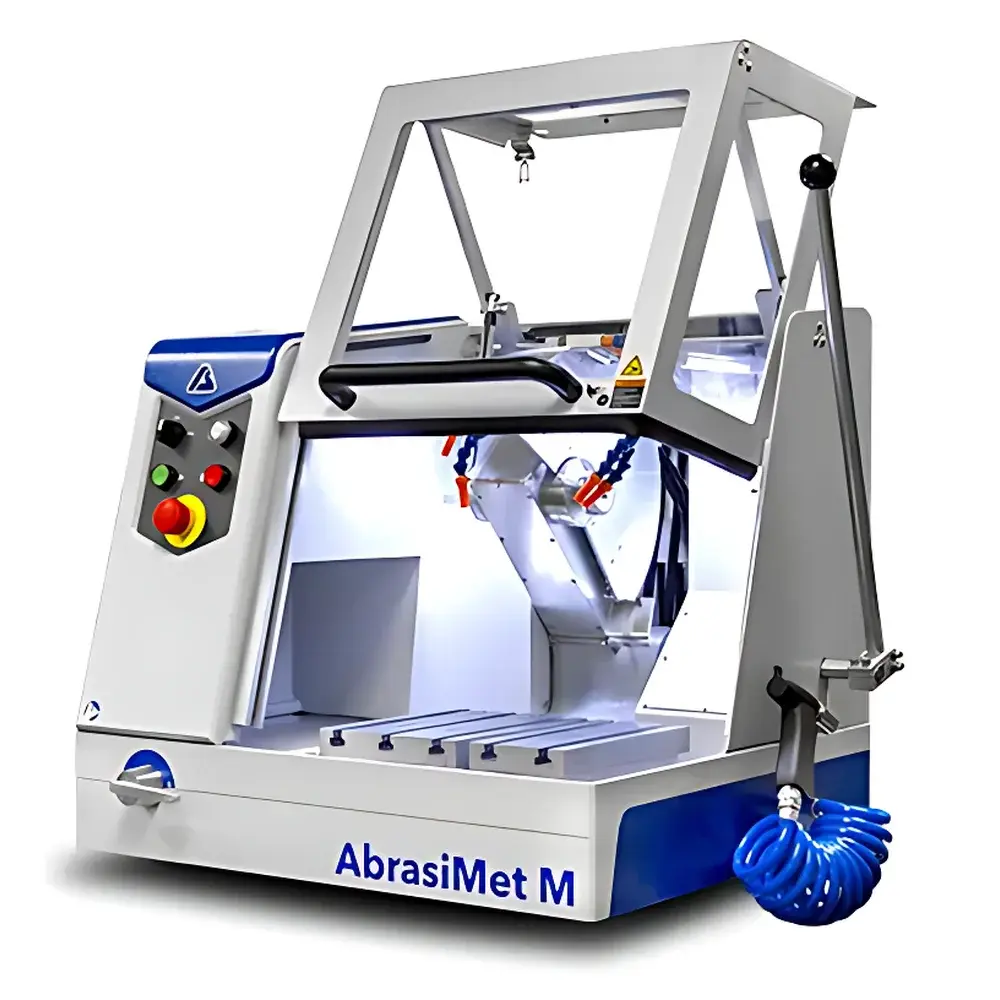
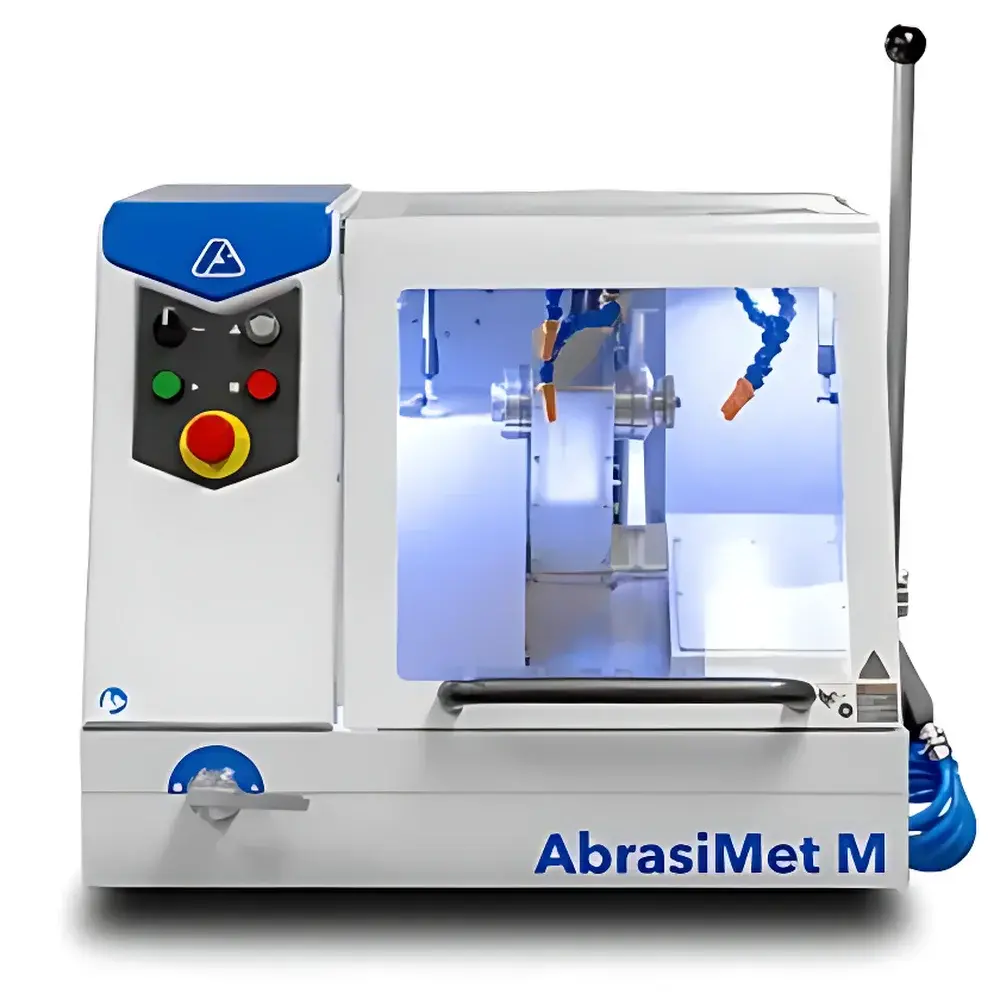
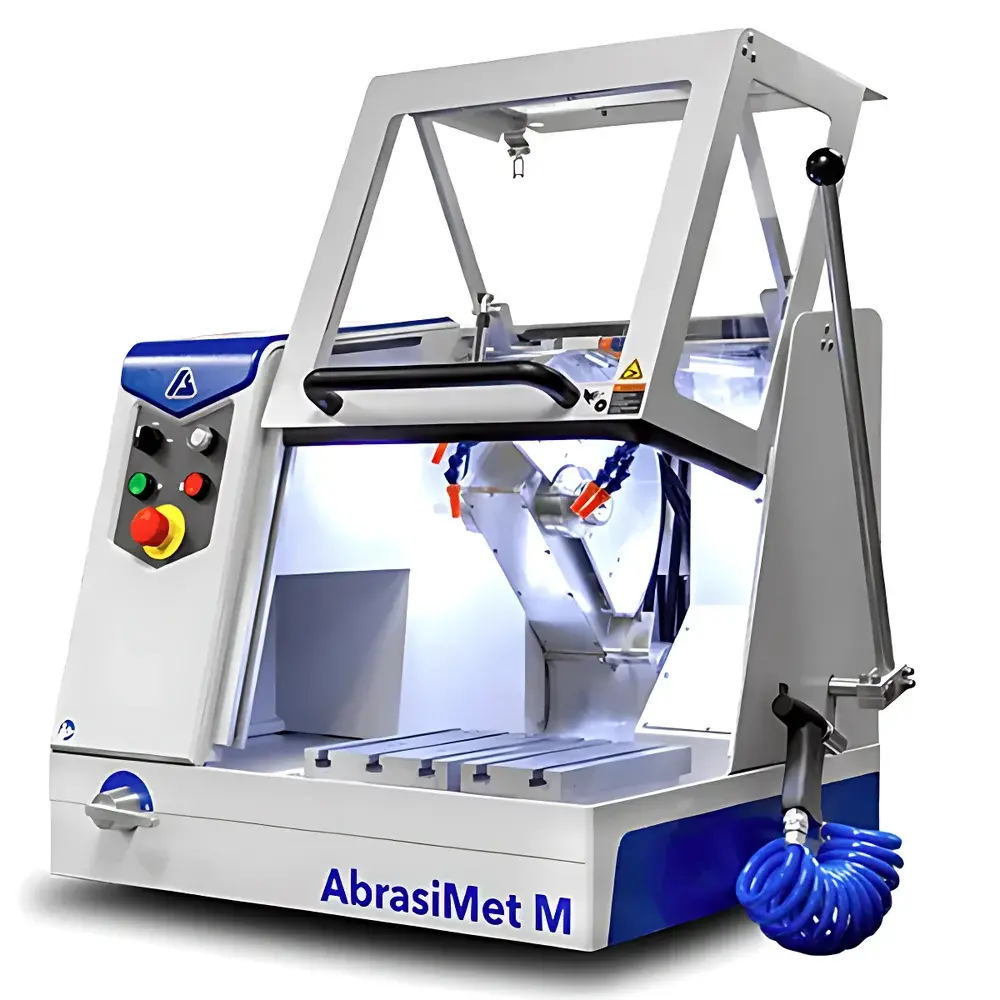
Buehler AbrasiMet M Manual Precision Cut-Off Machine
| Brand | Buehler |
|---|---|
| Origin | USA |
| Model | AbrasiMet M |
| Instrument Type | Abrasive Cut-Off Machine |
| Motor Power | 4 kW (5.5 hp) |
| Voltage/Frequency | 200–240 VAC or 380–460 VAC, 3-phase, 50/60 Hz |
| Cutting Wheel Diameter | 254 mm (10 in) |
| Max Sample Length | 635 mm (25 in) |
| Max Cutting Depth | 109 mm (4.3 in) |
| Wheel Speed | 3000 rpm (254 mm) / 2600 rpm (305 mm) |
| Z-Axis Travel | Adjustable |
| LED Illumination | Dual Strip |
| Safety Compliance | CE Directive |
| Dimensions (H×W×D, closed hood) | 653 × 791 × 694 mm |
| Weight | Not specified |
| Dual-Blade Cutting Width Range | 1.52–25.4 mm (0.06–1.0 in) in 0.06 in increments |
| T-Slot Table Size (L/R) | 250 × 180 mm / 250 × 115 mm |
| Wheel-to-Table Distance | 172 mm (6.8 in) / 147 mm (5.8 in) |
| Filtration System | Fixed Mesh Screen + Dual-Pump Coolant Recirculation |
| Blade Change | Tool-Free Self-Locking Nut |
Overview
The Buehler AbrasiMet M is a manually operated, benchtop abrasive cut-off machine engineered for precision, repeatability, and operational safety in metallurgical, materials science, and failure analysis laboratories. It employs high-speed rotating abrasive wheels—compatible with standard 254 mm (10 in) and 305 mm (12 in) diameters—to perform controlled sectioning of metallic, ceramic, composite, and hardened polymer specimens. Its core design principle centers on mechanical stability, ergonomic manual control, and consistent thermal management during cutting: the dual-pump coolant circulation system, fixed stainless-steel mesh filter, and optimized flow path minimize slurry accumulation and extend coolant service life—critical for maintaining dimensional accuracy and surface integrity in preparation for subsequent metallographic mounting, grinding, or microstructural evaluation. The machine operates under rigid mechanical constraints along the Z-axis only, eliminating lateral drift and ensuring vertical cut alignment within ±0.1° tolerance across repeated cycles.
Key Features
- Tool-free blade replacement via self-locking nut mechanism—no wrenches or torque tools required; reduces downtime and eliminates risk of overtightening.
- Ergonomically balanced cutting arm with adjustable length and pivot angle to accommodate operator height and preferred hand position, minimizing fatigue during extended use.
- Sliding safety interlocked hood provides unobstructed access to the cutting chamber while maintaining full CE-compliant enclosure integrity during operation.
- Dual high-intensity LED strip lighting ensures uniform illumination of the cutting zone, enhancing visibility of specimen edges and kerf geometry without shadow interference.
- Robust cast-iron base and reinforced column structure dampen vibration, preserving wheel concentricity and cut edge squareness—even when sectioning high-hardness alloys (e.g., tool steels, Inconel, tungsten carbide).
- Integrated emergency stop button and mechanical safety lock prevent unintended activation during maintenance or blade changes.
Sample Compatibility & Compliance
The AbrasiMet M accommodates specimens up to 635 mm in length and 109 mm in maximum cross-sectional depth, supporting both single- and dual-blade configurations. Its T-slot table (250 × 180 mm left section; 250 × 115 mm right section) accepts standard mechanical clamps, vise adapters, and custom fixtures for irregular geometries—including threaded rods, turbine blades, weld coupons, and additively manufactured parts. All electrical and mechanical subsystems comply with the EU Machinery Directive 2006/42/EC and Low Voltage Directive 2014/35/EU. The CE marking confirms conformity with essential health and safety requirements, including noise emission limits (<78 dB(A)), electromagnetic compatibility (EMC), and protection against mechanical hazards per EN ISO 12100. No additional certification is required for routine use in ISO/IEC 17025-accredited labs performing ASTM E3, ISO 14487, or EN 10365 sample preparation.
Software & Data Management
As a fully manual instrument, the AbrasiMet M does not incorporate embedded software, programmable logic controllers (PLCs), or digital interfaces. All operational parameters—including feed rate, dwell time, and cut depth—are governed by direct mechanical actuation and operator judgment. This architecture eliminates firmware dependencies, cybersecurity vulnerabilities, and validation overhead associated with electronic controls. Consequently, the system requires no FDA 21 CFR Part 11 compliance documentation, audit trails, or electronic record retention—making it suitable for GLP- and GMP-aligned environments where procedural traceability is maintained via written SOPs and paper-based logbooks. Calibration verification is performed mechanically using certified depth gauges and angular alignment fixtures at scheduled intervals per internal quality protocols.
Applications
The AbrasiMet M serves as a primary sectioning tool in applications demanding geometric fidelity and minimal heat-affected zones: cross-sectioning of welded joints per AWS D1.1 or ISO 5817; preparation of tensile test coupons from rolled sheet or extruded profiles; isolation of representative volumes from castings or forgings for hardness mapping; trimming of sintered powder metallurgy compacts prior to density measurement; and serial sectioning of geological core samples for petrographic analysis. Its dual-blade option enables simultaneous parallel cuts—reducing total cycle time by up to 50% when producing multiple identically spaced sections for layer-by-layer microstructural comparison or tomographic reconstruction workflows.
FAQ
What types of abrasive wheels are compatible with the AbrasiMet M?
Standard resin-bonded silicon carbide or aluminum oxide wheels with ISO arbor dimensions (32 mm bore, 10 mm thickness) and rated for ≥3000 rpm at 254 mm diameter are approved. Diamond-impregnated wheels may be used for ceramics and CMCs, provided they meet speed rating and flange compatibility specifications.
Is coolant filtration mandatory for daily operation?
Yes—the fixed-mesh screen and dual-pump recirculation system are integral to thermal stability and wheel life. Skipping filtration accelerates abrasive loading, increases kerf width variability, and risks thermal cracking in sensitive alloys.
Can the AbrasiMet M be integrated into an automated sample prep line?
No—it lacks digital I/O ports, Ethernet connectivity, or PLC-compatible signaling. It is designed exclusively for standalone manual operation.
Does Buehler provide installation qualification (IQ) or operational qualification (OQ) documentation?
Standard IQ/OQ templates are available upon request for laboratory validation teams, though no factory-installed software or sensors necessitate formal performance qualification beyond mechanical verification per ASTM E832.
What is the recommended maintenance interval for the coolant system?
The coolant reservoir should be drained, cleaned, and refilled every 200 operating hours or quarterly—whichever occurs first—with ISO VG 32 hydraulic oil or equivalent water-soluble coolant meeting ASTM D4627 specifications.



