
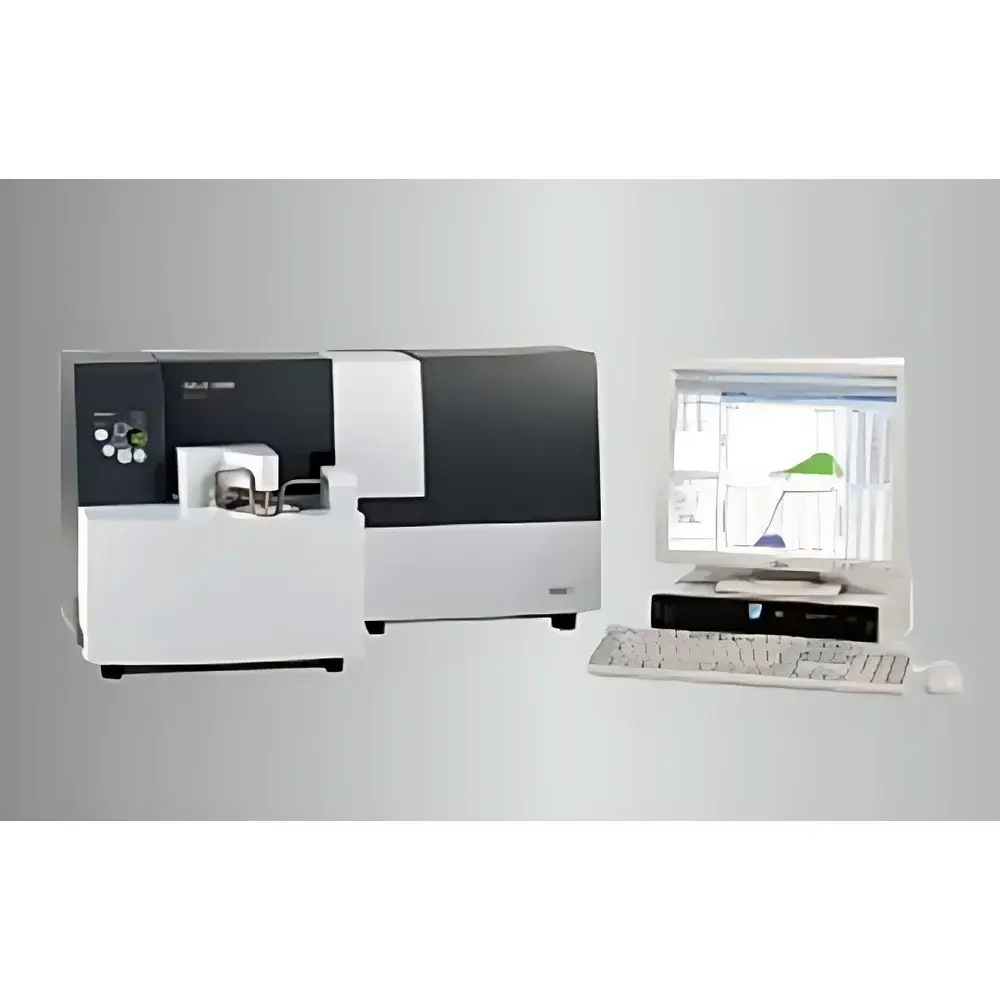
Shimadzu SALD-2300 Laser Diffraction Particle Size Analyzer
| Brand | Shimadzu |
|---|---|
| Origin | Japan |
| Model | SALD-2300 |
| Measurement Principle | Laser Diffraction (ISO 13320 / JIS Z 8825-1) |
| Size Range | 0.017–2500 µm |
| Detection Wavelength | 680 nm (Red Semiconductor Laser) |
| Minimum Sampling Interval | 1 s |
| Optical Detector Array | 84-element (79 forward + 1 side + 4 backward) |
| Sample Handling | Wet & Dry Dispersion |
| Refractive Index Selection | AI-driven LDR-based Auto-selection (Kinosita Method) |
| Software | Wing SALD II v3.x |
| Compliance | ISO 13320, JIS Z 8825-1, FDA 21 CFR Part 11 (audit trail enabled), GLP/GMP-ready operation log |
Overview
The Shimadzu SALD-2300 is a high-performance laser diffraction particle size analyzer engineered for continuous, single-principle measurement across an exceptionally wide dynamic range—from 17 nanometers to 2500 micrometers. Unlike multi-source or segmented-range instruments, the SALD-2300 employs a unified optical architecture: one high-stability red semiconductor laser (680 nm), one optimized light path, and a single monolithic detector array comprising 84 photodiodes (79 forward-scatter, 1 side-scatter, and 4 back-scatter elements). This design ensures full compliance with ISO 13320 and JIS Z 8825-1 standards for laser diffraction particle sizing, eliminating data discontinuities associated with hybrid or stitched measurement approaches. The instrument’s core physics relies on Mie theory-based inversion of angular light intensity distribution, enabling quantitative analysis of particle size distribution (PSD) in both wet and dry dispersions. Its 1-second minimum acquisition interval supports real-time kinetic monitoring—critical for assessing dispersion stability, aggregation onset, or colloidal response during formulation development or process qualification.
Key Features
- Single-source, single-optics architecture covering 0.017–2500 µm without range switching or data stitching
- High-intensity 680 nm semiconductor laser with 10,000-hour operational lifetime
- 84-element multi-angle photodetector array optimized for resolution across the full size range, including enhanced sensitivity for sub-100 nm particles
- OSAF (Omnidirectional Shock Absorption Frame) mechanical isolation system ensuring long-term optical alignment stability under laboratory vibration
- AI-powered auto-ranging algorithm that dynamically selects optimal computational parameters based on raw scattering intensity profiles
- World-first LDR-based (Light Distribution Recalculation) automatic refractive index selection—patented “Kinosita Method”—providing five statistically ranked refractive index candidates with confidence metrics
- Integrated safety interlock: laser automatically deactivates upon chamber door opening (IEC 60825-1 Class 1 compliant)
Sample Compatibility & Compliance
The SALD-2300 supports both wet and dry dispersion modes with dedicated accessories. The standard SALD-MS23 multifunctional wet disperser integrates a SUS/fluoropolymer fluidic path resistant to aggressive organic solvents (e.g., THF, DMF, chloroform), a programmable ultrasonic probe (20–40 kHz), peristaltic water supply pump, and CPU-controlled automation for fill/drain/stir/cycle/clean sequences. A low-volume sample cell (12 mL capacity) with vertical oscillating stirrer minimizes sedimentation bias for low-concentration or high-density suspensions. Dry dispersion utilizes a controlled air-jet module compatible with heat-sensitive or solvent-incompatible materials. All hardware and firmware comply with ISO 13320:2020 for laser diffraction methodology, and the Wing SALD II software includes full 21 CFR Part 11 audit trail, electronic signature support, and GLP/GMP-aligned operation logging—including timestamps for blank measurements, laser alignment checks, and cell contamination status.
Software & Data Management
Wing SALD II v3.x is a modular, Windows-based application designed for analytical traceability and method robustness. It provides real-time overlay of scattering intensity patterns and derived PSDs at ≤1 s update intervals. Key modules include: statistical batch comparison (up to 200 datasets), time-series trend analysis with derivative calculation, 3D contour mapping of evolving distributions, and cross-platform data harmonization tools—such as sieve-to-laser conversion modeling and multi-instrument data fusion. The software implements proprietary algorithms for scattering angle evaluation, mixture simulation (arbitrary component ratios), and seamless merging of SALD data with external modalities (e.g., sieve analysis >2 mm). All raw and processed data are stored in vendor-neutral formats (.csv, .txt) alongside metadata-rich operation logs, ensuring full reproducibility and regulatory readiness.
Applications
The SALD-2300 serves critical quality control and R&D functions across regulated and industrial sectors. In pharmaceutical development, it characterizes active pharmaceutical ingredient (API) crystallinity, excipient blending homogeneity, and nanoparticle drug carrier stability under shear or pH stress. In battery materials science, it quantifies cathode/anode precursor particle agglomeration and slurry dispersion integrity prior to coating. Cosmetics and food manufacturers rely on its ability to resolve fine emulsion droplets (100 µm) within a single run—supporting texture, opacity, and shelf-life prediction. Environmental labs apply its extended lower detection limit to analyze engineered nanomaterials in aqueous effluents, while cement and mineral processing facilities use its upper-range fidelity for clinker and fly ash grading. Its real-time kinetics capability is routinely deployed in immunology research for antigen–antibody complex formation assays and in polymer synthesis for monitoring nucleation/growth dynamics.
FAQ
Does the SALD-2300 require multiple lasers or optical modules to cover its full size range?
No. It uses a single 680 nm semiconductor laser and a unified optical train—eliminating calibration drift between ranges and ensuring ISO-compliant continuity from 17 nm to 2500 µm.
How does the automatic refractive index selection work?
It applies the Kinosita Method (LDR principle): the software iteratively recalculates theoretical scattering patterns across candidate refractive indices and selects those yielding minimal residual error against measured intensity distributions—ranked by statistical confidence.
Can the instrument validate dispersion stability during measurement?
Yes. With 1-second sequential acquisitions, users can generate time-resolved PSDs to detect onset of aggregation, flocculation, or Ostwald ripening—and quantify rate constants via derivative analysis.
Is the system compatible with Good Manufacturing Practice (GMP) environments?
Yes. Wing SALD II includes 21 CFR Part 11-compliant audit trails, role-based access control, electronic signatures, and immutable operation logs tied to every dataset.
What maintenance is required for long-term optical stability?
The OSAF frame and thermally stabilized laser minimize routine alignment needs. Automated self-diagnostic routines verify detector linearity, laser output, and fluidic integrity—generating service alerts only when parametric thresholds are exceeded.



