
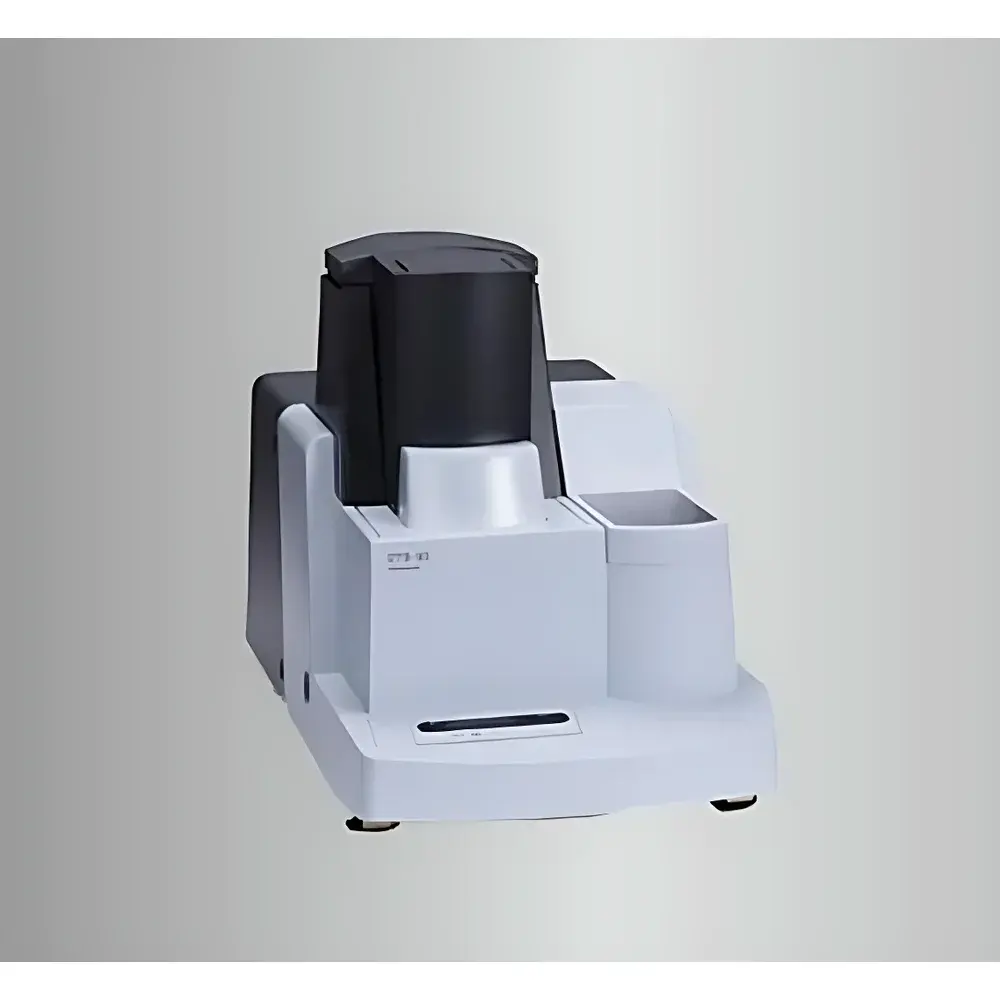
Shimadzu DTG-60A Simultaneous Differential Thermal and Thermogravimetric Analyzer
| Brand | Shimadzu |
|---|---|
| Origin | Japan |
| Model | DTG-60A |
| Automation | Integrated 24-position autosampler |
| Atmosphere Control | Automated gas switching (inert/oxidizing) |
| Software | TA-60WS thermal analysis suite |
| Compliance | Designed for GLP/GMP environments with audit-trail-capable data handling |
Overview
The Shimadzu DTG-60A is a high-precision simultaneous differential thermal analysis (DTA) and thermogravimetric analysis (TGA) instrument engineered for rigorous laboratory environments requiring reproducible, multi-parameter thermal characterization. It operates on the principle of concurrent measurement of heat flow differences (DTA) and mass change (TGA) as a function of temperature or time under controlled atmospheric conditions. This dual-signal acquisition enables direct correlation between endo-/exothermic events and mass loss/gain phenomena—critical for decomposition kinetics, phase transition identification, compositional quantification (e.g., filler content, moisture, volatiles), and oxidative stability assessment. The system features a vertically aligned dual-furnace design with independent temperature control zones, ensuring minimal thermal lag and high baseline stability across wide temperature ranges (typically ambient to 1100 °C, per Shimadzu standard configuration). Its core architecture supports ISO 11358, ASTM E1131, and USP thermal analysis methodologies.
Key Features
- Integrated 24-position robotic autosampler with rapid sample tray exchange—enabling unattended operation exceeding 24 hours without manual intervention
- Automated atmosphere switching between inert (N₂, Ar) and reactive (air, O₂) gases via solenoid-valve manifold, programmable per step in multi-segment temperature ramps
- Dual-sensor microbalance with high-resolution mass detection (typical readability ≤0.1 µg) and active buoyancy compensation for accurate TGA data under variable gas density conditions
- High-stability DTA sensor utilizing matched thermocouple pairs in symmetrical crucible geometry, minimizing thermal gradient artifacts and enhancing signal-to-noise ratio
- Modular furnace assembly with optimized thermal shielding and PID-controlled heating/cooling profiles, supporting heating rates from 0.1 to 100 °C/min
- Rugged mechanical design compliant with IEC 61000-6-3 EMC standards and equipped with integrated overtemperature and overpressure safety interlocks
Sample Compatibility & Compliance
The DTG-60A accommodates standard platinum, alumina, and graphite crucibles (up to 100 µL volume), supporting solid powders, granules, films, fibers, and small metallic specimens (≤100 mg typical mass range). Sample holders are compatible with Shimadzu’s optional high-pressure cells and humidity-controlled modules for specialized applications. All hardware and firmware conform to ISO/IEC 17025 requirements for testing laboratories. Data acquisition and processing within TA-60WS comply with FDA 21 CFR Part 11 for electronic records and signatures, including user authentication, audit trail logging, and immutable raw-data archiving. System validation documentation supports IQ/OQ/PQ protocols required for pharmaceutical and materials R&D facilities operating under GMP/GLP frameworks.
Software & Data Management
TA-60WS is a Windows-based thermal analysis platform offering synchronized real-time display of DTA and TGA curves, derivative (DTG) calculation, peak deconvolution, and kinetic modeling (e.g., Kissinger, Ozawa-Flynn-Wall methods). It supports automated baseline correction, multi-curve overlay, customizable report templates (PDF/Excel export), and batch processing of autosampler sequences. Raw data files (.tdf) are stored in a structured directory hierarchy with embedded metadata (operator ID, instrument serial, method parameters, calibration timestamps). The software includes role-based access control, electronic signature capability, and integration-ready APIs for LIMS and ELN systems via OPC UA or CSV export.
Applications
- Pharmaceutical: Polymorph screening, hydrate/solvate stability, excipient compatibility, and residual solvent quantification per ICH Q1E guidelines
- Polymers: Degradation onset temperature (Td), char yield, flame retardant efficacy, and curing behavior analysis
- Ceramics & Composites: Sintering profile optimization, binder burnout kinetics, and inorganic filler quantification
- Batteries: Cathode/anode material thermal runaway evaluation, SEI layer formation studies, and electrolyte decomposition thresholds
- Geochemistry & Catalysts: Mineral dehydration, carbonate decomposition, and supported metal catalyst oxidation/reduction cycles
FAQ
What temperature range does the DTG-60A support?
Standard operation spans ambient to 1100 °C; extended configurations (with optional furnace upgrades) reach up to 1500 °C.
Can the system perform isothermal holds during analysis?
Yes—TA-60WS allows precise definition of isothermal segments at any temperature point, with dwell times programmable from seconds to days.
Is calibration traceable to national standards?
All temperature and mass calibrations are performed using NIST-traceable reference materials (e.g., Ni Curie point, Al₂O₃, CaC₂O₄·H₂O) and documented per ISO/IEC 17025.
How is data integrity ensured during long-duration autosampler runs?
Each sample run generates a timestamped, digitally signed data package with checksum verification; interruptions trigger automatic resume-from-interrupt functionality.
Does the system support purge gas flow rate monitoring?
Yes—integrated mass flow controllers (MFCs) provide real-time feedback and closed-loop regulation of gas flow rates (typically 10–200 mL/min), logged alongside thermal data.



