
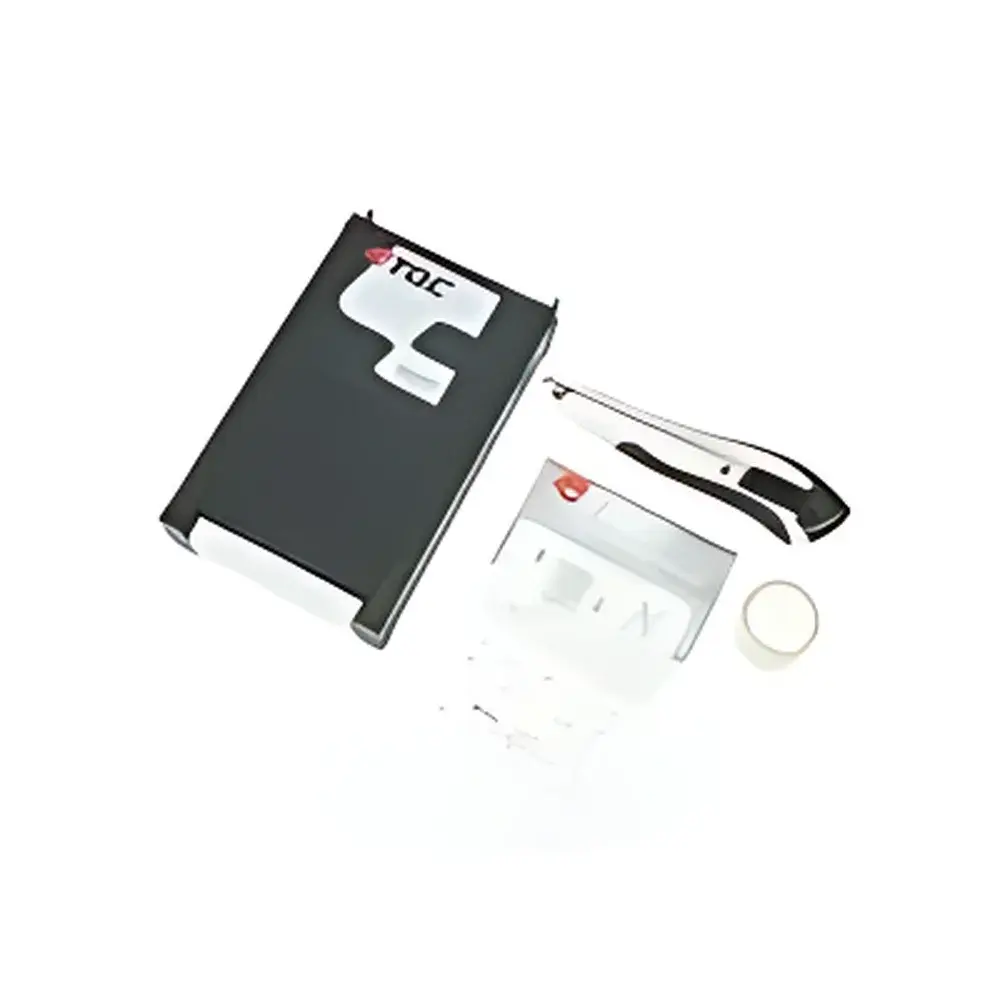
TQC SP3000 Card-Type Cross-Cut Adhesion Tester
| Brand | TQC |
|---|---|
| Origin | Guangdong, China |
| Model | SP3000 |
| Standard Compliance | ISO 2409:2003, ASTM D3359 (Method B) |
| Cut Spacing Options | 1 mm, 1.5 mm, 2 mm, 3 mm |
| Wet Film Thickness Range | 50–160 µm |
| Dry Film Thickness Capability | up to 180 µm |
| Includes | Precision Cutting Blade Assembly & ASTM-D3359-Compliant Pressure-Sensitive Tape |
Overview
The TQC SP3000 Card-Type Cross-Cut Adhesion Tester is a portable, handheld instrument engineered for rapid, standardized assessment of coating adhesion to rigid substrates using the cross-cut method. It operates on the principle of mechanical delamination resistance evaluation: a precisely spaced grid of parallel cuts is made through the coating down to the substrate, followed by application and rapid removal of pressure-sensitive tape under controlled conditions. The degree of coating removal—quantified according to ISO 2409:2003 and ASTM D3359 (Method B)—serves as an objective, comparative metric for interfacial bond strength. Unlike motorized or benchtop adhesion testers, the SP3000’s card-form factor enables on-site use in production lines, field inspections, and quality control labs where space, portability, and procedural consistency are critical. Its design prioritizes repeatability across operators and environments, with fixed blade geometry and calibrated tape application force ensuring minimal operator-induced variability.
Key Features
- Interchangeable cutting combs supporting four standard cut spacings: 1 mm, 1.5 mm, 2 mm, and 3 mm — enabling compliance with both fine- and coarse-grid evaluation requirements per ISO 2409 classification levels 0–5.
- Integrated stainless-steel guide rails and precision-ground tungsten-carbide cutting blades ensure orthogonal, full-depth cuts without substrate deformation or blade deflection.
- Ergonomic, low-profile card chassis (dimensions: 120 × 75 × 8 mm) facilitates one-handed operation and stable positioning on curved or confined surfaces.
- Pre-calibrated tape applicator module ensures consistent 10 N/cm² contact pressure during tape application, meeting ASTM D3359 tape adhesion protocol specifications.
- No external power source required — fully manual operation supports use in cleanrooms, hazardous locations, or remote facilities without electrical infrastructure.
- Tool-free blade replacement system allows rapid exchange of worn or contaminated blades while maintaining alignment integrity.
Sample Compatibility & Compliance
The SP3000 is validated for use on flat or moderately curved rigid substrates including cold-rolled steel, aluminum, glass, and rigid plastics (e.g., ABS, polycarbonate). It accommodates coatings with wet film thicknesses from 50 µm to 160 µm and dry film thicknesses up to 180 µm — covering typical industrial applications such as automotive OEM primers, coil coatings, powder coatings, and marine antifouling systems. The instrument meets all mechanical and procedural requirements defined in ISO 2409:2003 (Paints and varnishes — Cross-cut test) and ASTM D3359 – 22 (Standard Test Methods for Measuring Adhesion by Tape Test), including blade sharpness tolerance, cut depth uniformity, and tape specification (e.g., 3M™ 600 or equivalent). While not certified to GLP or ISO/IEC 17025 as a standalone device, its traceable geometry and documented test procedure support integration into auditable quality management systems compliant with IATF 16949, ISO 9001, and aerospace standards such as AS9100.
Software & Data Management
The TQC SP3000 is a hardware-only instrument with no embedded electronics or digital interface. As such, it does not include proprietary software or data logging capabilities. However, its output — the visual cross-cut rating (0–5 scale) — is directly transcribable into LIMS, QMS, or ELN platforms via standardized reporting templates. Users may document results using TQC’s optional digital workflow add-ons (e.g., TQC Inspector mobile app), which support photo capture of cut grids, geotagged inspection records, and export to CSV or PDF formats compatible with FDA 21 CFR Part 11–enabled systems when paired with appropriate electronic signature controls. All physical test records generated using the SP3000 satisfy ALCOA+ principles (Attributable, Legible, Contemporaneous, Original, Accurate) when maintained per internal SOPs.
Applications
- Automotive: Verification of e-coat, primer-surfacer, and topcoat adhesion on stamped body panels prior to baking or assembly.
- Architectural Coatings: On-site evaluation of stucco, EIFS, and metal cladding systems following curing protocols.
- Packaging: Adhesion validation of UV-curable inks and barrier coatings on aluminum cans and PET containers.
- Aerospace: Pre-flight inspection of corrosion-inhibiting primers on aluminum airframes under MIL-PRF-85582 and BAC 5741 requirements.
- R&D Laboratories: Comparative screening of novel binder formulations, nanocomposite additives, or surface pretreatment efficacy across substrate families.
FAQ
What substrates are suitable for testing with the SP3000?
Rigid, non-flexible substrates with surface hardness ≥ 2H pencil hardness (e.g., steel, aluminum, glass, rigid plastics). Flexible films, elastomers, or wood substrates are not recommended due to deformation under blade load.
Can the SP3000 be used for wet-film adhesion assessment?
No — the SP3000 evaluates dry or cured film adhesion only. Wet film thickness measurement (50–160 µm) is a prerequisite parameter for test selection but not a functional capability of the instrument itself.
Is calibration required before each use?
No formal calibration is mandated; however, daily verification of blade sharpness (using a 10× magnifier) and comb spacing accuracy (with gauge pins) is recommended per ISO 2409 Annex A.
Does the SP3000 comply with FDA or pharmaceutical coating standards?
While not specifically validated for USP or , its adherence to ISO 2409 and ASTM D3359 makes it suitable for adhesion screening of protective coatings on pharmaceutical equipment surfaces under GMP Annex 15 guidelines.
How often should the cutting blade be replaced?
Typical service life is 200–300 cross-cut tests per blade under normal use on steel substrates; replacement frequency increases with abrasive substrates (e.g., sandblasted metal) or high-viscosity coatings.



