
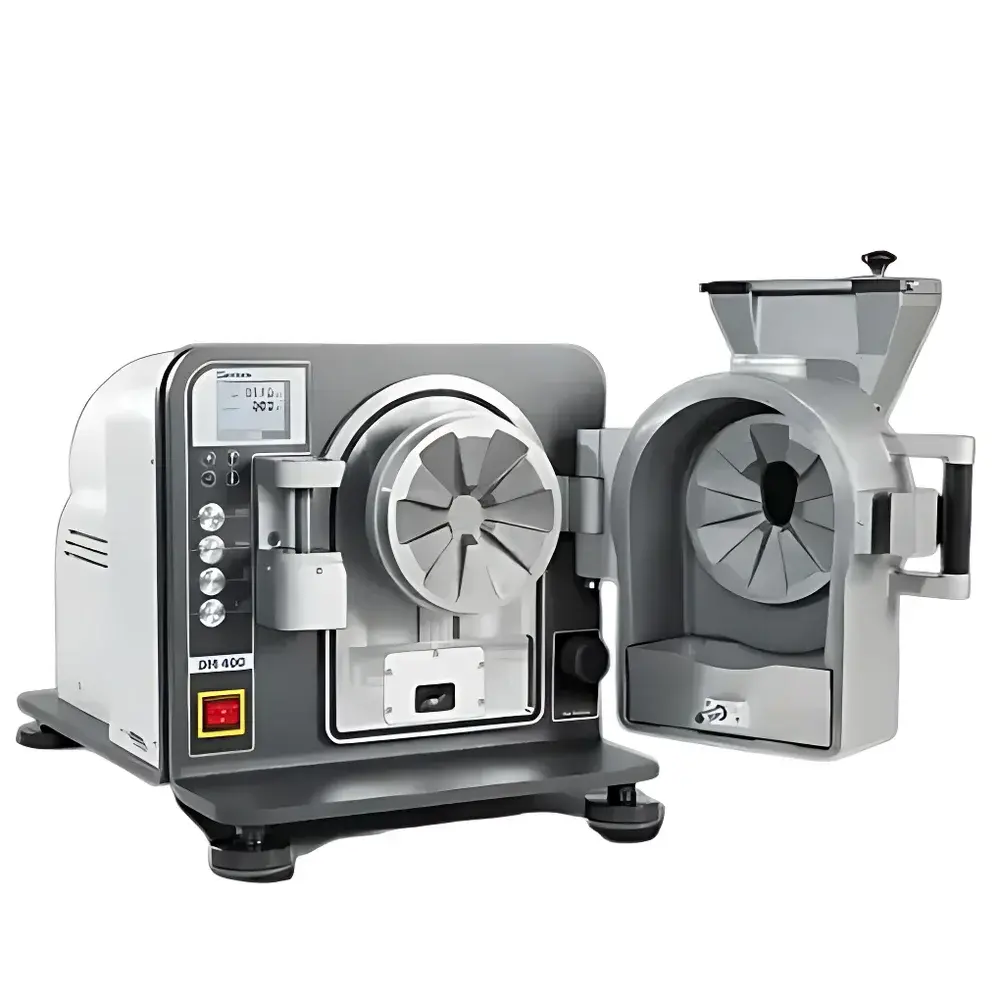
RETSCH DM 400 Disc Mill
| Brand | RETSCH |
|---|---|
| Origin | Germany |
| Model | DM 400 |
| Instrument Type | Disc Mill |
| Sample Hardness | Hard to Very Hard Materials |
| Maximum Feed Size | < 20 mm |
| Final Particle Size | < 50 µm |
| Adjustable Grinding Gap | 0.05 mm (digital display) |
| Display | TFT touchscreen interface |
| Hopper Material | Removable smooth-surface polymer hopper |
| Grinding Chamber | Smooth-walled, easy-clean design with optional polymer coating |
| Sealing | Dual O-ring sealing system |
| Disc Replacement | Tool-free, rapid exchange mechanism |
| Compliance | Designed for ISO 13320-compliant particle size preparation prior to laser diffraction or sieve analysis |
Overview
The RETSCH DM 400 Disc Mill is a high-precision, laboratory-scale disc grinding instrument engineered for reproducible size reduction of hard, brittle, and fibrous solid materials. Operating on the principle of compression and shear between two counter-rotating, parallel grinding discs — one stationary and one rotating at fixed speed — the DM 400 delivers controlled mechanical comminution under defined gap conditions. Unlike impact-based mills, this disc mill minimizes heat generation and particle agglomeration, making it particularly suitable for preparing representative subsamples for subsequent analytical workflows including X-ray fluorescence (XRF), inductively coupled plasma (ICP-OES/MS), loss-on-ignition (LOI), and standardized sieve or laser diffraction particle size distribution (PSD) analysis per ISO 13320 and ASTM E11. Its robust cast-iron housing, precision-ground stainless steel grinding surfaces, and zero-point calibration function ensure long-term dimensional stability and inter-laboratory comparability.
Key Features
- Adjustable grinding gap from 0.05 mm with digital micrometer readout and automatic zero-point calibration — enabling precise control over final particle size distribution.
- TFT touchscreen interface with intuitive menu navigation, real-time status feedback, and programmable grinding parameters (e.g., time, rotation direction, pause intervals).
- Large-diameter, removable polymer hopper with ultra-smooth internal surface — optimized for low-residue feeding of irregular or cohesive samples such as dried sludge, slag, or ceramic shards.
- Smooth-walled grinding chamber with integrated sealing system (dual elastomer O-rings) — prevents cross-contamination and ensures dust-tight operation during grinding of hazardous or hygroscopic materials.
- Tool-free grinding disc exchange mechanism — facilitates rapid maintenance and material-specific disc configuration (e.g., hardened steel, tungsten carbide, or corrosion-resistant variants).
- Optional polymer internal coating (e.g., PTFE or polyurethane) — reduces metal contamination risk for trace-element analysis of geological or environmental samples.
Sample Compatibility & Compliance
The DM 400 is validated for use with hard-to-grind matrices including cement clinker, sintered ceramics, quartzite, granitic rock, bauxite, coal, coke, glass frits, dental enamel, refractory clays, and metallurgical slags. It complies with preparatory requirements outlined in ISO 18333 (geological sample preparation), ASTM D75 (standard practice for sampling aggregates), and USP & EP guidelines for homogenization prior to elemental assay. When operated within specified feed size (<20 mm) and moisture limits (<1% w/w), the mill consistently achieves final particle sizes below 50 µm — meeting the input specification for many XRF fusion bead protocols and ICP digestion procedures. The sealed grinding chamber supports GLP-compliant documentation when paired with RETSCH’s optional data logging software.
Software & Data Management
The DM 400 integrates seamlessly with RETSCH’s RetschControl software suite (Windows-based), enabling remote parameter configuration, method storage, audit-trail generation, and electronic signature support compliant with FDA 21 CFR Part 11. All grinding cycles — including start/stop timestamps, gap settings, runtime, and operator ID — are automatically logged and exportable in CSV or PDF format. Optional Ethernet or USB connectivity allows integration into centralized laboratory information management systems (LIMS) for traceable sample tracking from raw intake to analytical result.
Applications
- Preparation of homogeneous sub-samples from heterogeneous environmental solids (e.g., sewage sludge, contaminated soils, fly ash) prior to heavy metal leaching tests (TCLP, SPLP) or total digestion.
- Size reduction of construction waste (concrete, bricks, tiles) for compositional screening via XRF or LIBS.
- Homogenization of mineralogical reference materials (e.g., NIST SRMs, SARMs) for calibration standard production.
- Routine comminution of metallurgical by-products (slag, furnace residues) for phase identification by XRD and quantitative oxide analysis.
- Processing of pharmaceutical excipients and dental biomaterials (e.g., hydroxyapatite, alumina ceramics) where minimal amorphization and thermal degradation are critical.
FAQ
What types of materials are unsuitable for the DM 400?
Soft, elastic, oily, or highly fibrous materials — such as rubber, polymers, plant tissue, or wet clay — are not recommended due to clogging risk and insufficient compressive fracture behavior.
Can the DM 400 be used for cryogenic grinding?
No — the DM 400 is not designed for liquid nitrogen cooling; its mechanical architecture and sealing system are rated for ambient temperature operation only.
Is the grinding gap adjustment repeatable across instruments?
Yes — each unit undergoes factory calibration against traceable gauge blocks, and the digital micrometer system maintains ±0.01 mm repeatability under routine use.
How often should the grinding discs be replaced?
Disc lifetime depends on sample abrasivity and throughput; typical service life exceeds 500 kg of granite-equivalent material before measurable wear affects PSD reproducibility.
Does the DM 400 meet ATEX or explosion-proof certification requirements?
The standard DM 400 is not ATEX-certified; however, RETSCH offers a dedicated ATEX-compliant variant (DM 400 EX) for use in Zone 21/22 environments handling combustible dusts.



