
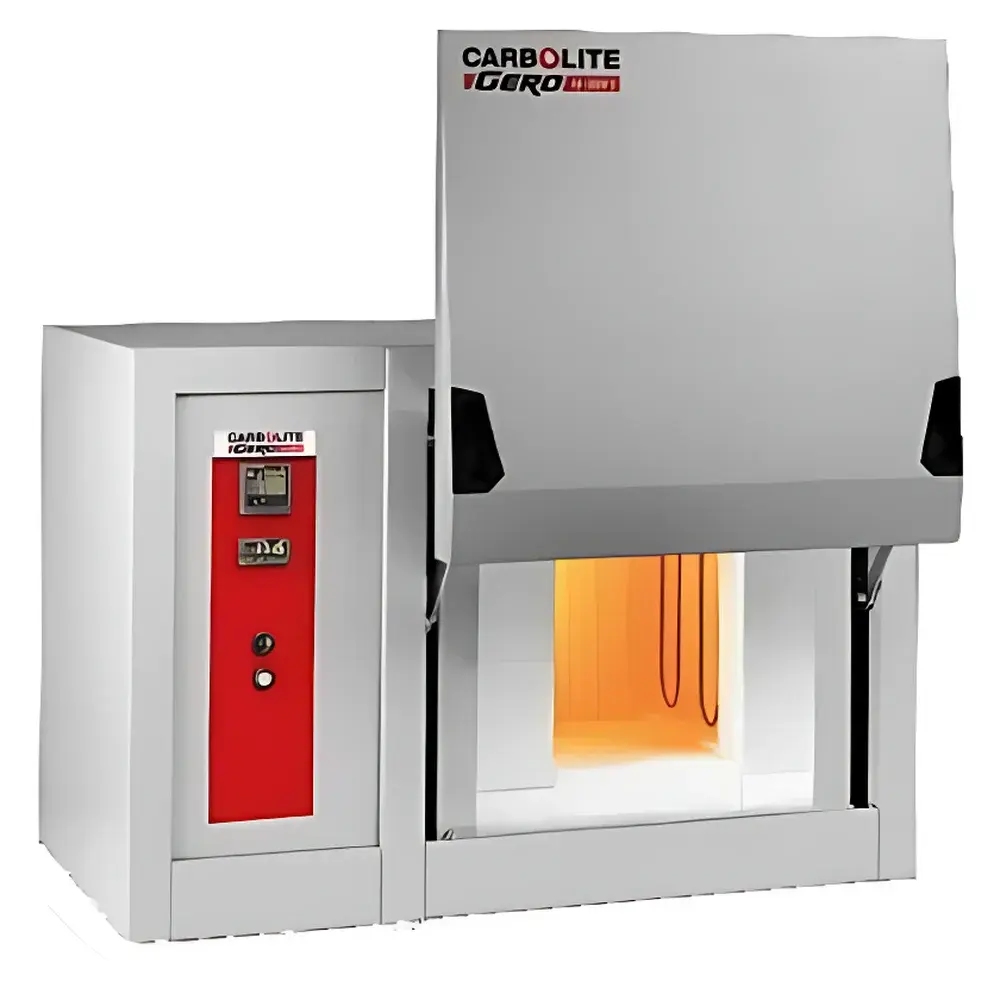
Carbolite Gero HTF High-Temperature Laboratory Box Furnace
| Brand | Carbolite Gero |
|---|---|
| Origin | Germany |
| Model | HTF |
| Heating Element | Silicon Molybdenum (MoSi₂) Rods |
| Max Operating Temperature | 1700 °C / 1800 °C (depending on configuration) |
| Chamber Volume | 4–10 L |
| Door Orientation | Vertical Top-Hinged |
| Insulation | Refractory Brick + Low-Thermal-Conductivity Lightweight Ceramic Fiber |
| Controller | EPC3016P1 Programmable PID Controller with Overtemperature Protection |
| Communication Interface | Ethernet (TCP/IP) |
| Cooling | Integrated External Casing Fan for Surface Temperature Control |
Overview
The Carbolite Gero HTF is a high-precision, vertically opening high-temperature box furnace engineered for demanding laboratory and research applications requiring thermal stability, repeatability, and long-term operational integrity at extreme temperatures. Designed and manufactured in Germany, the HTF series leverages Carbolite Gero’s decades of expertise in industrial and scientific thermal processing equipment. It operates on the principle of resistive heating via silicon molybdenum (MoSi₂) heating elements — known for exceptional oxidation resistance and stable emissivity above 1500 °C — enabling reliable performance up to 1700 °C or 1800 °C depending on model variant and insulation configuration. The vertical top-hinged door architecture minimizes radiant heat exposure to the operator during loading/unloading, while the robust refractory brick-lined chamber ensures mechanical durability and consistent thermal distribution across the working volume (4–10 L). This furnace is not intended for continuous industrial production but for controlled, repeatable thermal treatments in materials science, ceramics R&D, metallurgy, catalyst synthesis, and ashing protocols where traceability, temperature uniformity, and compliance-readiness are critical.
Key Features
- High-temperature capability: Certified operation up to 1700 °C or 1800 °C, validated per IEC 60519-12 and EN 60519 safety standards for high-temperature electrical heating equipment.
- MoSi₂ heating elements: Distributed in optimized geometry for uniform radial and axial temperature profiles; self-healing oxide layer ensures extended service life under cyclic thermal stress.
- Multi-layer insulation system: Combines dense alumina-silica refractory brick (inner lining) with low-conductivity ceramic fiber modules (intermediate and outer layers), minimizing energy consumption and external surface temperature rise.
- EPC3016P1 programmable controller: 16-segment ramp-soak profile capability, real-time logging of setpoint/actual temperature, configurable alarm thresholds, and integrated Class II overtemperature cut-off (independent of main control loop).
- Ethernet (TCP/IP) interface: Enables remote monitoring, parameter adjustment, and data export via standard industrial protocols — compatible with LabVIEW, SCADA systems, and custom Python-based automation frameworks.
- Active casing cooling: Integrated fan-assisted airflow manages external skin temperature to ≤55 °C under full-load conditions, meeting ergonomic safety requirements outlined in ISO 13732-1 for hot surface contact.
Sample Compatibility & Compliance
The HTF accommodates crucibles, boats, and sample holders made from high-purity alumina, zirconia, silicon carbide, or graphite — all compatible with inert, oxidizing, or mildly reducing atmospheres (when used with optional gas inlet kits). Its chamber geometry supports standardized DIN/ISO sample placement for inter-laboratory comparability. The furnace complies with CE marking requirements under the EU Machinery Directive 2006/42/EC and Electromagnetic Compatibility Directive 2014/30/EU. For regulated environments, it supports audit-ready operation when paired with validated software configurations that meet FDA 21 CFR Part 11 requirements for electronic records and signatures (e.g., through third-party validated data acquisition platforms). Routine calibration and verification procedures align with ASTM E220, ISO/IEC 17025, and EURAMET cg-18 guidelines for high-temperature furnaces.
Software & Data Management
While the EPC3016P1 provides local HMI-based control, the embedded Ethernet port enables seamless integration into centralized laboratory informatics infrastructure. Raw thermocouple (Type S or B) readings, program status, and alarm events are accessible via Modbus TCP or HTTP REST API endpoints. Time-stamped temperature logs can be exported in CSV or XML format, supporting traceability in GLP/GMP workflows. Optional Carbolite Gero FurnaceLink™ software (sold separately) adds multi-furnace scheduling, deviation reporting, and electronic signature functionality — fully compliant with ALCOA+ data integrity principles.
Applications
- Sintering and densification of advanced ceramics (e.g., Si₃N₄, AlN, YSZ)
- Heat treatment of refractory metals and superalloys (e.g., Mo, W, Ni-based alloys)
- Ash content determination per ISO 2171 and AOAC 942.05
- Thermal gravimetric analysis (TGA) pre-conditioning and residue stabilization
- Crystal growth annealing and phase transformation studies
- Catalyst calcination and support activation under controlled air or nitrogen flow
FAQ
What thermocouple types are supported for temperature measurement and control?
The HTF is factory-configured for Type S (platinum/rhodium) thermocouples as standard; Type B compatibility is available upon request for ultra-high-temperature applications (>1600 °C).
Is inert atmosphere operation possible?
Yes — optional quartz or stainless-steel gas inlet/outlet ports enable purging with N₂, Ar, or forming gas; full vacuum compatibility requires separate vacuum-rated variants (e.g., HTF-V series).
How is temperature uniformity verified across the working zone?
Carbolite Gero supplies a Certificate of Conformance with each unit, including measured uniformity data (±5 °C at 1600 °C, typical) obtained using a 9-point mapping procedure per ASTM E220 Annex A4.
Can the EPC3016P1 controller be upgraded to support digital signature or audit trail functions?
The base controller does not include electronic signature capability; however, full Part 11 compliance is achievable via external validated software layers interfacing through the Ethernet port.
What maintenance intervals are recommended for MoSi₂ heating elements?
Under normal usage (≤1700 °C, <10 cycles/week), MoSi₂ elements typically exceed 2,000 hours of service life; visual inspection and resistance measurement are advised every 500 operating hours.



