
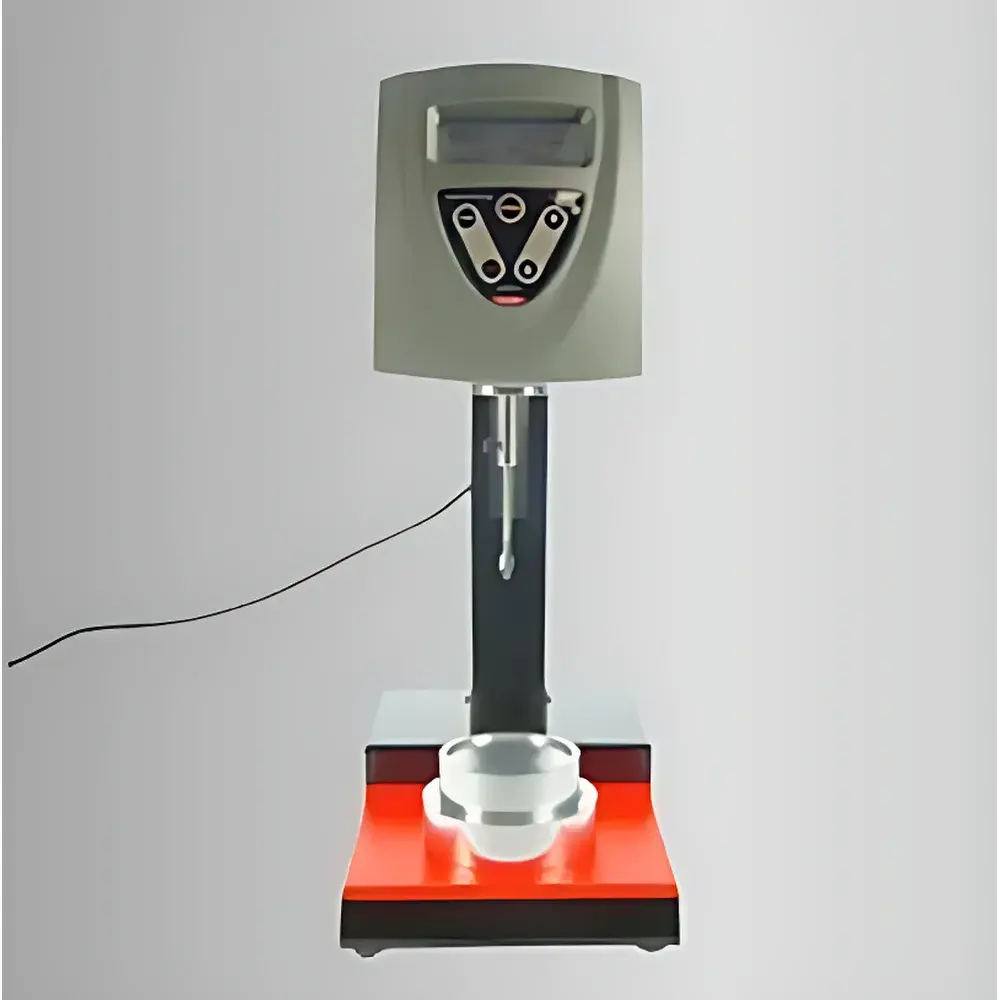
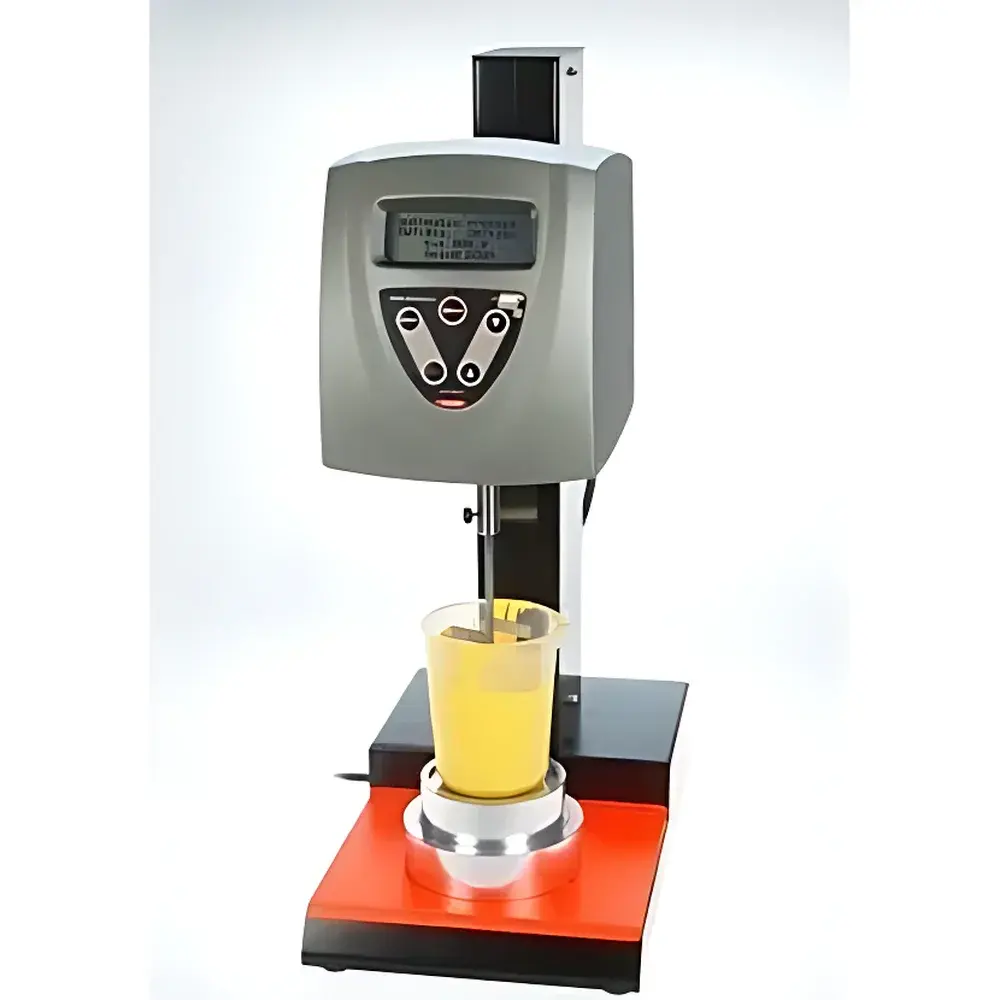
TQC DV1300 Automated Krebs Unit (KU) Viscometer
| Brand | TQC |
|---|---|
| Origin | Netherlands |
| Instrument Type | Rotational Viscometer |
| Viscosity Range | 40.2–141 KU |
| Compliance | ASTM D562, ASTM D1131, ASTM D856 |
| Display | 4-line backlit LCD |
| Interface | RS232 serial port (unidirectional) |
| Operating Modes | Automatic & Manual |
| Sample Holders | 1-pint and ½-pint leveling blocks |
| Included Accessories | Krebs rotor, leveling blocks, calibration tools, sample cup |
Overview
The TQC DV1300 Automated Krebs Unit (KU) Viscometer is a precision-engineered rotational viscometer designed specifically for the standardized measurement of Krebs Units (KU) in low-to-medium viscosity dispersions. Based on the Couette flow principle, it employs a standardized paddle-type rotor (Krebs spindle) rotating at a fixed speed of 200 rpm within a regulated sample volume—typically in a 1-pint or ½-pint container—while measuring the torque required to maintain that rotation. The resulting value is converted directly into Krebs Units per ASTM D562, the internationally recognized standard for paint, coatings, inks, and related industrial formulations. Unlike general-purpose rotational viscometers, the DV1300 implements a dedicated mechanical and control architecture optimized exclusively for KU compliance testing, ensuring traceable, repeatable, and operator-independent results across R&D, QC, and production environments.
Key Features
- Automated test cycle with programmable pre-rotation delay (0–99 s) and measurement duration (0–99 s), minimizing operator variability and improving inter-laboratory reproducibility.
- Dual-mode operation: fully automated sequence execution or manual step-by-step control for method development and troubleshooting.
- Four-line backlit LCD display providing real-time status feedback—including selected rotor, elapsed time, measured KU value, and system diagnostics.
- Integrated 1-pint and ½-pint leveling blocks with precision-machined alignment surfaces to ensure consistent sample geometry and meniscus positioning per ASTM requirements.
- Unidirectional RS232 serial interface compliant with standard industrial protocols, enabling direct connection to thermal printers for audit-ready hardcopy output without intermediate software.
- Rugged yet calibrated mechanical design featuring a brushless DC motor, hardened stainless-steel Krebs rotor, and temperature-stable torque sensing electronics.
- No external PC or proprietary software required—system operates as a standalone instrument meeting GLP-aligned documentation needs through native print functionality.
Sample Compatibility & Compliance
The DV1300 is validated for use with Newtonian and mildly non-Newtonian liquid-phase samples typical of architectural paints, industrial coatings, printing inks, latex dispersions, and certain pharmaceutical suspensions. Its fixed-speed, fixed-geometry methodology ensures strict adherence to ASTM D562 (Standard Test Method for Consistency of Paints Measuring Krebs Units), as well as supporting applications under ASTM D1131 (for putties and mastics) and ASTM D856 (for water-based coatings). While not intended for high-shear rheological profiling or yield stress quantification, its repeatability (±0.5 KU typical under controlled lab conditions) meets routine QC thresholds for batch release and formulation consistency monitoring. All supplied components—including the Krebs rotor, leveling blocks, and sample cups—are dimensionally certified to ASTM-specified tolerances.
Software & Data Management
The DV1300 operates as a self-contained instrumentation platform with embedded firmware; no host computer or license-dependent software is required for basic operation or data output. Measurement records are transmitted via RS232 in ASCII format, compatible with industry-standard thermal printers (e.g., Epson TM-T series) for immediate generation of dated, time-stamped reports. Each printed output includes instrument ID (DV1300), test date/time, selected mode (Auto/Manual), measurement duration, and final KU result—supporting 21 CFR Part 11–aligned record retention where handwritten logs are replaced by instrument-generated documentation. Optional third-party SCADA or LIMS integration is achievable via serial-to-USB or serial-to-Ethernet gateways using Modbus RTU or custom ASCII parsing scripts.
Applications
- Quality control of architectural and industrial coatings during raw material receipt, in-process checks, and final product release.
- Formulation development labs evaluating thickener efficiency, pigment dispersion stability, and rheology modifier performance.
- Ink manufacturing for gravure, flexographic, and screen-printing applications where KU correlates strongly with flow behavior on press.
- Pharmaceutical excipient characterization where suspension viscosity impacts dosing uniformity and syringeability.
- Automotive OEM supplier audits requiring documented compliance with OEM-specific KU specifications (e.g., Ford WSS-M99P20-A, GM 6277M).
- Educational laboratories teaching standardized viscosity metrology principles per ASTM curriculum guidelines.
FAQ
What standards does the DV1300 comply with?
The instrument is engineered and verified for conformance with ASTM D562 (primary), ASTM D1131, and ASTM D856. Calibration verification procedures follow ISO/IEC 17025–recommended practices for torque-based viscometry.
Can the DV1300 measure viscosity in centipoise (cP) or Pa·s?
No. The DV1300 outputs only Krebs Units (KU) as defined by ASTM D562. It does not provide dynamic or kinematic viscosity conversions, nor does it support alternative spindle geometries or variable shear rates.
Is the Krebs rotor included with the base unit?
Yes. The standard configuration includes one certified Krebs paddle rotor, two leveling blocks (1-pint and ½-pint), a sample cup, assembly tools, and an RS232 cable.
How often should the instrument be recalibrated?
Annual calibration against NIST-traceable reference standards is recommended. Field verification using certified KU reference fluids (e.g., TQC Standard KU Oils) should be performed before each testing shift or per internal QA protocol.
Does the DV1300 support GLP or GMP documentation requirements?
Yes—when paired with a time/date-enabled thermal printer, the native RS232 output satisfies core GLP/GMP documentation criteria for instrument identity, test parameters, raw result, and operator-agnostic timestamping. Audit trails require external logbook or LIMS linkage for user authentication.
Related Products



