
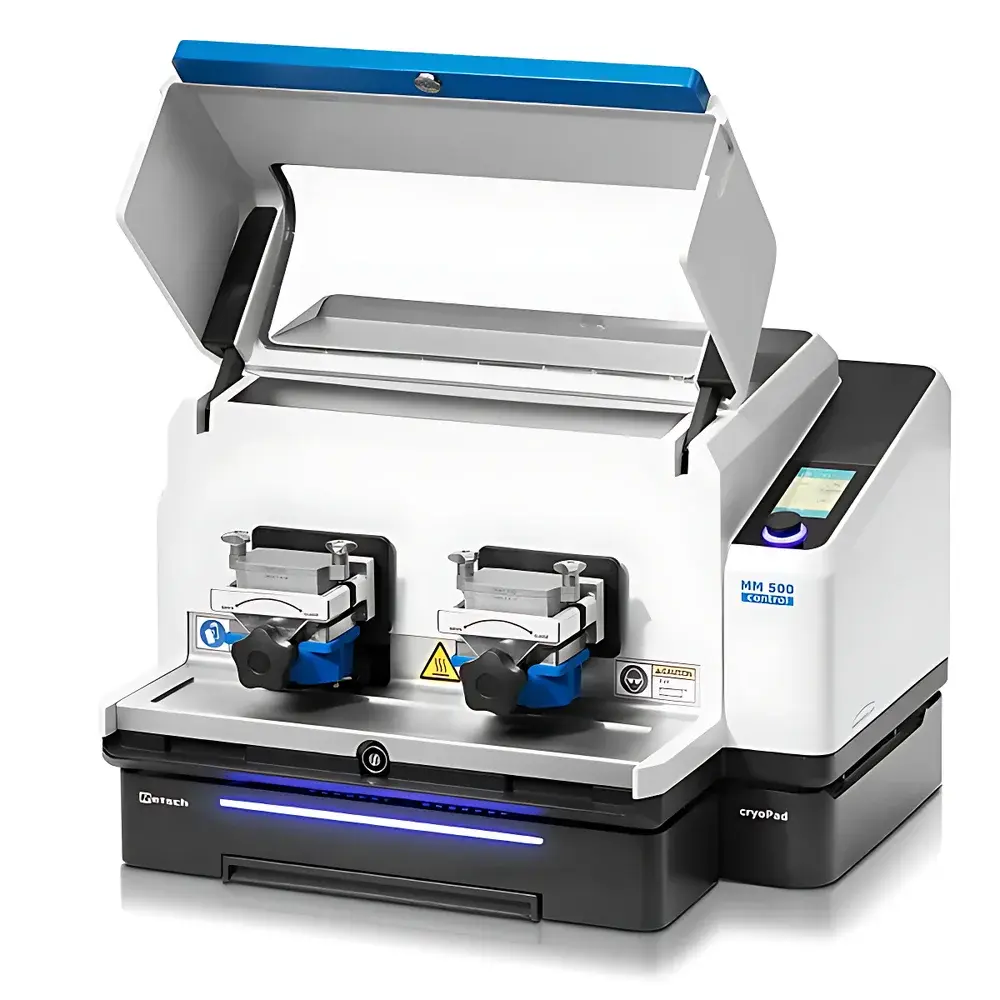
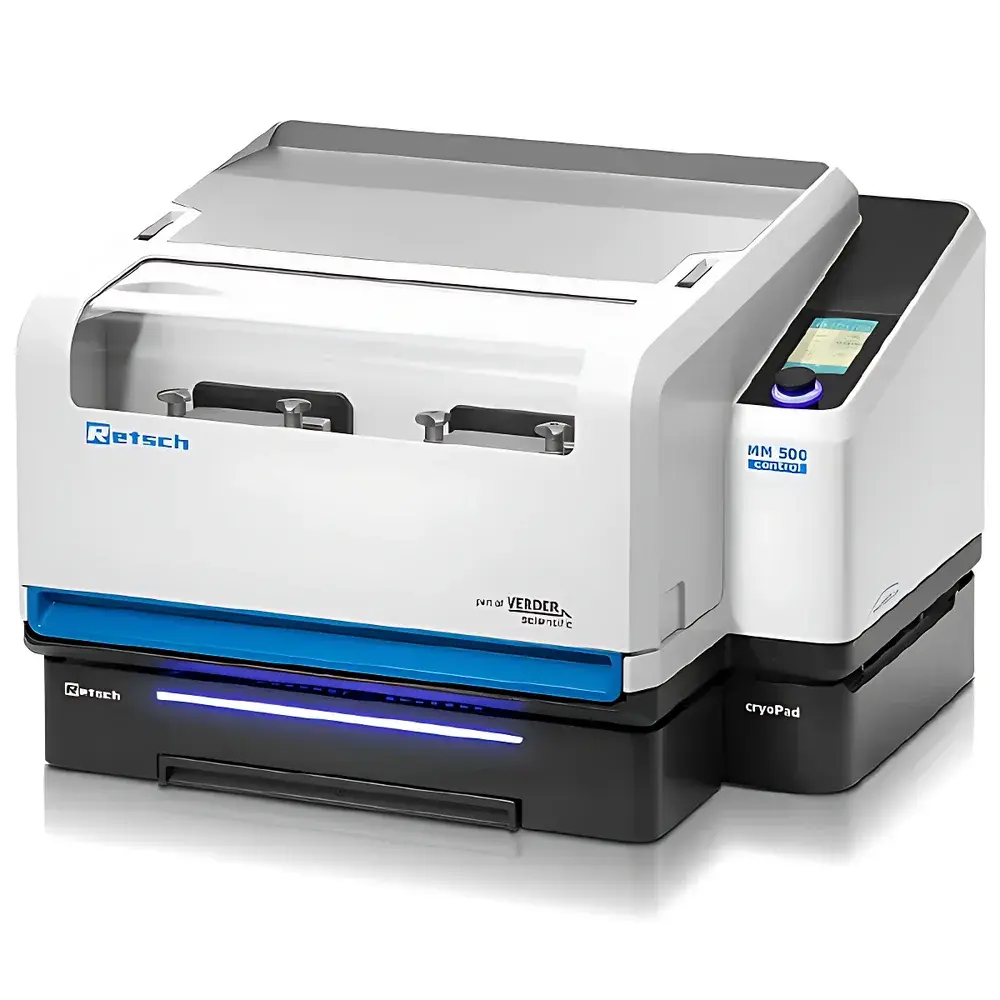
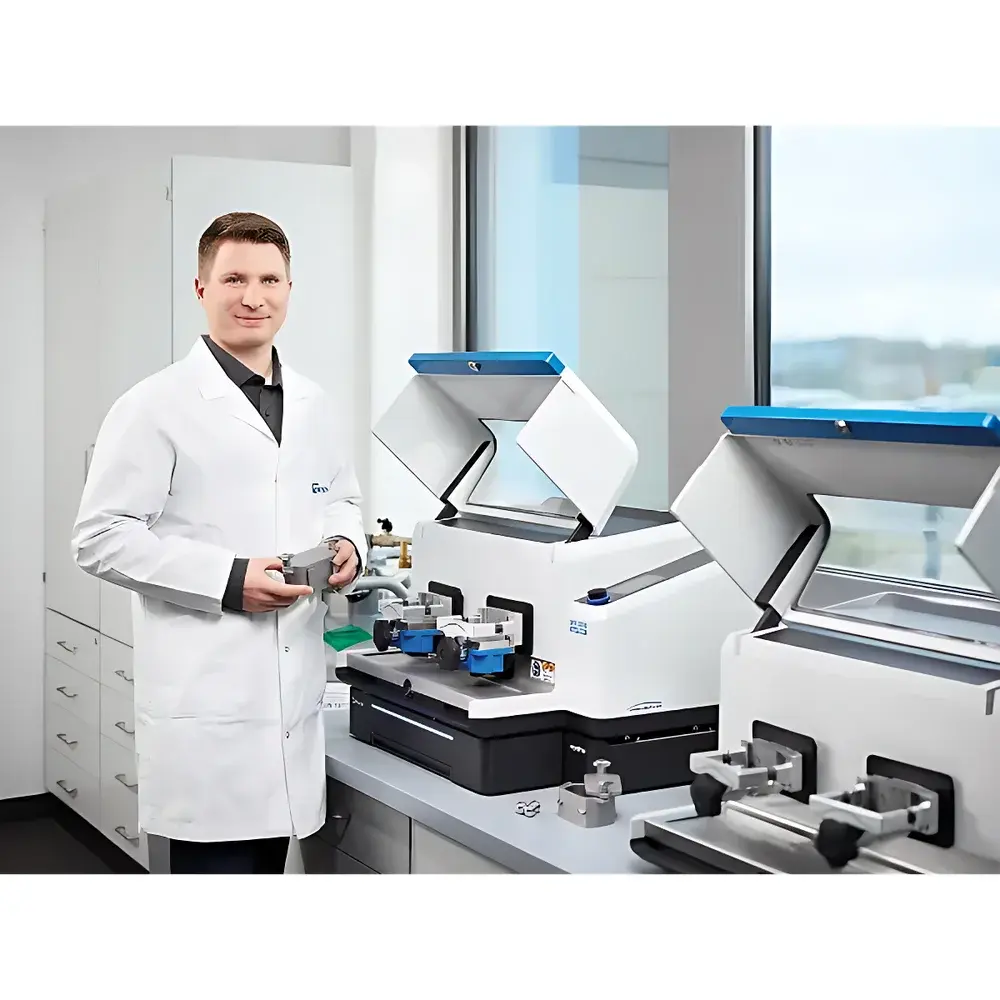
Retsch MM 500 CONTROL High-Energy Mixer Mill
| Brand | Retsch |
|---|---|
| Origin | Germany |
| Model | MM 500 CONTROL |
| Grinding Frequency | up to 30 Hz |
| Maximum Feed Size | ≤ 10 mm |
| Final Particle Size | down to ~0.1 µm |
| Temperature Control Range | –100 °C to +100 °C |
| Operating Modes | Dry, Wet, Cryogenic Grinding |
| CryoPad Compatibility | Yes (optional) |
Overview
The Retsch MM 500 CONTROL is a high-energy laboratory mixer mill engineered for reproducible, high-throughput size reduction of hard, brittle, fibrous, and temperature-sensitive materials. Unlike conventional shaker mills, it operates on the principle of impact and friction generated by oscillating grinding jars containing balls—driven by a precisely controlled electromagnetic drive system. Its defining innovation lies in real-time, closed-loop temperature monitoring and active thermal management during milling, making it the first mixer mill globally capable of continuous in-process temperature logging and regulation across a broad range from –100 °C to +100 °C. This capability is critical for preserving thermolabile compounds, preventing polymorphic transitions, inhibiting oxidation, or enabling cryogenic amorphization—particularly in pharmaceutical, materials science, and geochemical applications where thermal history directly influences phase behavior and analytical integrity.
Key Features
- Electromagnetic drive with digitally regulated frequency (0–30 Hz), ensuring precise energy input control and exceptional repeatability between runs.
- Integrated Pt100 temperature sensor embedded in the grinding jar holder, providing real-time temperature feedback with ±0.5 °C accuracy and automatic logging to internal memory or external PC via USB.
- Modular thermal interface supporting multiple heat transfer media—including liquid nitrogen (via cryoPad), chilled glycol, heated oil, or ambient air—enabling both cryogenic and elevated-temperature milling protocols.
- Optional cryoPad accessory: a dedicated cryogenic adapter kit that enables stable, programmable cooling within the –100 °C to 0 °C range using liquid nitrogen; includes insulated grinding chamber, pressure-relief valve, and automated LN₂ flow control.
- Intuitive 5.7-inch color touchscreen interface with preconfigured methods, user-defined parameter sets (frequency, time, pause intervals, temperature setpoints), and password-protected method locking for GLP/GMP compliance.
- Robust stainless-steel housing with integrated safety interlocks, vibration-dampening feet, and automatic emergency stop triggered by abnormal temperature deviation or lid opening.
Sample Compatibility & Compliance
The MM 500 CONTROL accommodates a wide spectrum of sample types—from hard ceramics (e.g., alumina, silicon carbide) and metallic alloys to biological tissues, polymers, and pharmaceutical APIs. With a maximum feed size of ≤10 mm and achievable final particle sizes down to ~0.1 µm, it supports both coarse pre-grinding and ultrafine comminution. All grinding jars (stainless steel, tungsten carbide, hardened steel, PTFE, agate, zirconia) are certified for trace-metal-free analysis and compatible with ISO 13320 (laser diffraction), ASTM E11 (test sieves), and USP particulate matter testing workflows. The instrument meets CE, UL/CSA safety standards and supports 21 CFR Part 11-compliant electronic records when used with Retsch’s optional software package, including audit trails, user access levels, and electronic signatures.
Software & Data Management
Control and data acquisition are managed through RETSCH’s proprietary MM 500 CONTROL Software (v3.2+), installed on Windows-based PCs. The software enables remote method setup, live temperature/frequency/time visualization, export of CSV-formatted raw data (including timestamped temperature curves), and batch reporting compliant with ISO/IEC 17025 documentation requirements. All parameter changes, run starts/stops, and temperature excursions are automatically recorded with user ID and timestamp—facilitating full traceability in regulated environments. Data files are encrypted and support digital signature validation to meet FDA and EMA expectations for analytical instrument qualification (AIQ) and computerized system validation (CSV).
Applications
- Pharmaceutical development: Cryogenic milling of heat-sensitive APIs to prevent degradation and maintain crystallinity; preparation of nanosuspensions for bioavailability enhancement.
- Materials research: Mechanical alloying of intermetallics, synthesis of metastable oxide phases, and homogenization of composite precursors prior to sintering.
- Geochemistry & mining: Preparation of representative sub-100 nm fractions from ore samples for XRF, ICP-MS, or SEM-EDS without elemental fractionation.
- Environmental analysis: Homogenization of contaminated soils and sediments under inert or cryogenic conditions to preserve volatile organic compounds (VOCs) and redox-sensitive species.
- Academic laboratories: Teaching advanced comminution mechanics, studying mechanochemical reaction kinetics, and calibrating particle size analyzers with NIST-traceable reference materials.
FAQ
What types of grinding jars are compatible with the MM 500 CONTROL?
Standard options include stainless steel (10–50 mL), tungsten carbide (1–25 mL), agate (1–25 mL), zirconia (1–50 mL), and PTFE (1–25 mL); all are vacuum-tight and rated for cryogenic use with cryoPad.
Is the MM 500 CONTROL suitable for regulatory submissions (e.g., FDA filings)?
Yes—when operated with validated methods, audit-trail-enabled software, and documented IQ/OQ/PQ protocols, it fulfills data integrity requirements per ALCOA+ principles and supports GxP-aligned workflows.
Can I perform wet grinding with temperature control?
Yes—liquid coolants or heating media can be circulated around sealed grinding jars containing solvent-based slurries; compatibility with common solvents (e.g., ethanol, acetone, isopropanol) is confirmed in the technical manual.
How does the cryoPad differ from standard liquid nitrogen cooling attachments?
cryoPad integrates active flow regulation, thermal insulation, and real-time LN₂ consumption monitoring—enabling stable, repeatable sub-zero setpoints without manual venting or ice formation risks typical of open-bath setups.
Does the instrument support multi-step grinding protocols?
Yes—up to 99 program steps per method, including alternating frequency, dwell time, cooling/heating phases, and intermediate pauses for sample addition or temperature equilibration.



