
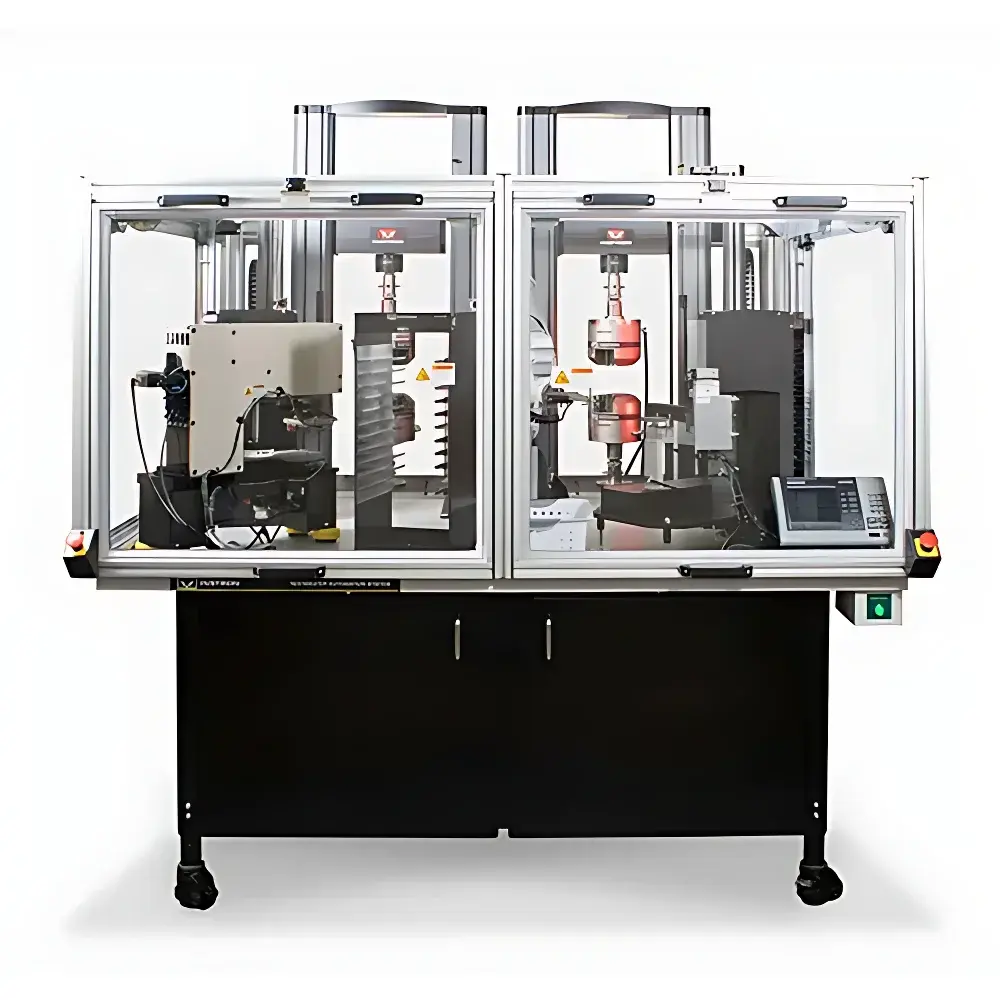
INSTRON AT6 6-Axis Robotic Automation Testing System
| Brand | INSTRON |
|---|---|
| Origin | USA |
| Manufacturer Type | Authorized Distributor |
| Product Category | Imported Equipment |
| Model | AT6 6-Axis Robotic Automation Testing System |
| Instrument Type | Electromechanical Universal Testing Machine |
| Force Capacity | Up to 600 kN |
| Configuration Options | Floor-standing, Bench-top, or Single-column Frames |
| Gripping Systems | Pneumatic and Hydraulic Fixtures |
| Strain Measurement | Video Extensometry and Contact Extensometers (Axial & Transverse) |
| End-effectors | Material-specific Tooling and Load-Frame Mounting Interfaces |
| Rack Layout | Dual-Frame Integration Capability |
| Safety Enclosure | Fully Interlocked, ISO 13857-Compliant Guarding |
| Robot Platform | Mitsubishi RV-Series 6-Axis Articulated Arm |
| Compliance | ASTM E4, ASTM E8/E21, ISO 6892-1, ISO 527, USP <1041>, FDA 21 CFR Part 11 Ready (with optional audit trail module) |
Overview
The INSTRON AT6 6-Axis Robotic Automation Testing System is an engineered solution for high-throughput, operator-independent mechanical testing of structural and functional materials. Built upon INSTRON’s electromechanical universal testing platform and integrated with a precision Mitsubishi 6-axis articulated robot, the AT6 implements closed-loop automation for specimen handling, positioning, gripping, alignment, loading, unloading, and post-test evaluation. Its core architecture leverages servo-controlled force application (up to 600 kN), synchronized motion coordination between test frame and robotic arm, and real-time feedback from optical and contact-based extensometry systems. Designed explicitly for laboratories operating under GLP, GMP, or ISO/IEC 17025 frameworks, the AT6 eliminates manual intervention in repetitive physical tasks—thereby mitigating human-induced variability in alignment, grip pressure, strain rate control, and cycle timing—while maintaining full traceability of all mechanical and procedural parameters.
Key Features
- Fully interlocked safety enclosure compliant with ISO 13857:2019 (minimum safety distances) and ANSI B11.19-2022, ensuring zero operator access during active testing cycles
- Dual-frame configuration support: one robot services up to two synchronized test frames, doubling throughput without additional labor or footprint expansion
- Programmable dual-axis specimen measurement station enables pre-test dimensional verification (width, thickness, gauge length) with ±1 µm repeatability
- Automated specimen marking via integrated video extensometer triggers—enabling precise tracking of fiducial points across deformation history
- Material-agnostic end-effector library including pneumatic vise grips, hydraulic wedge grips, peel fixtures, and custom-machined tooling for composites, metals, polymers, and biomedical specimens
- Real-time synchronization between Bluehill Universal software and robot motion controller (Mitsubishi MELSEC-Q series) via EtherCAT and OPC UA protocols
Sample Compatibility & Compliance
The AT6 accommodates specimens ranging from miniature tensile coupons (ASTM E8M sub-size) to full-scale structural components (e.g., ASTM E21 large-section tensile bars). Compatible sample geometries include flat strips, round rods, tubes, laminates, adhesively bonded joints, and orthopedic implant constructs. All automated workflows adhere to standardized test methods including ASTM E4 (force verification), ASTM E8/E21 (tensile testing of metallic materials), ISO 6892-1 (metallic tensile testing at ambient temperature), ISO 527 (plastics tensile properties), and ASTM D3039 (composite tensile behavior). Optional validation packages support IQ/OQ documentation aligned with FDA 21 CFR Part 11 requirements, including electronic signature enforcement, audit trail logging, and role-based user access control.
Software & Data Management
Control and data acquisition are managed through INSTRON’s Bluehill Universal software v4.4+, extended with AT6-specific automation modules. The system records synchronized timestamps across robot joint positions, load cell output, crosshead displacement, extensometer signals, and environmental sensor inputs (optional temperature/humidity monitoring). All raw and processed datasets are stored in vendor-neutral HDF5 format with embedded metadata per ASTM E1447 and ISO/IEC 17025 clause 7.5.2. Data export supports CSV, XML, and PDF report generation with configurable templates—including multi-language support for CE-marked installations. Audit trails capture user login/logout events, method modifications, calibration interventions, and emergency stop activations—retained for ≥36 months as required by GLP Annex 11 and EU GMP Annex 11.
Applications
- High-volume quality control testing of aerospace alloys and additive-manufactured components under ASTM B557 and AMS 2369
- Repetitive fatigue and creep testing of polymer matrix composites per ASTM D3479 and ISO 13003
- Regulatory submission testing for medical device materials (ISO 5832-1, ISO 13485-compliant workflows)
- Automated tensile-to-failure mapping across heat-treated lots in automotive powertrain component manufacturing
- Multi-condition environmental mechanical testing when coupled with thermal chambers and humidity enclosures
- Research-grade constitutive modeling using synchronized digital image correlation (DIC) and robotic repositioning for multi-axial loading sequences
FAQ
Does the AT6 require dedicated electrical or compressed air infrastructure?
Yes. The system operates on 208–480 VAC, 3-phase, 60 Hz (or 50 Hz with configuration), and requires clean, dry compressed air at 0.6 MPa (90 psi) for pneumatic grippers. Hydraulic actuation options demand ISO 46 hydraulic fluid and dedicated filtration units.
Can legacy INSTRON test frames be retrofitted with the AT6 robotic system?
Retrofitting is supported for INSTRON 5980-series and 6800-series frames manufactured after 2015, subject to mechanical interface assessment and firmware upgrade to Bluehill Universal v4.3+. Frame rigidity and encoder resolution must meet minimum thresholds defined in INSTRON Technical Bulletin TB-512.
Is third-party hardware integration (e.g., thermal chambers, DIC systems) supported?
Yes. The AT6 provides open API access via RESTful endpoints and native Modbus TCP/RTU support. Integration with commercial DIC systems (e.g., Correlated Solutions VIC-3D, LaVision StrainMaster) is validated and documented in Application Note AN-AT6-DIC-01.
What level of operator training is required to deploy and maintain the AT6?
INSTRON-certified Level 2 Automation Engineers are recommended for initial deployment. Routine operation requires trained technicians with Bluehill Universal certification and basic robotics safety awareness (OSHA 1910.212/ANSI/RIA R15.06). Preventive maintenance schedules follow INSTRON Service Manual SM-AT6-Rev.D.



