
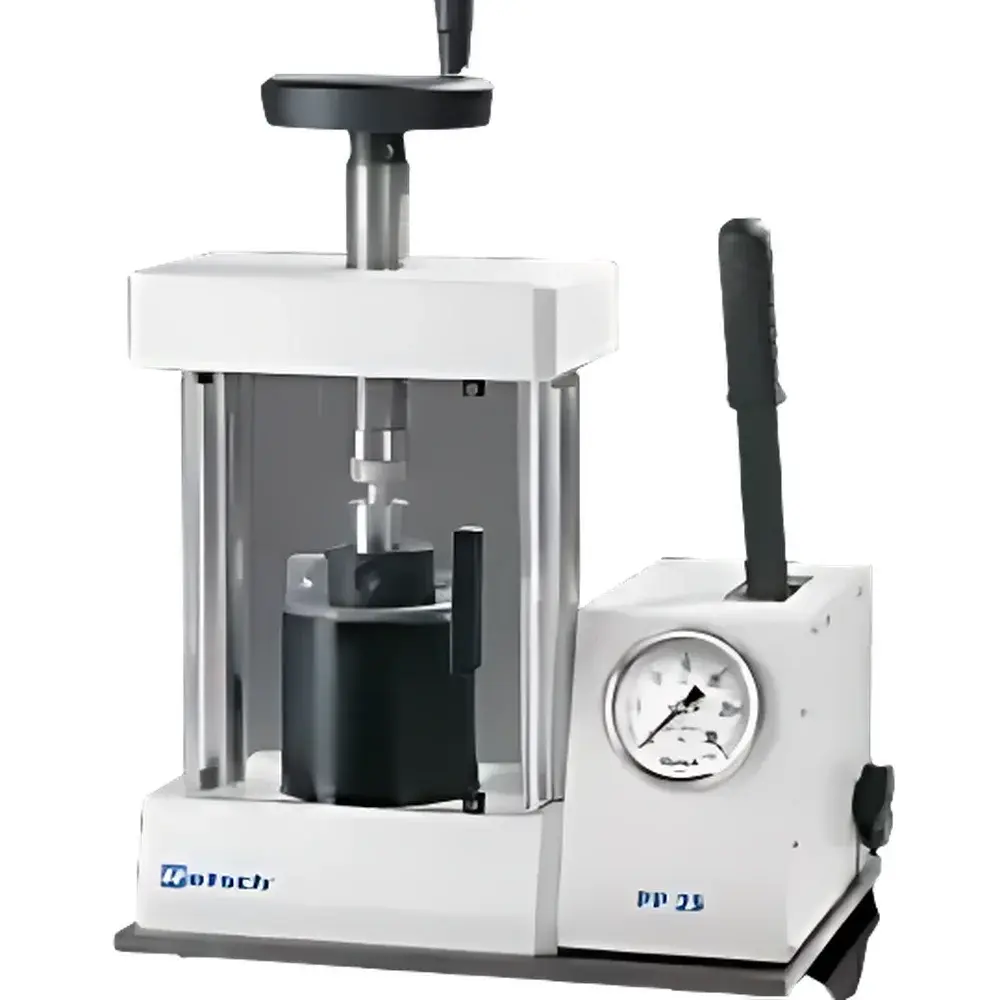
RETSCH PP 25 Manual Hydraulic Pellet Press
| Brand | RETSCH |
|---|---|
| Origin | Germany |
| Model | PP 25 |
| Instrument Type | Manual Hydraulic Pellet Press |
| Maximum Force | 25 t (10–250 kN) |
| Available Die Sizes | Ø32 mm, Ø40 mm |
| Dimensions (W × H × D) | 380 × 620 × 300 mm |
| Net Weight | 50 kg |
| Vacuum Capability | Yes |
| Compliance | Designed for ISO/IEC 17025-compliant sample preparation workflows |
Overview
The RETSCH PP 25 is a precision-engineered manual hydraulic pellet press designed for reproducible, high-integrity sample compaction in analytical laboratories. It operates on the principle of uniaxial cold pressing—applying controlled, uniform hydraulic force to powdered or granular specimens confined within precision-machined die cavities. This process eliminates inter-particle voids and ensures homogeneous density distribution across the pellet cross-section—critical for quantitative spectroscopic analysis including XRF, FTIR, and XRD. Unlike motorized or semi-automated systems, the PP 25 delivers full operator control over pressure ramping, dwell time, and release kinetics, enabling method optimization for challenging matrices such as cement clinker, metallurgical slags, geological ores, and ceramic precursors. Its compact benchtop footprint and rigid cast-iron frame ensure mechanical stability during high-force compression cycles, minimizing lateral deformation and enhancing pellet dimensional repeatability.
Key Features
- Manual hydraulic system with calibrated pressure gauge (0–25 t / 0–250 kN), offering fine-grained force adjustment and visual real-time feedback
- Vacuum-compatible die holder assembly—enables evacuation of air from powder beds prior to compression, significantly reducing porosity and improving spectral signal-to-noise ratio
- Interchangeable precision-ground stainless-steel dies (standard Ø32 mm and Ø40 mm; optional custom diameters available per ISO 12891-1)
- Polished, hardened steel pressure punches with parallelism tolerance < 2 µm—ensuring uniform stress transmission and minimizing edge chipping
- Ergonomic lever mechanism with mechanical advantage ratio optimized for consistent operator effort across the full 1–25 t range
- Integrated safety guard and pressure relief valve compliant with EN 692:2014 (mechanical presses)
Sample Compatibility & Compliance
The PP 25 accommodates a broad spectrum of inorganic and composite powders—including Portland cement, blast furnace slag, bauxite, kaolin, fly ash, phosphate rock, sintered oxides, and recycled electronic waste fractions. Its force range (10–250 kN) and die geometry support ASTM E1190-20 (XRF pellet preparation), ISO 12891-1 (soil and sediment compaction), and USP (pharmaceutical tablet hardness qualification protocols). All wetted components are electropolished stainless steel (AISI 316), certified non-reactive with alkaline fluxes (e.g., Li₂B₄O₇, Na₂CO₃) and halide-based binders. The unit is CE-marked and conforms to EU Machinery Directive 2006/42/EC. Documentation packages include Factory Calibration Certificate traceable to PTB (Physikalisch-Technische Bundesanstalt) standards.
Software & Data Management
As a manually operated instrument, the PP 25 does not incorporate embedded electronics or digital control software. However, it is fully compatible with laboratory information management systems (LIMS) and electronic lab notebooks (ELN) via standardized procedural documentation templates. Each compression cycle can be logged with metadata—including applied force, dwell duration, die ID, vacuum level (when used with external vacuum pump), ambient temperature/humidity, and operator ID—supporting GLP/GMP audit readiness. Optional digital force transducer kits (e.g., RETSCH FTK-PP25) enable analog-to-digital output for integration with SCADA or LabVIEW-based data acquisition platforms, providing timestamped force-time curves for method validation under ISO/IEC 17025 Clause 7.7.
Applications
- X-ray fluorescence (XRF) sample preparation for geochemical mapping and industrial raw material certification
- FTIR quantitative analysis of polymer blends and mineralogical phases requiring matrix-free, binderless pellets
- Preparation of pressed discs for XRD phase identification in metallurgical process control and slag valorization studies
- Standardized compaction of construction materials (e.g., concrete admixtures, refractory aggregates) per EN 196-1
- Environmental solid waste characterization—compressing heterogeneous soil/sediment composites into stable, transport-safe discs for regulatory screening (EPA Method 6010D)
FAQ
What is the maximum recommended operating pressure for routine XRF pellet preparation?
For optimal pellet integrity and minimal die wear, RETSCH recommends 15–20 t (150–200 kN) for most oxide-based samples using Ø40 mm dies.
Can the PP 25 be used with borate fusion fluxes?
No—this instrument is intended for cold pressing only. Borate fusion requires high-temperature furnaces (e.g., RETSCH AF 22) and is incompatible with hydraulic press components.
Is calibration required before first use?
Yes—initial verification of gauge linearity against a certified dead-weight tester is mandatory per ISO/IEC 17025 Section 6.5. RETSCH provides calibration service documentation upon request.
Are replacement dies supplied with certification of dimensional accuracy?
All standard dies include a metrology report certifying bore diameter tolerance (±0.005 mm), concentricity (< 0.01 mm), and surface roughness (Ra ≤ 0.2 µm) measured per ISO 4287.
Does the PP 25 meet FDA 21 CFR Part 11 requirements for electronic records?
The base unit does not generate electronic records. When paired with optional digital transducers and validated LIMS interfaces, full Part 11 compliance—including audit trails, electronic signatures, and data integrity controls—can be achieved through site-specific validation protocols.



