
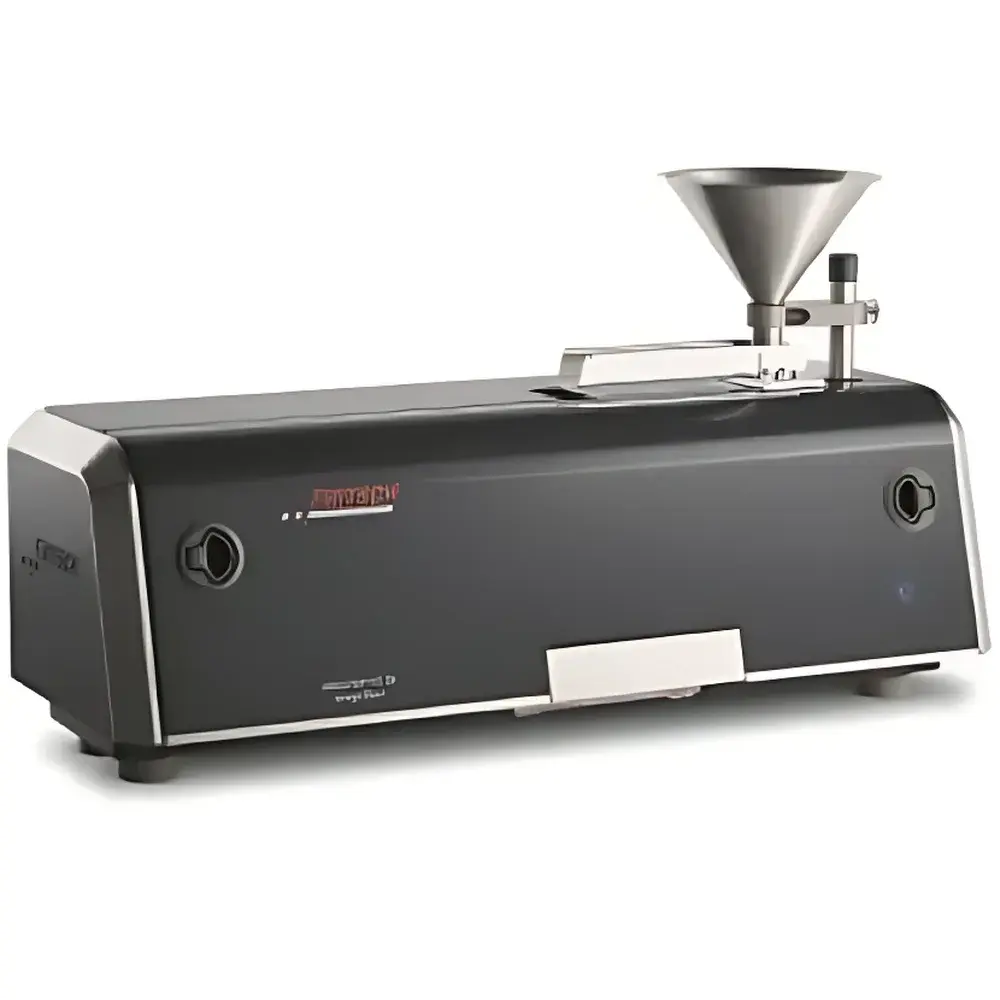
Fritsch ANALYSETTE 28 ImageSizer Dynamic Particle Image Analyzer
| Brand | Fritsch |
|---|---|
| Origin | Germany |
| Model | ANALYSETTE 28 ImageSizer |
| Measurement Principle | Dynamic Image Analysis |
| Particle Size Range | 20 µm – 20 mm |
| Measurement Time | < 5 min |
| Typical Sample Mass | 10–100 g |
| Output Parameters | Particle Size Distribution (equivalent circular diameter, Feret diameters, Martin length, etc.) and Morphology (aspect ratio, convexity, roundness, solidity, symmetry) |
| Lens Options | Four telecentric lenses (150 µm–20 mm, 52 µm–6.7 mm, 28 µm–3.5 mm, 20 µm–2.7 mm) |
| Camera Resolution | 5 MP, bidirectional telecentric imaging |
| Frame Rate | Up to 30 fps |
| Software | FRITSCH ISS Control & Evaluation Software |
| Compliance | ISO 13322-2:2013 |
| Dimensions (W × D × H) | 90 × 30 × 50 cm |
Overview
The Fritsch ANALYSETTE 28 ImageSizer is a high-precision dynamic particle image analyzer engineered for quantitative morphological and dimensional characterization of dry, free-flowing powders and coarse granular materials. Operating on the principle of dynamic image analysis, the instrument captures high-resolution silhouette images of particles in motion—transported continuously through a precisely controlled U-shaped dispersion channel under gravity-driven flow. Unlike static image analysis systems requiring manual sample preparation or suspension stabilization, the ANALYSETTE 28 acquires statistically robust datasets by analyzing thousands of individual particles per measurement cycle, delivering reproducible size distributions (based on equivalent circular diameter, Feret min/max, Martin length, and projected area) alongside morphology descriptors including aspect ratio, convexity, roundness, solidity, and symmetry. Its design eliminates sedimentation bias and agglomeration artifacts common in wet dispersion methods, making it especially suitable for fragile, irregular, or density-heterogeneous particles where mechanical or liquid-induced alteration must be avoided.
Key Features
- High-speed 5-megapixel bidirectional telecentric imaging system enabling real-time particle capture at up to 30 frames per second with sub-pixel edge resolution.
- Four interchangeable telecentric lens modules—covering discrete magnification ranges (20–2.7 mm, 28–3.5 mm, 52–6.7 mm, and 150 µm–20 mm)—allow seamless adaptation to diverse particle populations without hardware recalibration.
- U-shaped automatic feeding trough with integrated optical concentration monitoring and adaptive feed-rate control ensures consistent particle flux and optimal single-particle separation across the field of view.
- Automated image acquisition and metadata tagging: each captured particle image is time-stamped, spatially referenced, and stored with full traceability for retrospective re-evaluation or audit compliance.
- Intuitive SOP-driven workflow within FRITSCH ISS software enables rapid method setup, operator-independent execution, and repeatable measurement conditions across shifts and laboratories.
- FRITSCH Cloud-enabled morphology analytics provide cloud-synchronized access to standardized shape libraries, inter-laboratory comparison dashboards, and AI-assisted outlier detection (e.g., broken fragments, fused agglomerates, oversized contaminants).
Sample Compatibility & Compliance
The ANALYSETTE 28 is validated for dry, non-cohesive to moderately cohesive particulates—including metal powders, mineral aggregates, pharmaceutical granules, food ingredients, catalysts, and recycled construction materials. It excludes samples prone to electrostatic adhesion or excessive dust generation without optional anti-static accessories. All measurement protocols conform rigorously to ISO 13322-2:2013 (“Particle size analysis — Image analysis methods — Part 2: Dynamic image analysis”), ensuring international equivalence with reference sieving and laser diffraction data where applicable. The system supports GLP-compliant operation through full electronic audit trail logging (user actions, parameter changes, calibration events), and ISS software optionally integrates with 21 CFR Part 11–compliant electronic signature modules for regulated environments.
Software & Data Management
FRITSCH ISS (ImageSizer Software) provides a unified interface for instrument control, real-time visualization, batch processing, and report generation. Raw image archives are stored in lossless TIFF format with embedded EXIF metadata (lens ID, exposure, gain, timestamp). Quantitative outputs include cumulative/differential size distributions, bivariate scatter plots (e.g., roundness vs. aspect ratio), and statistical summaries (D10, D50, D90, span, shape index variance). Customizable templates support automated PDF/Excel export with configurable branding, QA/QC flags, and pass/fail thresholds against user-defined specifications. Data integrity is preserved via encrypted local storage and optional network-based backup to secure NAS or LIMS-integrated repositories.
Applications
- Quality control of additive manufacturing metal powders (e.g., Ti-6Al-4V, Inconel 718) for sphericity and satellite detection prior to printing.
- Monitoring granulation endpoints in solid-dose pharmaceutical manufacturing per USP & Ph. Eur. guidelines.
- Characterizing angularity and surface texture of fine aggregates for asphalt and concrete mix design (ASTM D3398, EN 933-5).
- Evaluating attrition resistance of catalyst pellets and fertilizer granules during transport and handling.
- Forensic analysis of soil or debris samples where particle shape signatures indicate origin or processing history.
- R&D screening of milling, crushing, or classification efficiency across process development stages.
FAQ
Does the ANALYSETTE 28 require sample dilution or dispersion agents?
No—dynamic dry dispersion eliminates the need for solvents, surfactants, or ultrasonication, preserving native particle structure.
Can the system differentiate between touching or overlapping particles?
Yes—the telecentric optics combined with advanced edge-detection algorithms and deconvolution filters enable reliable splitting of contacting particles based on curvature discontinuity and shadow separation criteria.
Is calibration traceable to NIST or PTB standards?
Lens magnification calibration is performed using certified stage micrometers traceable to PTB (Physikalisch-Technische Bundesanstalt); particle size verification uses ISO-standard glass bead reference materials.
How is data security managed in cloud-connected mode?
All cloud transmissions use TLS 1.2+ encryption; customer data resides in ISO 27001-certified EU-hosted infrastructure with role-based access controls and zero-knowledge encryption options.
What maintenance intervals are recommended for long-term accuracy?
Annual optical alignment verification and lens cleaning protocol; no routine recalibration required unless mechanical impact or environmental contamination is suspected.
Related Products



