
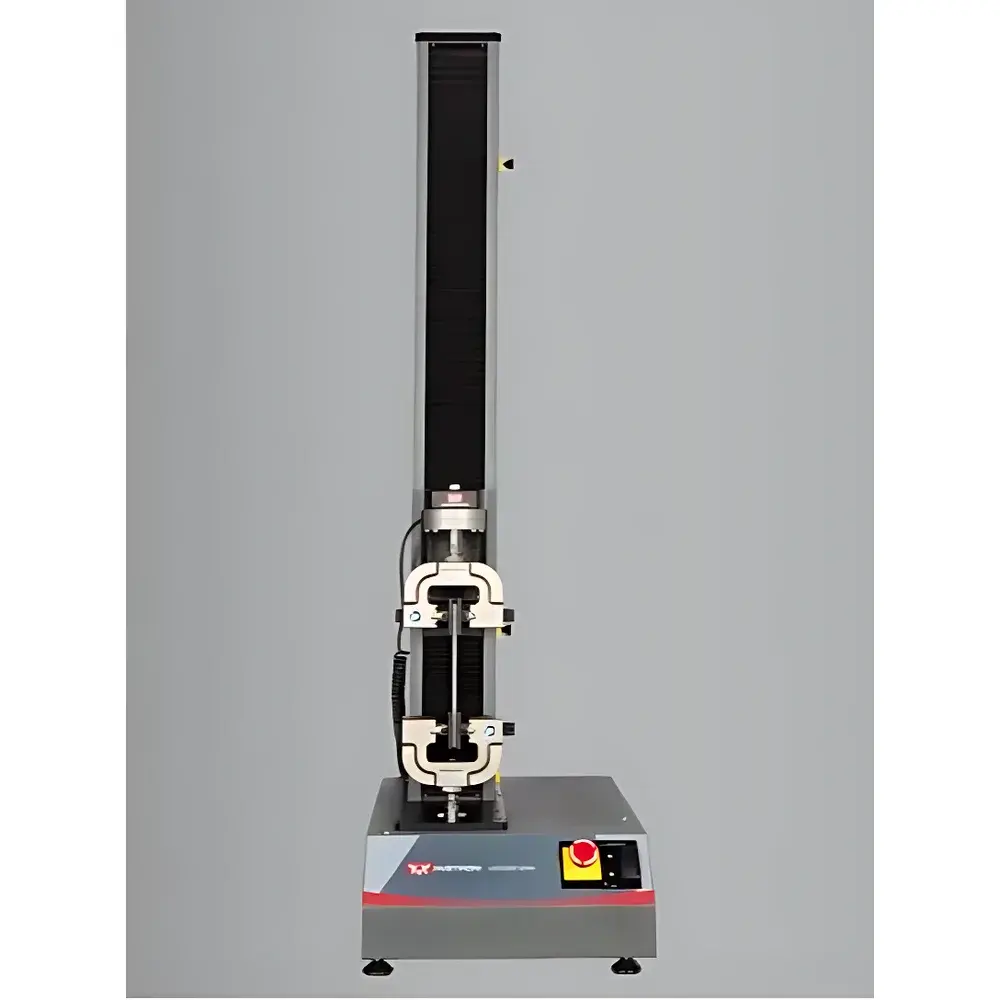
Instron 2340 Series Single-Column Electromechanical Testing System
| Brand | Instron |
|---|---|
| Origin | USA |
| Model | 2340 Series |
| Load Capacity Options | 2 kN (2344) / 5 kN (2345) |
| Vertical Test Space | 1123 mm (standard), up to 1383 mm (high-rise variant) |
| Load Accuracy | ±0.5% of indicated load |
| Force Resolution | Down to 1/200 of full-scale capacity without loss of accuracy |
| Data Acquisition Rate | 500 Hz |
| Compliance | CE-marked |
| Control & Software | Fully software-controlled with automatic transducer recognition |
| Fixture Compatibility | Extensive library of standardized and application-specific grips and tooling |
Overview
The Instron 2340 Series is a precision-engineered single-column electromechanical testing system designed for routine tensile, compression, flexure, and peel testing in quality control laboratories and R&D environments where space efficiency, operational simplicity, and regulatory traceability are critical. Operating on the principle of closed-loop servo-controlled motion, the system employs high-fidelity load cells and linear encoders to deliver repeatable mechanical property measurements—including ultimate tensile strength, yield point, modulus, elongation, and energy absorption—across a broad range of materials including polymers, elastomers, thin metals, composites, medical devices, and packaging substrates. Its compact footprint (typically under 0.5 m² floor space) enables seamless integration into constrained laboratory layouts while maintaining full accessibility to the test zone—a key requirement for rapid specimen loading, visual monitoring, and in situ adjustments during dynamic testing protocols.
Key Features
- High-resolution force measurement: Load cells calibrated to ASTM E4 and ISO 7500-1 standards, delivering ±0.5% accuracy across the full scale—from 0.5% to 100% of capacity—with no interpolation or range-switching required.
- Robust motion control architecture: DC servo motor with integrated encoder feedback ensures precise displacement control and consistent strain rates per ASTM D638, ISO 527, and ISO 178.
- Real-time data acquisition at 500 Hz: Captures transient mechanical events—including crack initiation, load drops, and hysteresis loops—with sufficient temporal resolution for post-test event analysis and digital signal filtering.
- Automatic transducer recognition: Plug-and-play detection of load cell and extensometer IDs via embedded EEPROM, eliminating manual calibration entry and reducing setup errors.
- Modular frame design: Standard vertical travel of 1123 mm accommodates most ASTM and ISO specimen geometries; optional high-rise configurations extend travel to 1383 mm for elongated specimens or multi-specimen fixtures.
- CE-compliant safety architecture: Integrated emergency stop circuitry, guarded test zone interlocks, and overload protection aligned with Machinery Directive 2006/42/EC requirements.
Sample Compatibility & Compliance
The 2340 Series supports standardized and custom test specimens ranging from 1 mm diameter filaments to 100 mm wide laminates. Its open-front configuration facilitates use with pneumatic, wedge, hydraulic, and specialized grips—including ASTM D3039-compliant composite tabs, ISO 1133 melt flow adapters, and USP compliant pharmaceutical film clamps. All hardware and firmware comply with ISO/IEC 17025:2017 documentation requirements for accredited testing laboratories. The system meets essential performance criteria outlined in ASTM E4, ISO 7500-1 (force verification), and ISO 9513 (extensometer verification), and supports audit-ready reporting for GLP and GMP environments.
Software & Data Management
Controlled via Bluehill Universal software (v4.x or later), the system provides intuitive test method creation, real-time curve overlay, and automated pass/fail evaluation against user-defined limits. Data export adheres to ASTM E1434 and ISO 10360-6 formats, with native support for CSV, XML, and PDF report generation. Audit trail functionality complies with FDA 21 CFR Part 11 requirements—including electronic signatures, time-stamped operator logs, and immutable record retention—enabling deployment in regulated pharmaceutical, biomedical, and aerospace QA/QC workflows.
Applications
- Tensile characterization of thermoplastics per ASTM D638 and ISO 527
- Compression testing of foams and elastomers per ASTM D3574 and ISO 3386
- Flexural modulus determination of rigid plastics per ASTM D790 and ISO 178
- Peel and shear adhesion testing of pressure-sensitive tapes and medical adhesives per ASTM D903 and ISO 8510
- Mechanical validation of disposable medical devices (e.g., catheter shafts, suture packaging) per ISO 11607-2
- Quality conformance testing for automotive interior trim, textile reinforcements, and packaging films
FAQ
What is the maximum load capacity of the 2340 Series?
The series includes two standard configurations: the 2344 model rated for 2 kN (450 lbf) and the 2345 model rated for 5 kN (1,125 lbf).
Does the system support extensometry?
Yes—both contact (e.g., clip-on, pneumatic) and non-contact (video-based) extensometers can be integrated and auto-recognized via Bluehill Universal.
Is the 2340 Series suitable for ISO/IEC 17025-accredited laboratories?
Yes—when operated with certified load cells, verified fixtures, and validated software configurations, it satisfies metrological traceability and uncertainty budgeting requirements specified in ISO/IEC 17025:2017 Clause 6.4 and 6.5.
Can test methods be exported and shared across multiple instruments?
Yes—Bluehill Universal uses portable .bhu method files that retain all calibration references, calculation definitions, and pass/fail logic, ensuring cross-system consistency.
What electrical and environmental requirements apply?
Standard operation requires 100–240 VAC, 50/60 Hz, single-phase power; ambient temperature range is 10–35 °C with ≤80% non-condensing relative humidity.



