
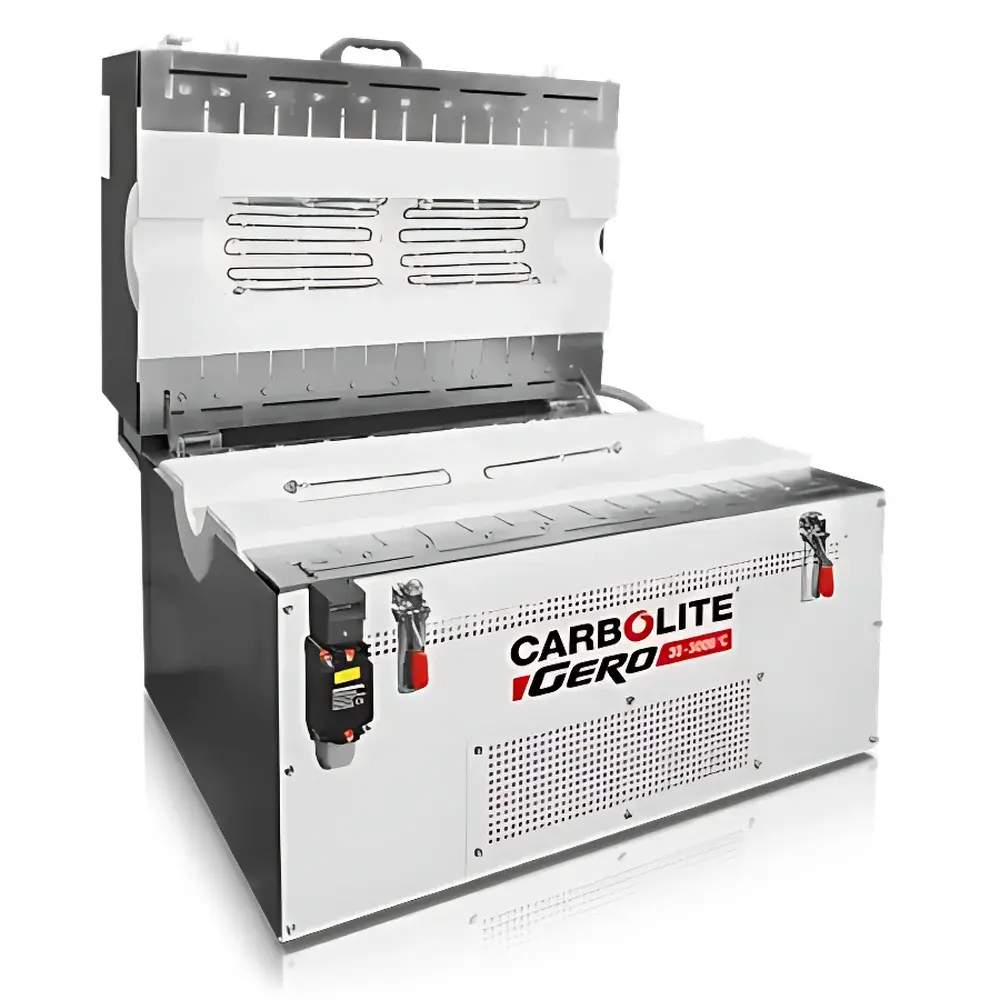
Carbolite Gero FST/FZS Series 1300°C Split-Hinge Tube Furnace
| Brand | Carbolite Gero |
|---|---|
| Origin | Germany |
| Model | FST/FZS |
| Maximum Operating Temperature | 1300 °C |
| Temperature Controller | 24-Stage Programmable (EPC3016P1 for FST |
| Tube Outer Diameter Capacity | Up to 150 mm |
| Heating Zone Configurations | Single-zone (200/500/1000 mm), Triple-zone (500/1000 mm) |
| Heating Element | High-Durability FeCrAl Wire (Ø5 mm) |
| Insulation | Low-Heat-Capacity Ceramic Fiber |
| Thermocouple Type | Precision S-Type |
| Over-Temperature Protection | Dual-Stage Independent Safety Circuit |
| Communication Interface | Ethernet (optional), RS485, Analog Output |
| Gas Compatibility | Inert, Reducing (H₂ up to 750 °C), Vacuum (mechanical pump or turbomolecular pump options) |
| Atmosphere Control | Manual/Electric Multi-Gas Valve Packages, Oxygen Probe Integration, Counterflow Flange, Radiation Shielding Plugs, Thermal Insulation Plugs |
| Mounting Flexibility | Horizontal or Vertical Orientation via L-Bracket |
| Hinge Mechanism | Motorized or Manual Split-Hinge Opening |
| Cable Length Between Furnace & Control Cabinet | 6 m (standard) |
| Compliance | CE, IEC 61000-6-2/6-4, EN 60519-2 |
Overview
The Carbolite Gero FST/FZS Series split-hinge tube furnace is an engineered solution for high-precision thermal processing in research and industrial laboratories. Designed around a robust horizontal or vertical single- or triple-zone resistive heating architecture, it operates on the principle of Joule heating via high-stability FeCrAl alloy elements embedded within low-thermal-mass ceramic fiber insulation. This configuration ensures rapid thermal response, exceptional temperature uniformity (±1 °C over ±25 mm axial zone at 1300 °C), and long-term stability under cyclic operation. The defining mechanical feature — a precision-machined split-hinge design — enables safe, repeatable access to pre-assembled reaction tubes, flanged reactors, or custom sample fixtures without disassembly. This eliminates alignment drift and preserves vacuum/gas integrity during routine loading/unloading, making it especially suitable for CVD precursor delivery systems, fuel cell electrode sintering, catalyst activation protocols, and thermocouple calibration traceable to NIST standards.
Key Features
- Split-hinge mechanical architecture with reinforced ceramic half-shell shielding — protects heating elements while accommodating pre-flanged quartz, alumina, or silicon carbide tubes up to 150 mm OD
- Modular heating zone configurations: single-zone (200/500/1000 mm) and triple-zone (500/1000 mm) variants support graded thermal profiles for gradient annealing or multi-step pyrolysis
- Dual-stage over-temperature protection: independent CC-T1 safety controller (FZS) or EPC3016P1 programmable logic module (FST) with hardware cutoff at 1350 °C
- Integrated radiation shielding plugs and low-conductivity thermal insulation plugs — reduce axial heat loss by >40% and improve radial uniformity across the hot zone
- Optional motorized hinge actuation with position feedback — enables integration into automated material synthesis workflows and unattended overnight runs
- Gas management compatibility: electrically actuated 3-channel gas manifold (up to 3 gases), inert gas counterflow flange, oxygen partial pressure monitoring interface, and hydrogen-safe operation certified per EN 13445-3 for temperatures ≤750 °C
Sample Compatibility & Compliance
The FST/FZS accommodates standard and custom tubular substrates including fused silica, recrystallized alumina, molybdenum, and silicon carbide — all rated for continuous service at 1300 °C. Its open-frame geometry supports direct mounting of thermocouples, pressure transducers, and mass flow controllers onto reactor flanges. The system complies with EN 60519-2 (safety requirements for industrial electroheating equipment), IEC 61000-6-2 (immunity) and IEC 61000-6-4 (emission), and meets CE marking requirements for laboratory use within the EU. Optional configurations support GLP-compliant data integrity: audit-trail-enabled controllers with time-stamped event logging satisfy FDA 21 CFR Part 11 requirements when paired with validated software environments.
Software & Data Management
Carbolite Gero’s optional digital controllers integrate seamlessly with LabVIEW™, MATLAB®, and Python-based automation frameworks via Ethernet (TCP/IP) or RS485 Modbus RTU. Standard firmware supports 24-segment ramp-soak programming with user-defined rate limits (0.1–50 °C/min), hold timers, and conditional jump logic. Data recording occurs at configurable intervals (1–60 s) with simultaneous storage of setpoint, process value, power output, and alarm status. All controllers include non-volatile memory retention (≥10 years) and real-time clock synchronization. Optional cloud-ready gateways enable remote monitoring, predictive maintenance alerts, and secure data export in CSV or TDMS formats compliant with ISO/IEC 17025 documentation standards.
Applications
- Chemical vapor deposition (CVD) of graphene, transition metal dichalcogenides, and thin-film photovoltaic layers
- Fuel cell component testing: cathode/anode sintering, electrolyte densification, and interconnect oxidation studies
- Catalyst synthesis and regeneration: supported metal nanoparticle formation, coke burn-off, and redox cycling under controlled pO₂
- Thermoelectric material optimization: phase-pure synthesis of Bi₂Te₃, SnSe, and Mg₂Si via solid-state reaction or spark plasma sintering pre-heating
- Calibration of Class A and Class B platinum resistance thermometers and S-type thermocouples per ASTM E230/E230M
- Advanced ceramics processing: MIM debinding, CIM sintering, and SiC/Si₃N₄ co-firing under nitrogen or argon atmospheres
FAQ
What tube materials are compatible with the 1300 °C operating limit?
Quartz (limited to 1100 °C), high-purity alumina (99.8% Al₂O₃), recrystallized alumina, silicon carbide, and molybdenum are routinely used. Material selection must consider chemical compatibility with process gases and thermal expansion matching.
Can the furnace be operated under vacuum?
Yes — optional vacuum packages include two-stage rotary vane pumps (10⁻² mbar base pressure) or turbomolecular pumping systems (10⁻⁶ mbar), fully integrated with furnace flanges and leak-tested to ISO 20484 standards.
Is hydrogen atmosphere operation supported?
Hydrogen service is approved up to 750 °C using the dedicated H₂-safe gas package, which includes explosion-proof solenoid valves, flame arrestors, and continuous oxygen monitoring via zirconia probe.
How is temperature uniformity verified and documented?
Uniformity mapping is performed per ASTM E220 using a 5-point traversing thermocouple array; as-shipped certification reports include axial/radial deviation data referenced to the center of the hot zone.
What level of cybersecurity is implemented for network-connected controllers?
Ethernet interfaces support TLS 1.2 encryption, role-based user authentication (admin/operator/viewer), and configurable firewall rules aligned with IEC 62443-3-3 SL2 requirements.



