
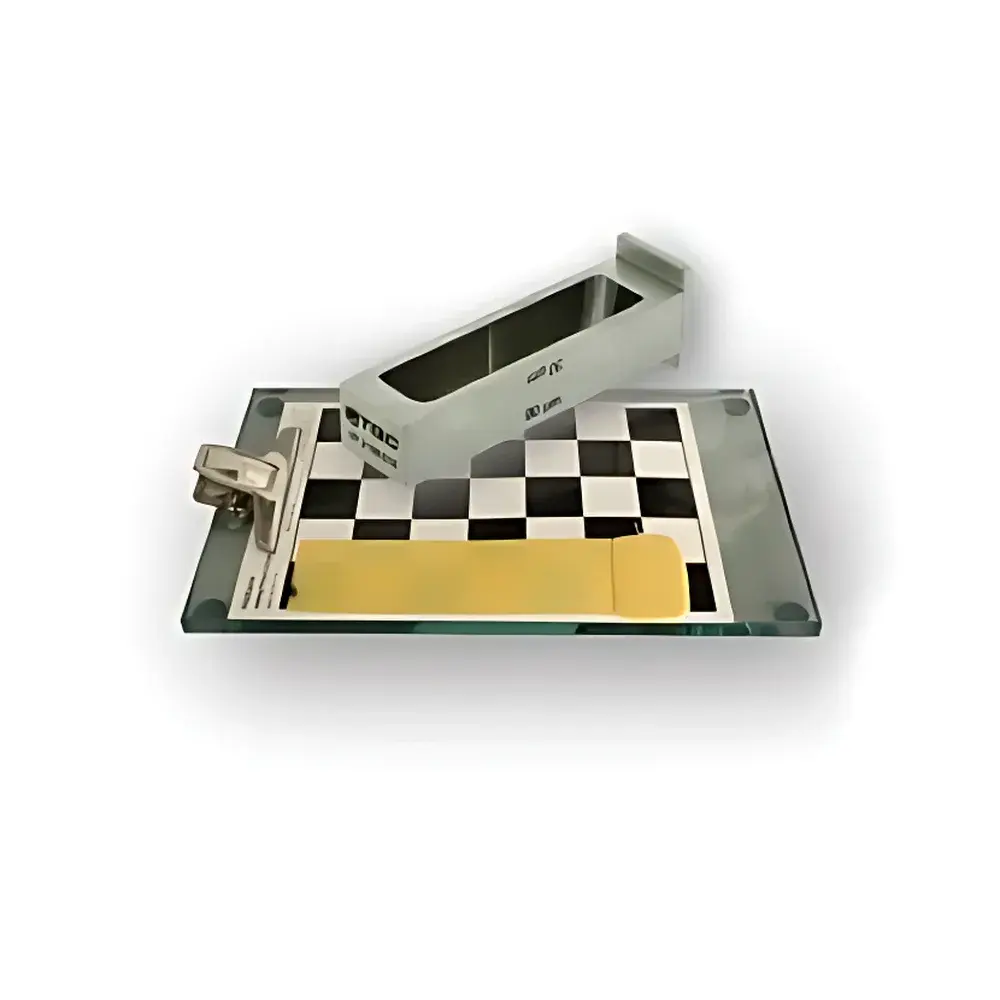
TQC Quad-Blade Drawdown Bar
| Brand | TQC |
|---|---|
| Origin | Netherlands |
| Model | Quad-Blade Drawdown Bar |
| Compliance | ASTM D 823 |
| Blade Widths | 60 mm (2.4 in) and 80 mm (3.1 in) |
| Material | High-Grade Stainless Steel |
| Removable Guide Blade | Yes |
| Application | Controlled Wet-Film Thickness Application for Coating Evaluation |
Overview
The TQC Quad-Blade Drawdown Bar is a precision-engineered manual film applicator designed for reproducible, standardized wet-film thickness (WFT) deposition on flat substrates during coating formulation development, quality control, and regulatory testing. It operates on the principle of controlled gap deposition—where the distance between the rigid blade edge and the substrate defines the nominal wet-film thickness applied during a single unidirectional drawdown stroke. This mechanical method ensures minimal operator-induced variability when used consistently with calibrated substrates and standardized drawdown speed and pressure. As a core tool in coating physical property assessment, it supports critical pre-cure evaluation parameters including leveling, sag resistance, orange peel, drying behavior, and appearance uniformity—each of which correlates directly with final dry-film performance and compliance with industrial specifications.
Key Features
- Four independently calibrated blade edges—each configured to deliver a distinct, repeatable wet-film thickness—enabling rapid comparative testing without blade interchange or recalibration.
- Two standard drawdown widths: 60 mm (2.4 in) and 80 mm (3.1 in), optimized for compatibility with common laboratory test panels (e.g., Leneta cards, glass slides, cold-rolled steel, and aluminum coupons).
- Integrated removable guide blade enhances edge definition and minimizes lateral paint spread during application—particularly beneficial for high-viscosity systems or low-surface-tension coatings prone to beading or feathering.
- Constructed entirely from high-grade stainless steel (AISI 316 or equivalent), offering exceptional resistance to corrosion from acidic, alkaline, and solvent-based coating formulations as well as aggressive cleaning agents (e.g., xylene, acetone, caustic soda solutions).
- Surface-finished to tight geometric tolerances (flatness ≤ ±2 µm over blade length) to ensure uniform gap consistency across the full drawdown width—critical for achieving ISO/IEC 17025-compliant measurement uncertainty in WFT-dependent tests.
Sample Compatibility & Compliance
The Quad-Blade Drawdown Bar is validated for use with liquid coatings across the full viscosity range typical of architectural paints, automotive basecoats, industrial primers, and functional polymer dispersions (approximately 10–5000 mPa·s at shear rates of 1–100 s⁻¹). Its design conforms explicitly to ASTM D 823 – “Standard Practice for Producing Films of Uniform Thickness of Paint, Varnish, and Related Products on Test Panels”, ensuring traceability in third-party audits and customer qualification protocols. While not an active measuring instrument, its dimensional accuracy contributes directly to GLP-compliant test execution when paired with certified micrometers (e.g., ASTM D 1212 for dry-film thickness) and environmental controls per ISO 2808 Annex A. It is routinely deployed in laboratories operating under ISO 9001, IATF 16949, and aerospace coating standards such as AMS 3010 and Boeing BAC 5718.
Software & Data Management
As a passive mechanical applicator, the TQC Quad-Blade Drawdown Bar does not incorporate embedded electronics, firmware, or software interfaces. However, it integrates seamlessly into digital laboratory workflows through documented procedural controls: SOPs must specify blade selection logic (e.g., “Edge #3 for 120 µm target WFT”), substrate conditioning (temperature/humidity per ASTM D 2247), drawdown speed (typically 1–2 cm/s manually guided), and post-application timing for subsequent measurements. When used in conjunction with automated film thickness gauges (e.g., magnetic induction or eddy current instruments), raw WFT data can be logged into LIMS platforms with full audit trail support—including operator ID, date/time stamp, substrate lot number, and environmental metadata—to satisfy FDA 21 CFR Part 11 requirements where applicable.
Applications
- Routine QC screening of batch-to-batch consistency in pigment dispersion stability and rheological response.
- Evaluation of anti-settling additives by comparing film uniformity across multiple drawdowns aged under controlled conditions.
- Accelerated weathering panel preparation where precise WFT governs UV degradation kinetics and gloss retention profiles.
- Correlation studies between wet-film rheology (measured via parallel-plate oscillatory rheometry) and macroscopic leveling behavior observed post-drawdown.
- Training and proficiency testing for new technicians—its visual simplicity and immediate feedback make it ideal for competency assessment in coating application fundamentals.
FAQ
Can this drawdown bar be used with waterborne coatings containing high levels of ammonia or amine catalysts?
Yes—the stainless steel construction resists pitting and stress corrosion cracking typically induced by amine-based curing agents and alkaline pH shifters commonly found in water-reducible epoxies and acrylic dispersions.
Is calibration required before each use?
No formal recalibration is needed; however, daily visual inspection for blade edge nicks, scratches, or residual cured film buildup is mandatory. Any surface defect exceeding 5 µm depth must trigger replacement per internal QA procedure.
Does TQC supply traceable calibration certificates for individual blades?
TQC provides dimensional certification upon request, referencing EN ISO 17025-accredited metrology labs. Certificates include measured gap height (±0.5 µm uncertainty) for each blade face, verified using laser interferometry and stylus profilometry.
How should the drawdown bar be cleaned between formulations?
Rinse immediately after use with compatible solvent (e.g., isopropanol for latex systems, toluene for solventborne alkyds), followed by ultrasonic cleaning in neutral detergent solution (pH 6.5–7.5) for 10 minutes, then air-dry in laminar-flow cabinet to prevent water-spotting.



