
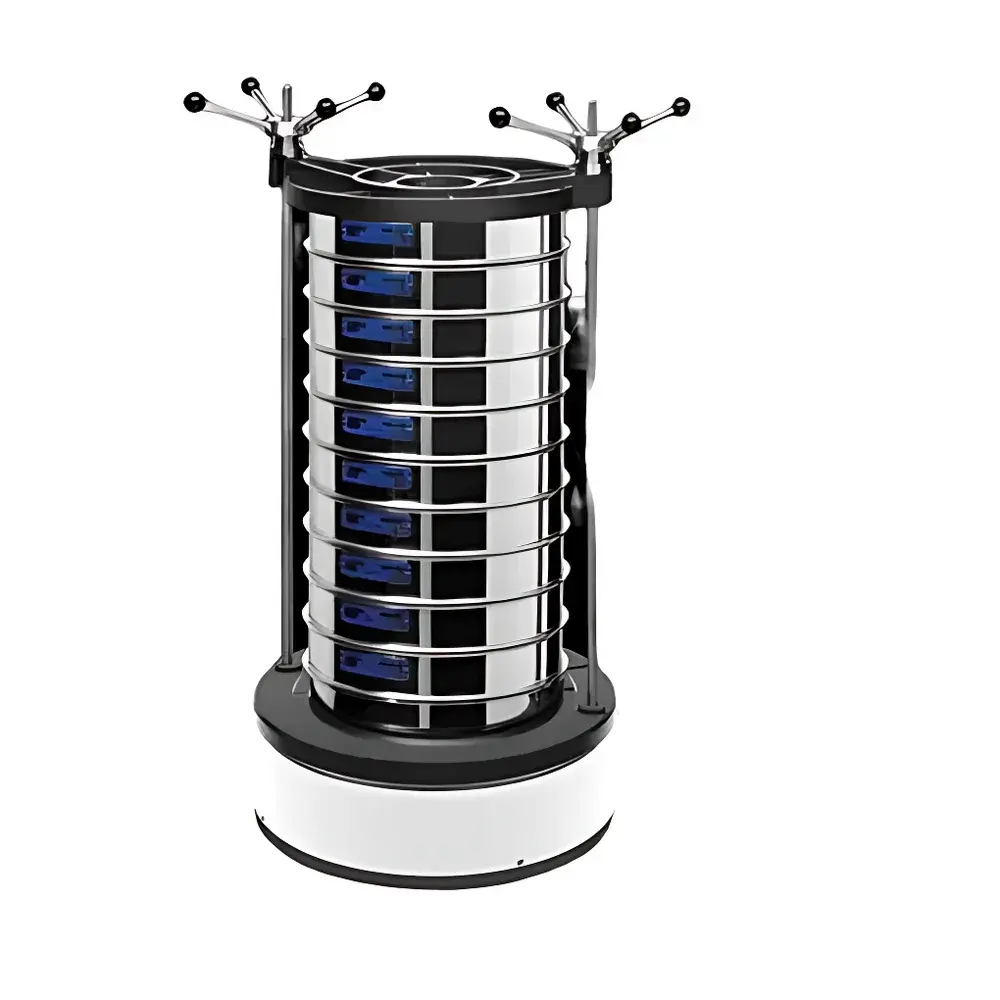
RETSCH AS 450 BASIC Digital Vibratory Sieve Shaker
| Brand | RETSCH |
|---|---|
| Origin | Germany |
| Model | AS 450 BASIC |
| Principle | Electromagnetically Driven 3D Vibratory Sieving |
| Measurement Range | 25 µm – 125 mm |
| Maximum Load Capacity | 15 kg |
| Sieve Stack Capacity | 12 sieves (standard configuration) |
| Adjustable Parameters | Digital time setting (0.1–999.9 min), digital amplitude control (0–3 mm), programmable pause intervals |
| Memory | 1 user-defined method |
| Drive Type | Electromagnetic, maintenance-free |
| Operation Panel | Detachable, ergonomically positioned |
Overview
The RETSCH AS 450 BASIC is a digitally controlled vibratory sieve shaker engineered for precise, reproducible dry and wet particle size analysis in laboratory and quality control environments. It operates on the principle of electromagnetic 3D vibratory motion—generating a controlled, multi-directional oscillation that ensures uniform sample dispersion across the full active surface of each sieve. This motion profile minimizes particle segregation, prevents blinding, and maximizes sieving efficiency—particularly critical when analyzing cohesive, fine, or irregularly shaped powders. Designed as the entry-level variant of the AS 450 platform, the BASIC model retains the core mechanical integrity and metrological reliability of its higher-tier counterparts while streamlining functionality to meet cost-sensitive yet technically demanding applications. Its robust cast-aluminum housing, vibration-damped base, and sealed electromagnetic drive unit deliver long-term stability under repeated high-load operation (up to 15 kg per run), making it suitable for routine QC workflows in pharmaceuticals, construction materials, minerals, food, and ceramics.
Key Features
- Electromagnetic 3D vibratory drive: Maintenance-free, silent, and highly responsive—enabling precise amplitude modulation (0–3 mm) without mechanical wear or lubrication requirements.
- Digital parameter control: Independent adjustment of sieving time (0.1–999.9 minutes), amplitude (in 0.1-mm increments), and optional intermittent pauses to optimize separation for challenging materials.
- Single-method memory storage: One complete sieving protocol—including time, amplitude, and pause settings—can be saved and recalled instantly for repeatable operator-independent execution.
- Detachable ergonomic control panel: Mounted on a flexible arm for optimal viewing and reach; reduces operator fatigue during extended batch processing.
- High-capacity sieve stack support: Accommodates up to 12 standard ISO 3310-1 or ASTM E11 sieves (diameter 200 mm or 203 mm) with integrated clamping and automatic centering alignment.
- Robust industrial-grade construction: Vibration-isolated base, reinforced frame, and IP54-rated enclosure ensure durability in shared lab environments and compliance with ISO 16882 for sieve shaker performance verification.
Sample Compatibility & Compliance
The AS 450 BASIC supports both dry and wet sieving protocols, accommodating a broad spectrum of particulate materials—from brittle mineral aggregates and metal powders to hygroscopic APIs and food-grade starches. Its 25 µm–125 mm analytical range covers coarse gravel fractions through ultrafine technical ceramics, with consistent reproducibility validated per ISO 9276-1 (representation of particle size distributions) and ISO 2591-1 (test sieving methods). The instrument complies with CE marking requirements under the EU Machinery Directive 2006/42/EC and meets essential safety and EMC standards (EN 61000-6-2, EN 61000-6-4). While not inherently GLP/GMP-certified, its deterministic digital controls, non-volatile parameter storage, and absence of analog dials facilitate audit-ready documentation when integrated into validated SOPs—especially when paired with RETSCH’s optional documentation software or external LIMS interfaces.
Software & Data Management
The AS 450 BASIC operates as a standalone hardware platform with no embedded PC or proprietary software suite. All operational parameters are set and monitored via its integrated LED display and membrane keypad. However, it is fully compatible with external data capture systems: weight values from analytical balances can be manually entered or auto-imported via RS-232 or USB-serial adapters (using standard ASCII protocols). For laboratories requiring electronic records compliant with FDA 21 CFR Part 11, the device may be operated within a validated procedural framework where parameter settings, start/stop timestamps, and sieve stack configurations are logged externally. Method traceability is supported through its single-program memory, enabling unambiguous linkage between physical sieving runs and associated documentation.
Applications
- Pharmaceutical QC: Granule and excipient particle size distribution assessment per USP and Ph. Eur. 2.9.32.
- Construction materials: Aggregate gradation analysis for concrete and asphalt specifications (ASTM C136, EN 933-1).
- Mineral processing: Liberation size determination and mill product classification verification.
- Food & feed: Flour fineness testing, spice particle homogeneity checks, and pet food kibble size grading.
- Recycled materials: Sorting efficiency evaluation of shredded plastics, e-waste, or battery black mass.
- Research labs: Method development for novel powder formulations where rapid, repeatable dry/wet sieving is required prior to laser diffraction or image analysis.
FAQ
Is the AS 450 BASIC suitable for wet sieving?
Yes—it is equipped with a corrosion-resistant stainless-steel base plate and compatible with RETSCH’s wet-sieving accessories, including splash guards and liquid collection trays.
Can I upgrade the AS 450 BASIC to the AS 450 CONTROL later?
No—the BASIC and CONTROL models differ in firmware architecture, control board design, and memory capacity; retrofitting is not supported by RETSCH.
What sieve diameters does it support?
Standard compatibility includes 200 mm and 203 mm diameter test sieves conforming to ISO 3310-1, ASTM E11, and DIN 4188.
Does it meet ISO/IEC 17025 requirements for accredited testing labs?
The instrument itself is not certified, but its performance characteristics—traceable amplitude calibration, stable frequency output, and documented repeatability—support compliance when used within a validated measurement system and accompanied by periodic verification using certified reference standards.
How often does the drive require servicing?
The electromagnetic drive is sealed and maintenance-free for the lifetime of the instrument under normal operating conditions; no lubrication or component replacement is specified by RETSCH.
Related Products



