
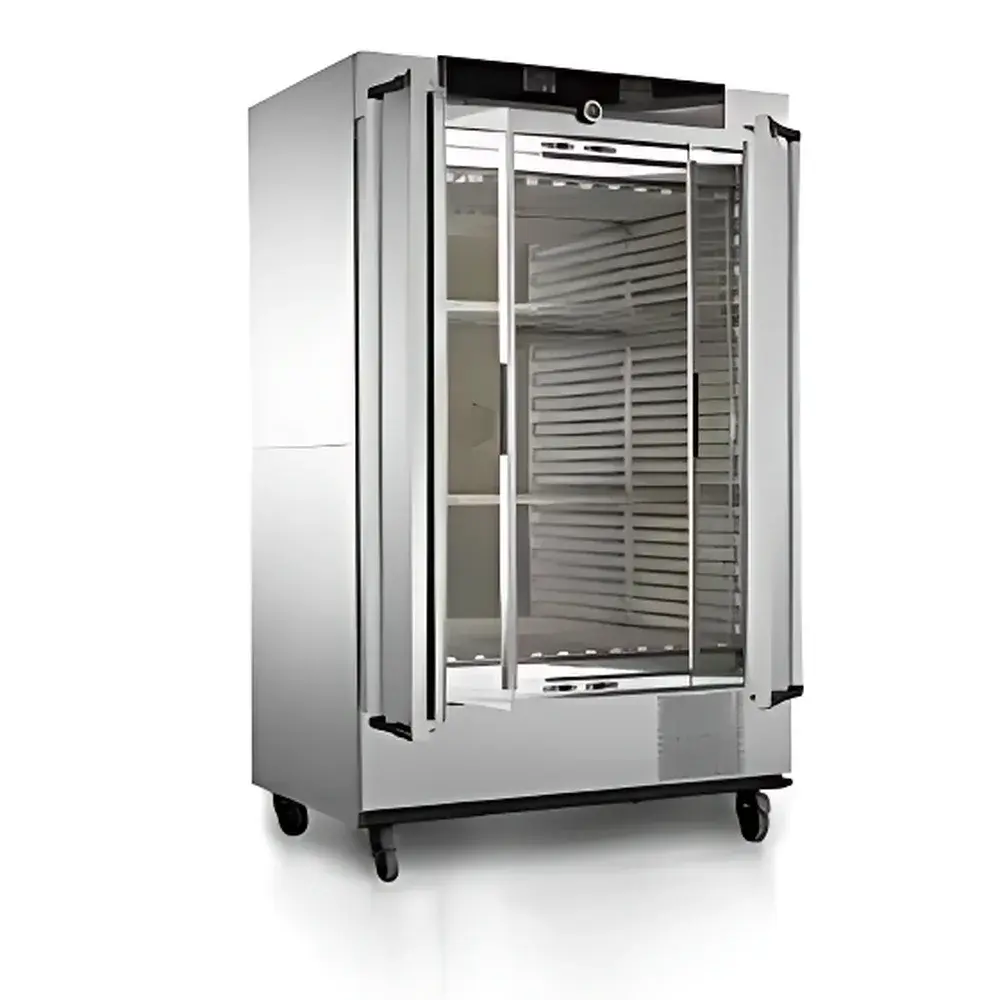
MEMMERT ICP/IPP Low-Temperature Biochemical Incubators
| Brand | MEMMERT |
|---|---|
| Origin | Germany |
| Model Series | ICP / IPP |
| Temperature Range (ICP) | 0 °C to 60 °C |
| Temperature Range (IPP) | +5 °C to +60 °C |
| Temperature Uniformity (ICP) | ±0.3 °C at 10 °C, ±0.2 °C at 37 °C |
| Temperature Uniformity (IPP) | < ±0.3 °C from 10 °C to 37 °C |
| Temperature Stability (IPP) | ±0.05 °C |
| Control Precision | ±0.1 °C |
| Sensor Type | Dual 4-wire PT100 |
| Heating System | Enclosed hot-air jacket (ICP) |
| Refrigerant (ICP) | R134a (CFC-free) |
| Chamber Material | Stainless steel (AISI 304) |
| Door Construction | Double-door — inner tempered glass, outer stainless steel |
| Air Exchange | Adjustable in 10% increments |
| Controller | Fuzzy logic PID with programmable ramp profiles (up to 40 segments, 1 min–999 h) |
| Memory | 1024 kB cyclic data logging |
| Interface | RS232 / RS485 (Celsius 2005 compatible), parallel printer port |
| Optional Storage | 32 kB Memory Card |
| Certification | IQ/OQ documentation available |
| Software Compliance | Celsius 2005 FDA Edition supports 21 CFR Part 11 audit trail, electronic signatures, and user access control (User-ID Card required) |
Overview
The MEMMERT ICP and IPP low-temperature biochemical incubators are precision-engineered environmental chambers designed for stable, reproducible temperature control in life science laboratories. Both series operate on the fundamental principle of active thermal regulation—ICP models utilize a compressor-based refrigeration system with an enclosed hot-air jacket for uniform heat distribution, while IPP models employ solid-state Peltier elements for bidirectional thermoelectric heating and cooling. This distinction makes the IPP series particularly suited for applications requiring silent operation, zero refrigerant emissions, compact footprint, and energy-efficient cycling between ambient and sub-ambient temperatures. Engineered in Bühl, Germany, and manufactured to DIN EN ISO 9001 standards, these incubators meet stringent requirements for cell culture, microbiological growth studies, enzyme kinetics, and stability testing under GLP and GMP frameworks.
Key Features
- High-precision dual 4-wire PT100 sensors ensure traceable, drift-compensated temperature measurement with ±0.1 °C control accuracy.
- Fuzzy logic PID controller enables adaptive response to load changes and door openings, maintaining stability within ±0.05 °C (IPP) or ±0.2 °C (ICP at 37 °C).
- Double-door design: Inner laminated safety glass minimizes condensation and enables non-intrusive observation; outer stainless steel door provides thermal insulation and mechanical durability.
- Adjustable air exchange (10% increments) supports aerobic culture conditions while minimizing humidity loss and cross-contamination risk.
- Programmable 40-segment ramp profiles (1 minute to 999 hours) allow complex thermal protocols—including stepwise acclimatization, circadian rhythm simulation, and accelerated aging studies.
- Robust stainless steel (AISI 304) chamber construction ensures corrosion resistance, ease of decontamination (e.g., VHP or ethanol wipe-down), and compliance with ISO 14644-1 Class 5 cleanroom-compatible handling.
Sample Compatibility & Compliance
These incubators accommodate standard laboratory vessels including Petri dishes, multiwell plates, flasks (Erlenmeyer, roller bottles), and bioreactor bags (up to 10 L). The uniform airflow geometry and minimized thermal gradients (< ±0.3 °C across working volume) support consistent growth kinetics for mammalian, bacterial, fungal, and insect cell lines. Both ICP and IPP models conform to IEC 61010-1 for electrical safety and carry CE marking. Optional IQ/OQ documentation packages align with ASTM E2500, EU Annex 15, and FDA Process Validation Guidance. The IPP series meets RoHS Directive 2011/65/EU due to its refrigerant-free design, while the ICP series uses R134a—a zero-ozone-depletion-potential (ODP), low-global-warming-potential (GWP) hydrofluorocarbon.
Software & Data Management
Integrated RS232/RS485 interfaces enable seamless connectivity with MEMMERT’s Celsius 2005 software suite. The FDA Edition version complies with 21 CFR Part 11 requirements, providing electronic signature capability, role-based user authentication (via optional User-ID Cards), immutable audit trails, and secure data export (CSV, PDF). Onboard 1024 kB memory logs temperature, setpoint, and alarm events in cyclic mode; optional 32 kB Memory Card extends archival capacity. Real-time monitoring, remote parameter adjustment, and automated report generation support quality management systems compliant with ISO/IEC 17025 and CAP accreditation standards.
Applications
- Long-term storage and growth of psychrotolerant microorganisms (e.g., Pseudomonas fluorescens, Lactobacillus spp.) at controlled sub-30 °C conditions.
- Enzyme activity assays requiring precise thermal ramps and dwell times (e.g., Taq polymerase characterization, cold-active protease profiling).
- Stability testing of biologics, vaccines, and diagnostic reagents per ICH Q5C guidelines.
- Cell line maintenance during cryopreservation recovery phases where gradual rewarming is critical.
- Environmental simulation for ecotoxicology studies involving aquatic or soil-derived isolates.
- QC/QA workflows in pharmaceutical manufacturing environments governed by EU GMP Annex 11 and USP endotoxin testing protocols.
FAQ
What distinguishes the ICP from the IPP series in terms of thermal performance?
The ICP uses compressor-driven refrigeration with R134a and achieves 0 °C minimum; the IPP relies on Peltier modules, limiting its lower range to +5 °C but offering superior noise reduction (<35 dB(A)), zero refrigerant use, and faster thermal reversibility.
Are calibration certificates included with shipment?
Yes—each unit ships with factory-issued calibration certificates traceable to DKD/DAkkS standards at 10 °C and 37 °C, valid for 12 months from date of issue.
Can the incubator be integrated into a LIMS or MES environment?
Yes—Celsius 2005 FDA Edition supports OPC UA and Modbus TCP gateways for enterprise-level data integration, enabling automated batch record linkage and electronic lab notebook (ELN) synchronization.
Is validation support available for GxP-regulated facilities?
MEMMERT provides full IQ/OQ protocol templates, test scripts, and witnessed execution services through authorized partners—fully aligned with FDA, EMA, and PMDA expectations for equipment qualification.
How is humidity managed inside the chamber?
Neither ICP nor IPP models include active humidification; however, optional external humidifiers (e.g., MEMMERT HPP series) can be coupled via ducted interface for applications requiring >70% RH control.





