
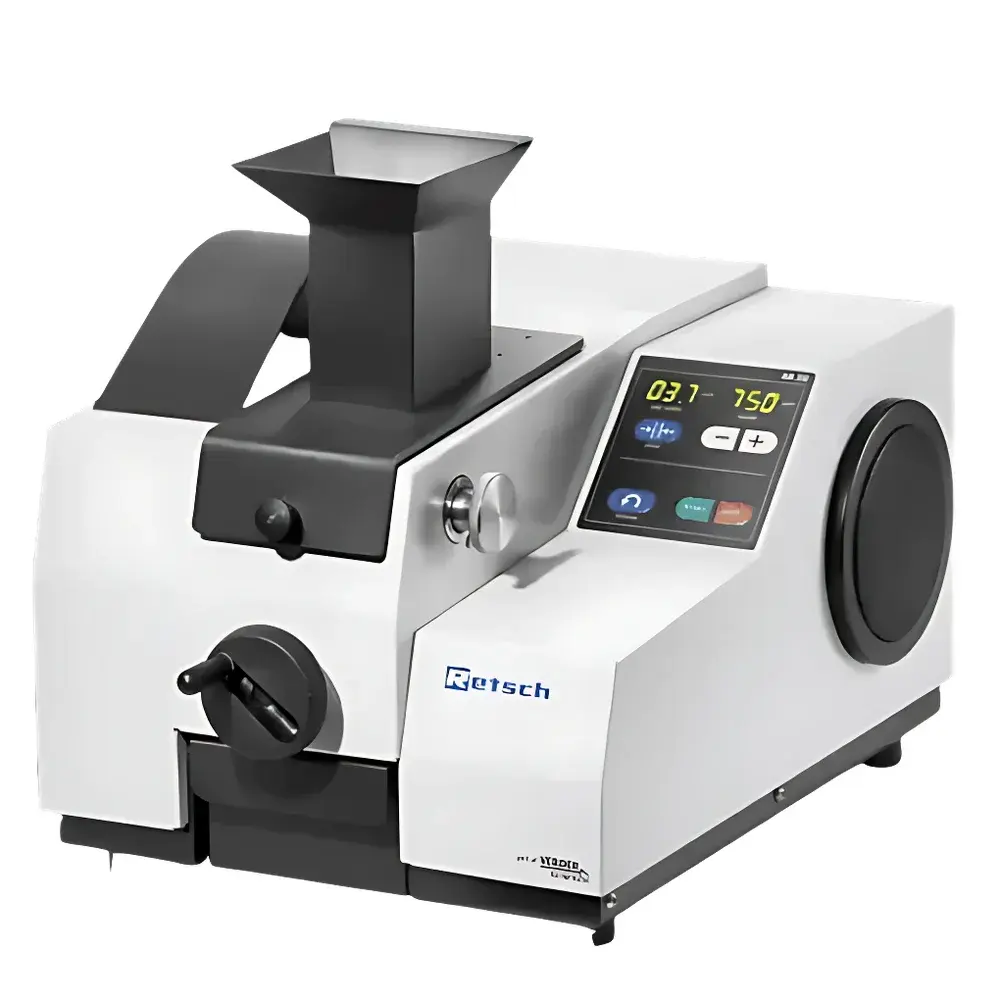
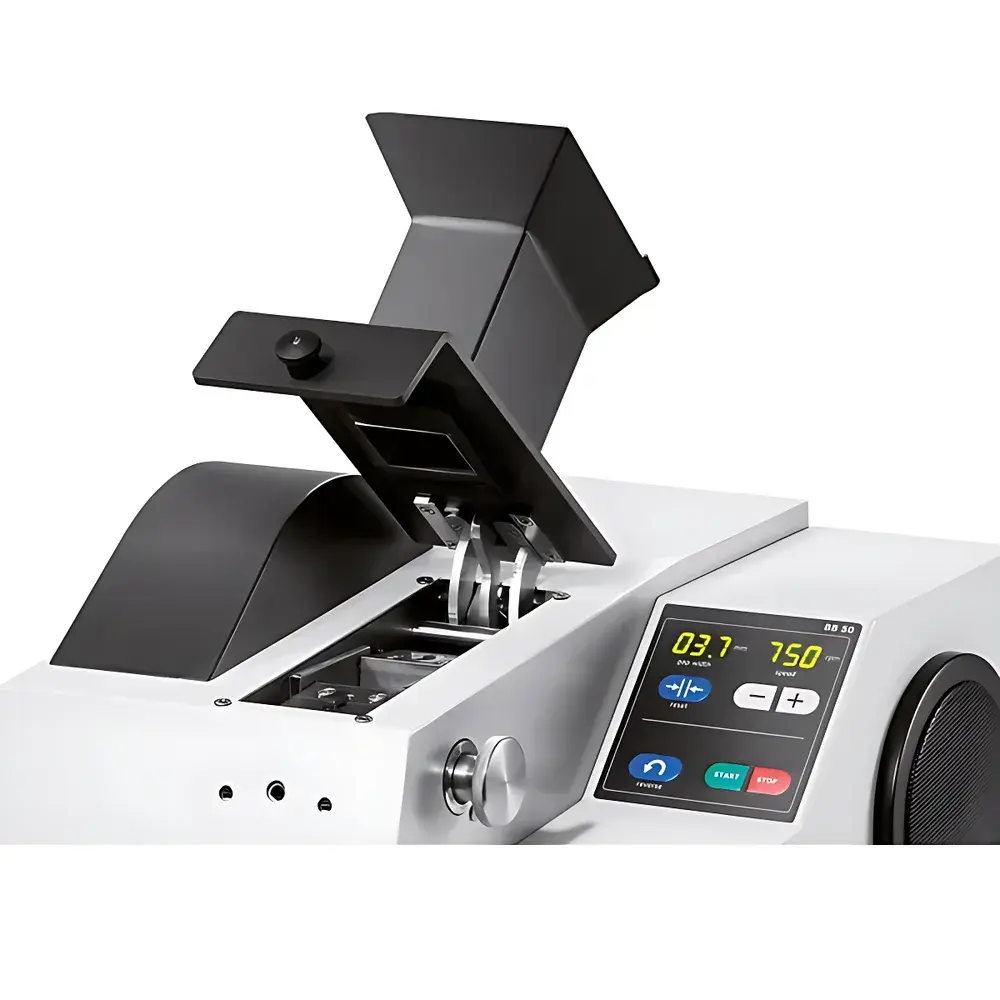
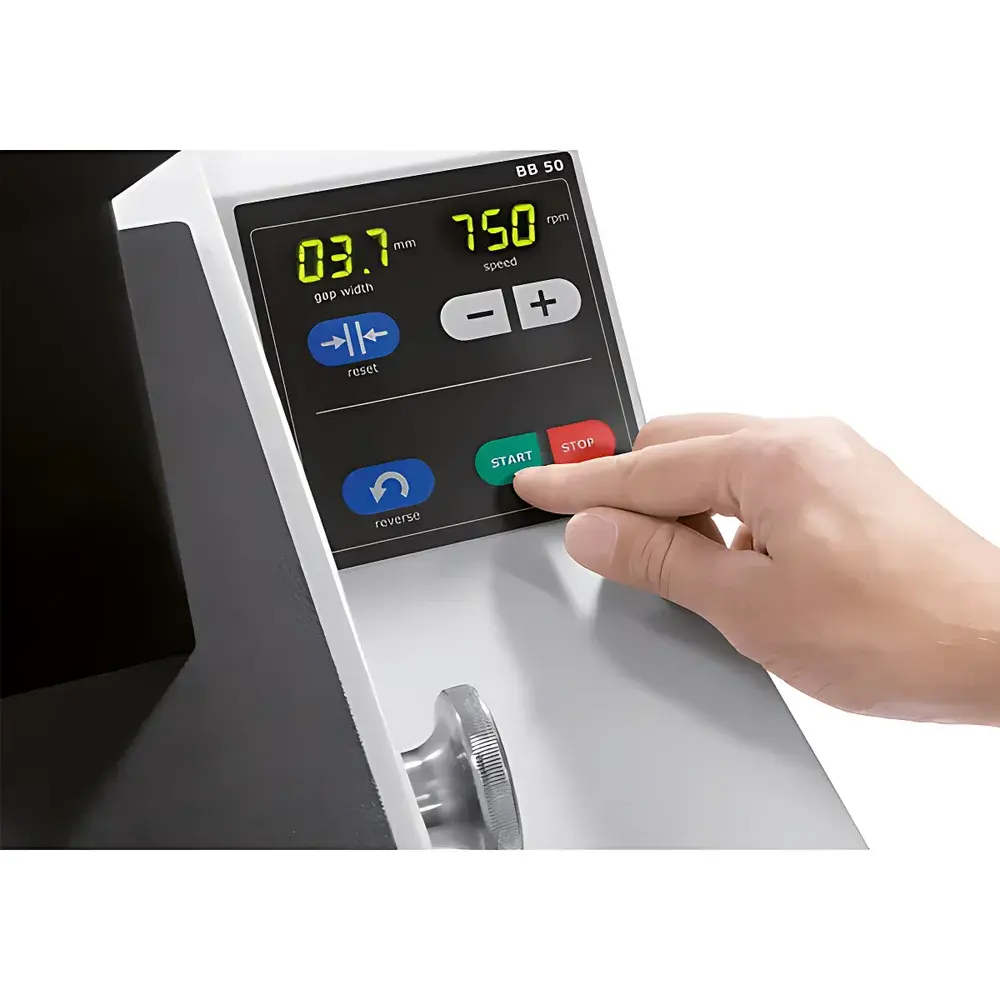
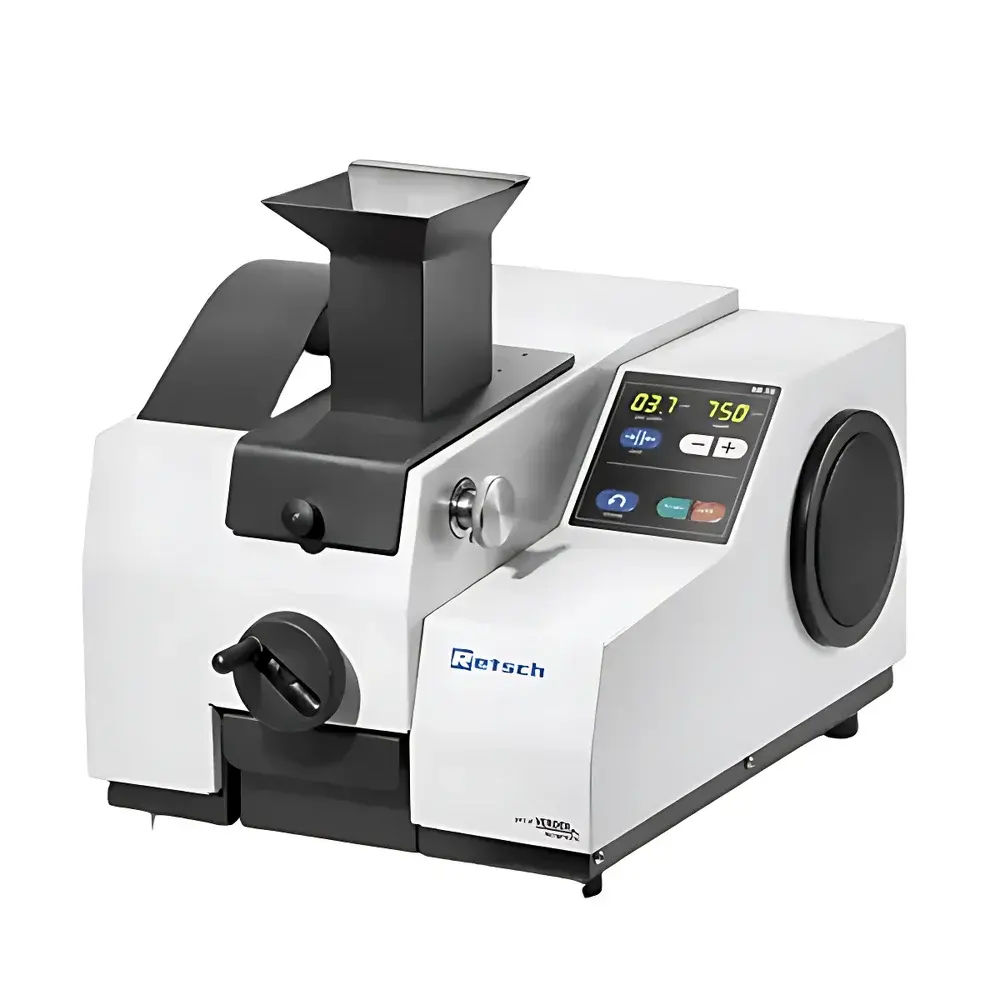
RETSCH BB 50 Jaw Crusher
| Brand | RETSCH |
|---|---|
| Origin | Germany |
| Model | BB 50 |
| Crusher Type | Laboratory Jaw Crusher |
| Sample Hardness | Medium-hard to hard, brittle materials |
| Max. Feed Size | < 40 mm |
| Final Particle Size | ≤ 0.5 mm |
| Batch Capacity | 3 L |
| Jaw Plate Width | 45 × 59 mm |
| Adjustable Grinding Gap | 0–11 mm (0.1 mm increments) |
| Digital Gap Display | Yes |
| Zero-point Calibration | Yes |
| Counter-rotating Drive | Yes |
| Reversible Funnel | Yes |
| Dust-tight Sealing Option | Yes |
| Central Lubrication System (Optional) | Yes |
| Motor Power | 1100 W |
| Drive | Three-phase frequency-controlled motor |
| Voltage Options | Configurable for regional single-phase supply |
| Protection Class | IP 20 / IP 00 at ventilation slots |
| Dimensions (W × H × D) | 420 × 460 × 560 mm |
| Net Weight | ~79 kg |
| Compliance | CE-marked |
| Grinding Chamber Materials | Manganese steel, stainless steel (1.4404), tungsten carbide, zirconium oxide, steel 1.1750 (heavy-metal-free option) |
Overview
The RETSCH BB 50 Jaw Crusher is a compact, benchtop laboratory crusher engineered for reliable and reproducible coarse comminution of solid, medium-hard to hard, and brittle materials. Operating on the principle of compressive crushing—where material is subjected to controlled mechanical pressure between two opposing jaw plates—the BB 50 delivers consistent particle size reduction without sample loss or thermal degradation. Designed as the smallest model in RETSCH’s jaw crusher series, it occupies minimal bench space while maintaining industrial-grade robustness and precision engineering typical of German-manufactured laboratory instrumentation. Its application scope spans preparatory steps prior to analytical techniques such as X-ray fluorescence (XRF), X-ray diffraction (XRD), elemental analysis (ICP-OES/MS), and wet chemical digestion. The device complies with CE safety directives and is constructed to meet long-term operational stability under routine laboratory conditions.
Key Features
- Adjustable grinding gap (0–11 mm) with digital display and zero-point calibration function—enabling automatic compensation for jaw plate wear and ensuring inter-batch reproducibility.
- Counter-rotating drive system that enhances crushing efficiency and minimizes vibration during operation.
- Reversible funnel design for flexible feed orientation and optimized material flow into the crushing chamber.
- Modular grinding set options—including manganese steel, stainless steel (1.4404), tungsten carbide, zirconium oxide, and low-contamination steel 1.1750—supporting application-specific requirements including heavy-metal-free sample preparation for pharmaceutical or environmental testing.
- Dust-tight sealing interface (optional) compatible with vacuum dust extraction systems, supporting occupational health compliance (e.g., OSHA PEL or EU Directive 2004/37/EC).
- Centralized lubrication system (available as optional upgrade) ensures uniform grease distribution across moving parts, extending service intervals and reducing maintenance downtime.
Sample Compatibility & Compliance
The BB 50 is validated for processing heterogeneous solids across diverse sectors: geological core samples, metallurgical alloys, ceramic and glass fragments, agricultural grains, pharmaceutical tablets, and biological tissues after freeze-drying. It accommodates feed particles up to 40 mm in maximum dimension and reduces them to a final top size of ≤ 0.5 mm—suitable for downstream homogenization or analytical subsampling. All grinding sets comply with ISO 8502-3 for surface cleanliness and are traceable per batch documentation. For regulated environments, the instrument supports GLP-compliant operation when integrated with electronic logbooks and audit-trail-enabled data acquisition systems. While not intrinsically compliant with FDA 21 CFR Part 11, its digital gap control and calibration logging functions provide foundational elements for validation protocols in GMP laboratories.
Software & Data Management
The BB 50 operates as a standalone mechanical unit without embedded software; however, its digital gap display and zero-point calibration interface generate timestamped parameter records accessible via external documentation workflows. Users may integrate operational logs—including batch number, feed size estimation, gap setting, and run duration—into LIMS or ELN platforms using manual entry or barcode-scanned metadata. Optional accessories include a programmable timer relay and analog output signals for remote status monitoring (e.g., run/completed/error states). No proprietary firmware or cloud connectivity is included, preserving data sovereignty and simplifying IT validation in secure research or quality control facilities.
Applications
- Agricultural science: Preparing soil, grain, and plant tissue samples for nutrient profiling and pesticide residue analysis.
- Pharmaceutical R&D: Reducing tablet formulations or excipient blends prior to dissolution testing or content uniformity assessment (USP <701>).
- Geochemistry and mining: Crushing drill core segments for bulk geochemical screening (e.g., ICP-MS multi-element analysis).
- Construction materials: Fragmenting concrete, asphalt, or refractory ceramics for phase composition evaluation via XRD.
- Environmental testing: Processing contaminated soils or sediment composites for TCLP or SPLP leaching studies (EPA Method 1311/1312).
FAQ
What types of materials can be processed in the BB 50?
The BB 50 is suitable for medium-hard to hard, brittle materials—including minerals, ores, ceramics, metals, pharmaceuticals, and dried biological matter. It is not recommended for fibrous, elastic, or highly adhesive substances.
Is the BB 50 compatible with regulatory documentation requirements?
Yes—its mechanical design, CE marking, and repeatable gap calibration support integration into GLP/GMP workflows when paired with procedural documentation and equipment qualification (IQ/OQ/PQ).
Can the BB 50 be used for heavy-metal-free sample preparation?
Yes—steel 1.1750 grinding sets are specifically engineered to eliminate Fe, Cr, Ni, and Mo leaching, meeting ASTM D5687 and ISO 17294-2 requirements for trace-metal analysis.
What maintenance is required for long-term reliability?
Routine inspection of jaw plate wear, periodic greasing (or activation of central lubrication), and verification of gap calibration every 50 operating hours are recommended per RETSCH Maintenance Guide No. MA-BB50-EN.
Does the BB 50 support automated feeding or continuous operation?
No—it is designed exclusively for discrete batch processing (max. 3 L per cycle) and requires manual loading and unloading. Continuous feed systems are available in larger RETSCH models (e.g., BB 200).



