
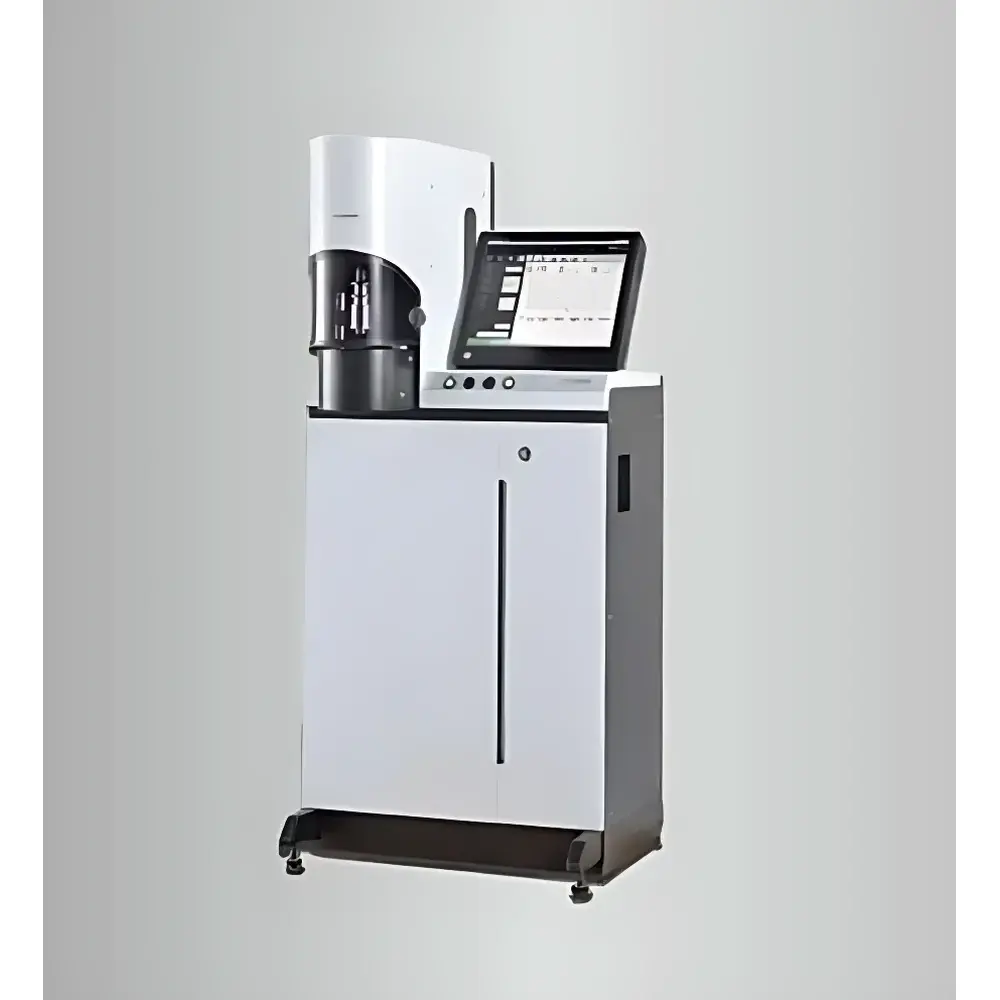
Shimadzu CFT-500EX/100EX Capillary Rheometer
| Brand | Shimadzu |
|---|---|
| Origin | Japan |
| Model | CFT-500EX / CFT-100EX |
| Temperature Range | 20–400 °C |
| Temperature Accuracy | ±0.2 °C |
| Temperature Resolution | 0.1 °C |
| Displacement Range | 15 mm |
| Displacement Resolution | 0.01 mm |
| Sample Volume | ≤1.5 cm³ |
| Viscosity Range | 1×10¹–1×10⁶ Pa·s (CFT-500EX) |
| Heating Method | Resistive Wire |
| Load Application | Dead-Weight Piston |
| Test Modes | Isothermal & Ramp (Rising-Temperature) |
Overview
The Shimadzu CFT-500EX and CFT-100EX Capillary Rheometers are precision instruments engineered for the quantitative characterization of melt and paste rheology under controlled thermal and mechanical conditions. Based on the capillary flow principle—governed by the Hagen–Poiseuille equation—the system measures shear stress, shear rate, and apparent viscosity of thermoplastic polymers, thermosets, elastomers, ceramic slurries, food pastes, cosmetic gels, pharmaceutical suspensions, and industrial inks. Unlike rotational rheometers, capillary rheometry provides direct access to high-shear-rate behavior (>100 s⁻¹) critical for extrusion, injection molding, and coating process simulation. The CFT series employs a dead-weight piston loading mechanism, ensuring stable, traceable normal force application without servo-induced noise or compliance artifacts. Its resistive wire heating system delivers uniform axial temperature profiles across the die assembly, enabling reliable evaluation of thermal transitions such as softening onset, melt flow initiation, and degradation thresholds.
Key Features
- Two-tier model configuration: CFT-500EX for high-viscosity materials (up to 1×10⁶ Pa·s) and CFT-100EX optimized for low-to-mid viscosity samples (down to 2.5 Pa·s), facilitating broad material coverage without cross-contamination or recalibration overhead.
- Wide operational temperature range (20–400 °C) with ±0.2 °C accuracy and 0.1 °C resolution, validated per ASTM D3835 and ISO 11443 calibration protocols.
- Dual test methodology support: isothermal mode for steady-state viscosity profiling and programmed temperature ramp mode for detecting thermal transition points—including flow onset temperature (FOT) and melt fracture thresholds.
- Integrated wind-shield enclosure minimizes convective heat loss and ambient drafts, improving thermal stability during long-duration tests and enhancing repeatability across multi-hour runs.
- High-resolution linear displacement sensing (0.01 mm) over a 15 mm stroke enables precise determination of piston travel velocity, essential for accurate shear rate calculation at low flow rates.
- Modular die system accommodates standardized L/D ratios (e.g., 10:1, 20:1, 30:1) and interchangeable capillary diameters (0.5–2.0 mm), supporting Bagley and Rabinowitsch corrections for entrance pressure loss and non-Newtonian wall slip compensation.
Sample Compatibility & Compliance
The CFT-500EX/100EX accepts solid pellets, granules, powders, and pre-compounded pastes with maximum sample volume of 1.5 cm³—sufficient for full thermal equilibration and multiple extrusion cycles per charge. It complies with international standards including ASTM D3835 (Standard Test Method for Determining the Melt Flow Rate of Thermoplastics), ISO 11443 (Plastics — Determination of the Fluidity of Thermoplastics Using Capillary Rheometers), and JIS K 7199. When operated with optional data audit trail and user access control modules, the system supports GLP and GMP environments compliant with FDA 21 CFR Part 11 requirements for electronic records and signatures.
Software & Data Management
Shimadzu’s dedicated CFT Analysis software provides real-time visualization of viscosity vs. shear rate, viscosity vs. temperature, and pressure vs. time curves. Raw displacement and load data are acquired at ≥100 Hz sampling rate and stored in vendor-neutral ASCII format for third-party analysis. The software implements automatic Bagley correction, Rabinowitsch–Mooney wall-slip analysis, and Arrhenius activation energy estimation from temperature-ramp datasets. All test parameters, operator IDs, calibration certificates, and instrument logs are embedded in metadata-rich output files, ensuring full traceability for internal QA audits and regulatory submissions.
Applications
- Thermoplastic resin development: melt index prediction, shear-thinning exponent (n) and consistency index (K) extraction for Cross or Carreau modeling.
- Thermoset formulation screening: monitoring viscosity build during cure induction and gel point detection via rapid ramp testing.
- Carbon toner rheology: evaluating hot-offset resistance and fusing window through low-shear viscosity plateau and high-shear thinning behavior.
- Ceramic green body extrusion: slurry yield stress and plastic viscosity assessment for die design validation.
- Pharmaceutical hot-melt extrusion (HME): polymer–API miscibility screening and processing window definition using temperature-dependent viscosity mapping.
- Food texture engineering: starch gelatinization onset, protein denaturation thresholds, and fat crystal network disruption temperatures.
FAQ
What types of materials are compatible with the CFT-500EX/100EX?
Thermoplastics (e.g., PP, PE, PC), thermosetting resins (epoxy, phenolic), elastomers (silicone, SBR), ceramic and metal powder feedstocks, food pastes (dough, batter), cosmetic emulsions, pharmaceutical excipients, and conductive inks.
Does the system support automated calibration verification?
Yes—Shimadzu provides NIST-traceable reference oils and certified calibration kits for routine verification of temperature, load, and displacement sensors per ISO/IEC 17025 guidelines.
Can the CFT series integrate with LIMS or enterprise QA systems?
Via optional OPC UA or CSV export modules, raw and processed data can be routed to laboratory information management systems (LIMS) or MES platforms while preserving audit trail integrity.
Is wall-slip correction available for filled or particulate systems?
Yes—the software includes Rabinowitsch–Mooney iterative algorithms to correct for apparent shear thinning induced by particle migration or interfacial slippage at the capillary wall.
What safety features are built into the instrument?
Overtemperature cutoff, emergency stop circuit, shielded heating zone, and interlocked wind-shield door prevent operator exposure to >200 °C surfaces and ensure compliance with IEC 61010-1 safety standards.



