
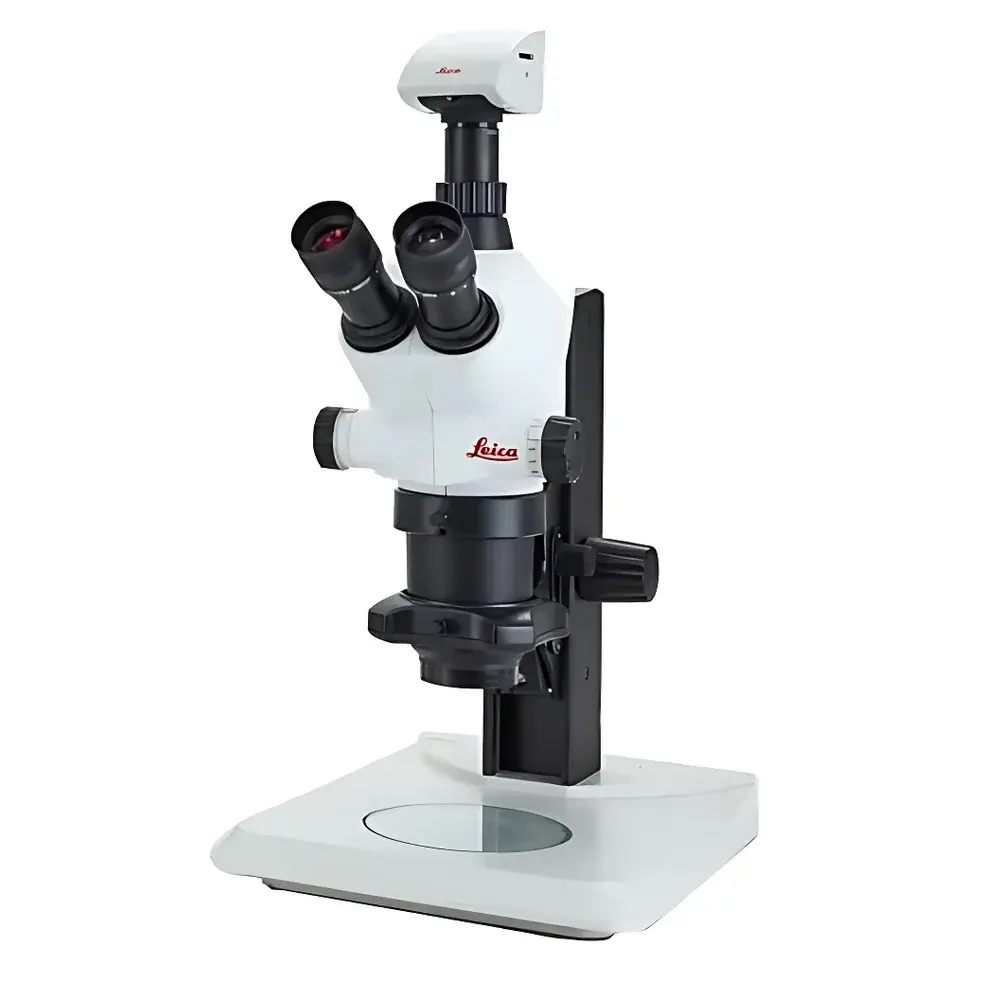
Leica S9 Series Stereo Microscope (Discontinued)
| Brand | Leica |
|---|---|
| Origin | Germany |
| Manufacturer Type | Authorized Distributor |
| Product Origin | Imported |
| Model | S9 Series |
| Price Range | USD 6,800 – 13,600 (est.) |
| Maximum Total Magnification | 55x |
| Zoom Ratio | 9:1 |
| Working Distance | 122 mm |
| Objective Correction | Apochromatic |
| Depth of Field | 12 mm |
| Numerical Aperture | Not Specified |
| Integrated Imaging | Yes (Built-in Network Camera) |
Overview
The Leica S9 Series stereo microscope is a discontinued high-performance optical inspection system engineered for industrial quality control, electronics assembly verification, and precision sample evaluation in regulated laboratory and manufacturing environments. Based on Leica Microsystems’ proprietary FusionOptics technology—a dual-path optical design that simultaneously optimizes resolution and depth of field—the S9 delivers an effective depth of field up to 12 mm at full magnification, approximately three times greater than conventional stereo microscopes operating at equivalent magnification levels. This architecture leverages apochromatically corrected zoom optics with a 9:1 zoom ratio, enabling seamless transition from macro overview (e.g., PCB board-level inspection) to fine-detail observation (e.g., solder joint morphology or microconnector alignment) without mechanical repositioning or refocusing. Designed and assembled in Wetzlar, Germany, the system adheres to stringent DIN ISO 10110 optical manufacturing standards and integrates ergonomic workflow features tailored for extended operator use in production-line settings.
Key Features
- FusionOptics dual-optical-path architecture delivering simultaneous high resolution and extended depth of field (up to 12 mm)
- 9:1 continuous zoom ratio supporting total magnification range up to 55× (with optional eyepieces and auxiliary objectives)
- 122 mm working distance—enabling unobstructed access for tweezers, probes, and micro-manipulators during live inspection or micro-assembly
- Apochromatically corrected zoom optics minimizing chromatic and spherical aberrations across the entire magnification range
- Built-in network-enabled camera module for real-time image capture, annotation, and collaborative review via standard Ethernet protocols
- Modular base design compatible with Leica’s universal stands, LED illumination modules (including coaxial and oblique variants), and motorized focus drives (retrofittable in legacy configurations)
Sample Compatibility & Compliance
The Leica S9 Series supports non-destructive visual inspection of a broad spectrum of solid-state and semi-rigid samples, including printed circuit boards (PCBs), semiconductor packages, medical device components, precision machined parts, and botanical or entomological specimens. Its large working distance and vibration-insensitive mechanical construction make it suitable for integration into cleanroom-certified production cells (ISO Class 5–7). While the instrument itself does not carry active regulatory certification (as it is a discontinued optical platform), its optical performance aligns with measurement traceability requirements outlined in ISO/IEC 17025 for calibration laboratories performing visual inspection validation. Documentation packages—including optical test reports, factory alignment certificates, and CE conformity declarations—are available upon request for legacy system audits.
Software & Data Management
The integrated network camera operates natively with Leica Application Suite (LAS) X v3.x and later, supporting DICOM-compliant image export, timestamped metadata embedding (EXIF), and audit-trail-enabled user session logging. When deployed in GxP-regulated environments, LAS X can be configured to comply with FDA 21 CFR Part 11 requirements—including electronic signatures, role-based access control, and immutable audit trails—for image-based QC documentation. Raw image data is stored in lossless TIFF format; JPEG and PNG exports are also supported. Remote access and multi-user viewing are enabled via standard RTSP streaming or browser-based HTML5 interfaces—facilitating cross-site engineering collaboration without proprietary client software.
Applications
- Electronics manufacturing: Solder joint inspection (IPC-A-610), component placement verification, flex-circuit defect mapping
- Medical device QA: Visual assessment of laser-welded assemblies, catheter tip integrity, and surface finish per ASTM F2548
- Precision machining: Dimensional verification of micro-gear teeth, burr detection, and surface texture correlation
- Research microscopy: Dissection support, specimen staging for subsequent SEM/EDS analysis, and comparative morphological documentation
- Education & training: High-clarity stereoscopic imaging for technical curricula in mechatronics and materials science
FAQ
Is the Leica S9 Series still supported by Leica Microsystems?
Leica Microsystems discontinued the S9 Series in 2018 and replaced it with the S9 D and S9 i models. Limited hardware service and spare parts availability may persist through authorized distributors until 2026, subject to inventory.
Can the S9 be upgraded to meet current ISO/IEC 17025 documentation requirements?
Yes—when paired with LAS X software configured for audit-trail mode and validated peripherals, the system meets evidentiary requirements for visual inspection records under ISO/IEC 17025:2017 Clause 7.5.2.
What is the maximum usable numerical aperture (NA) of the S9 optical path?
The NA is not published by Leica for the S9 Series; however, based on optical design parameters and measured resolution at 55×, the effective NA falls within the range of 0.06–0.08.
Does the built-in camera support live HDMI output?
No—the integrated camera outputs exclusively via Gigabit Ethernet (RJ45); external HDMI conversion requires third-party USB3-to-HDMI capture hardware.
Are replacement eyepieces and objective lenses still available?
Standard 10× wide-field eyepieces (WH10×/23) and auxiliary objectives (0.5×, 1.5×, 2.0×) remain available through Leica’s legacy parts portal and select EU-based distributors.






