
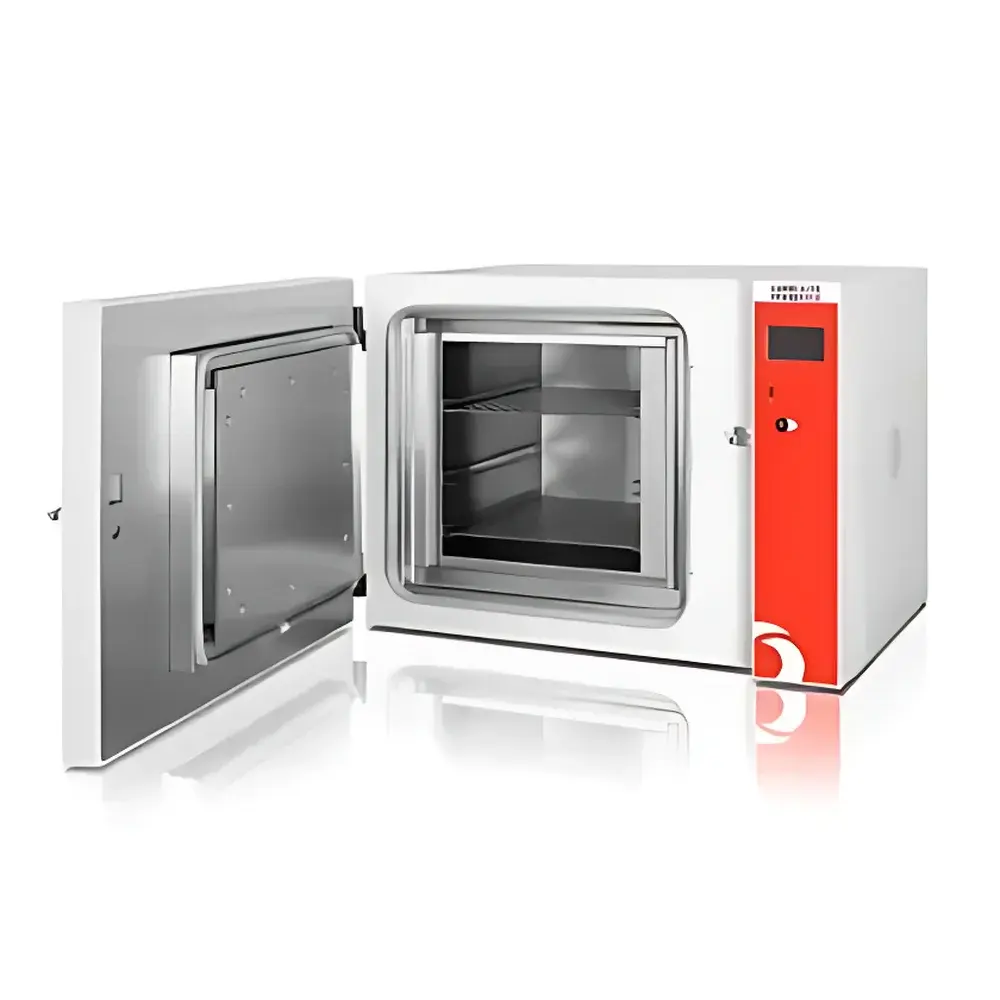
Carbolite Gero LHT Series High-Temperature Laboratory Oven
| Brand | Carbolite Gero |
|---|---|
| Origin | United Kingdom |
| Instrument Type | Benchtop Box Furnace |
| Model | LHT |
| Temperature Range | 400 °C / 500 °C / 600 °C (selectable by configuration) |
| Chamber Volume | 30 L / 60 L / 120 L |
| Control System | R38 PID Controller with Digital Display |
| Heating Uniformity | ±2 °C at maximum operating temperature |
| Insulation | Low-density, high-purity ceramic fiber board |
| Interior Material | Brushed stainless steel (AISI 304), corrosion-resistant |
| Fan-Assisted Convection | Integrated axial flow fan for enhanced thermal homogeneity |
| Energy Efficiency | Optimized thermal mass and insulation design |
| Accessories | Dual-position crucible holders standard |
| Compliance | Designed to meet IEC 61000-6-2 (EMC immunity) and IEC 61010-1 (safety for laboratory equipment) |
Overview
The Carbolite Gero LHT Series is a precision-engineered benchtop box furnace designed for controlled high-temperature thermal processing in research laboratories, quality control environments, and small-scale production settings. Operating on resistive heating principles with optimized radiant and forced-convection heat transfer, the LHT delivers stable, repeatable thermal profiles across its rated temperature range — up to 600 °C depending on model configuration. Its architecture integrates a low-thermal-mass chamber lined with corrosion-resistant AISI 304 stainless steel and insulated with high-purity, low-conductivity ceramic fiber boards. This combination ensures rapid ramp rates, minimal energy consumption per cycle, and long-term dimensional stability of internal geometry under repeated thermal cycling. Unlike traditional muffle furnaces relying solely on radiant heating, the LHT employs an integrated axial-flow convection fan that actively circulates heated air within the chamber, significantly improving temperature uniformity (±2 °C at setpoint) and reducing process variability — a critical requirement for applications such as ashing, drying, calcination, and pre-conditioning of reference materials.
Key Features
- Three standard chamber volumes (30 L, 60 L, 120 L) to accommodate varying sample throughput and spatial constraints
- Selectably rated maximum temperatures: 400 °C, 500 °C, or 600 °C — configured at time of order to match application-specific thermal demands
- R38 digital PID controller with programmable ramp/soak profiles, real-time temperature logging, and user-defined alarm thresholds
- Forced-air convection system with variable-speed fan control to maintain consistent airflow without turbulence-induced sample displacement
- Lightweight, low-thermal-conductivity ceramic fiber insulation — reduces standby heat loss by >40% compared to conventional brick-lined furnaces
- Corrosion-resistant brushed stainless steel interior (AISI 304) with seamless welds and rounded corners for ease of cleaning and residue removal
- Standard dual-position crucible support rack engineered for uninterrupted sequential processing; compatible with alumina, quartz, and silicon carbide fixtures
- Exterior housing finished with electro-galvanized steel substrate and epoxy-polyester powder coating for mechanical durability and chemical resistance
Sample Compatibility & Compliance
The LHT series accommodates a broad range of sample formats including crucibles (up to Ø100 mm × 80 mm height), petri dishes, ceramic boats, and custom fixtures mounted on the included dual-rack system. Its inert stainless-steel chamber and absence of organic binders in insulation materials prevent catalytic interference during ashing or thermal decomposition assays. The furnace conforms to IEC 61010-1:2010 for electrical safety in laboratory equipment and meets electromagnetic compatibility requirements per IEC 61000-6-2. While not certified for Class I Div 1 hazardous locations, it is suitable for use in ISO 17025-accredited laboratories performing thermal methods referenced in ASTM E166, ISO 1171, and USP . Optional data export via RS485 interface supports integration into GLP/GMP workflows requiring audit-trail-capable temperature records.
Software & Data Management
The R38 controller provides local parameter configuration and real-time monitoring via a high-contrast LCD display with tactile keypad navigation. All temperature programs — including multi-step ramps, holds, and cooling profiles — are stored in non-volatile memory. Optional PC connectivity (via RS485-to-USB adapter) enables remote operation and data capture using Carbolite Gero’s proprietary LHT Control Suite (Windows-compatible). This software supports CSV export of time-stamped temperature logs, event annotation (e.g., door opening, alarm activation), and generation of PDF reports compliant with 21 CFR Part 11 requirements when used with validated electronic signature modules. Audit trail functionality records operator ID, timestamp, and parameter changes — essential for regulatory submissions and internal QA reviews.
Applications
- Gravimetric moisture and ash content determination per AOAC 925.09, ASTM D2974, and ISO 5984
- Thermal pre-treatment of catalyst supports, battery electrode materials, and ceramic precursors
- Stabilization annealing of metal alloys and oxide powders prior to XRD or SEM analysis
- Drying of hygroscopic standards and reference materials under controlled ambient exclusion
- Pre-baking of glassware and quartz components in semiconductor metrology labs
- Calibration verification of thermocouples and RTDs using fixed-point reference blocks
FAQ
What is the typical temperature uniformity specification across the working volume?
At maximum operating temperature, the LHT achieves ±2 °C uniformity (measured per IEC 60068-3-5) at nine standardized points within the usable chamber space.
Can the LHT be operated under inert or reducing atmospheres?
Standard models are designed for ambient air operation only; optional gas-tight versions with flanged ports and purge fittings are available upon request for N₂ or Ar purging.
Is calibration documentation provided with shipment?
Each unit ships with a factory-issued calibration certificate traceable to UKAS-accredited standards, covering thermocouple linearity and controller accuracy at three temperature points (100 °C, 300 °C, and max setpoint).
What maintenance intervals are recommended for optimal performance?
Fan bearing inspection every 12 months; ceramic fiber integrity assessment every 24 months or after 500 thermal cycles above 500 °C; PID controller verification annually using external reference thermometer.
Are replacement parts such as heating elements and insulation kits available separately?
Yes — Carbolite Gero maintains full spare parts inventory for the LHT series, including zone-specific heating elements, R38 controller PCBs, and field-replaceable ceramic fiber liner kits with installation guides.



