
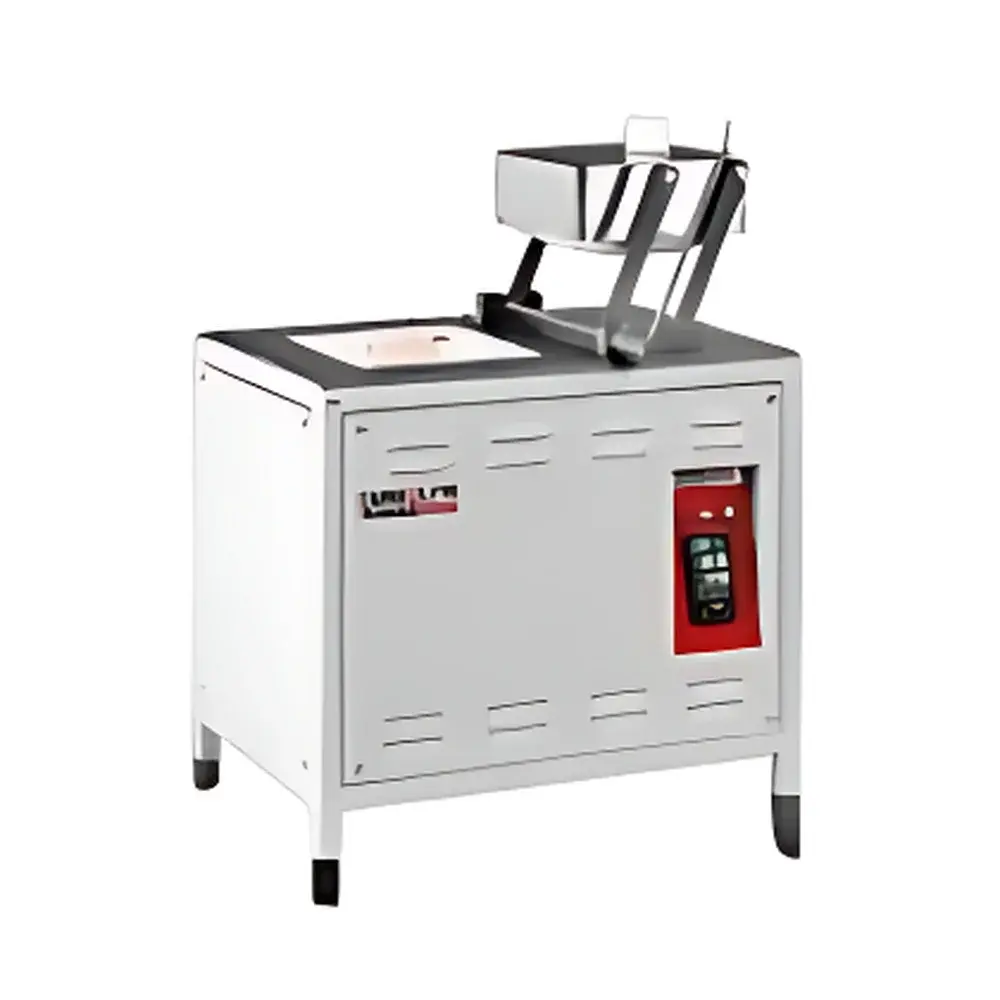
Carbolite Gero VCF Top-Loading Box Furnace
| Brand | Carbolite Gero |
|---|---|
| Origin | Germany |
| Model | VCF |
| Type | Box Furnace |
| Heating Method | Full-Radiation Resistance Wire, Four-Side Heating |
| Door Configuration | Top-Hinged Tilted Opening |
| Control System | PID301 Standard Controller (Single-Stage Programmable) |
| Thermocouple | Ceramic-Protected Type K |
| Available Chamber Volumes | 5 L, 10 L, 23 L, 100 L |
| Maximum Operating Temperature | 1200 °C |
Overview
The Carbolite Gero VCF is a precision-engineered top-loading box furnace designed for demanding thermal processing applications in research laboratories, quality control environments, and industrial R&D settings. Utilizing full-radiation resistance wire heating elements mounted on all four chamber walls, the VCF ensures uniform temperature distribution and exceptional thermal stability across its entire working volume — a critical requirement for reproducible heat treatment, ashing, sintering, calcination, and preheating protocols. Its top-hinged, tilt-opening door provides unobstructed vertical access to the chamber, minimizing heat loss during sample loading and enabling safe handling of hot crucibles or ceramic boats without lateral obstruction. Engineered for long-term reliability under continuous operation, the VCF complies with IEC 61000-6-3 (EMC) and IEC 61000-6-2 (immunity), and features robust thermal insulation using high-purity alumina-silica fiber modules rated for sustained service at 1200 °C.
Key Features
- Four-wall radiant heating architecture delivering ±1.5 °C temperature uniformity (measured at 1200 °C, per ISO 9001 calibration protocol)
- Top-hinged, pneumatically assisted tilt door with safety interlock — prevents operation when open and limits radiant exposure during access
- PID301 digital controller with single-segment programmable ramp-soak functionality, RS485 Modbus RTU interface, and configurable alarm thresholds
- Ceramic-sheathed Type K thermocouple (IEC 60584 compliant) integrated into the rear wall for stable, drift-resistant temperature feedback
- Chamber volumes available in four standardized configurations: 5 L (VCF-5), 10 L (VCF-10), 23 L (VCF-23), and 100 L (VCF-100), all with identical thermal performance specifications
- Front-mounted, ergonomically angled control panel with tactile buttons and high-contrast LED display — optimized for glove-compatible operation and seated laboratory workflows
- Double-layer stainless steel housing with passive air-cooling channels to maintain external surface temperature below 55 °C at maximum setpoint
Sample Compatibility & Compliance
The VCF accommodates standard laboratory crucibles (alumina, quartz, silicon carbide), ceramic boats, and refractory trays up to 150 mm in height (for VCF-5/10) or 250 mm (for VCF-23/100). Its inert, oxidation-resistant chamber lining eliminates catalytic interference during organic ashing or metal oxide synthesis. The furnace meets EN 61000-3-2 (harmonic current emissions) and carries CE marking under the EU Machinery Directive 2006/42/EC and Low Voltage Directive 2014/35/EU. Optional factory calibration certificates traceable to UKAS or DAkkS are available upon request, supporting GLP and ISO/IEC 17025 compliance requirements. While not intrinsically safe, the VCF may be integrated into Class 1 Div 2 environments when installed with appropriate ventilation and purge controls per NFPA 86 guidelines.
Software & Data Management
The PID301 controller supports data logging via optional USB memory stick (up to 10,000 timestamped records) and real-time monitoring through Carbolite Gero’s free LabManager Lite software (Windows-compatible, no license required). LabManager Lite enables remote setpoint adjustment, profile upload/download, and CSV export of temperature/time/alarms — facilitating audit-ready documentation for FDA 21 CFR Part 11–aligned workflows when paired with user-defined electronic signatures. All firmware updates are delivered via encrypted firmware packages validated against SHA-256 checksums. Event logs retain power-failure timestamps and controller-initiated fault codes (e.g., “TC Open”, “Overtemp Alarm”) for root-cause analysis during process validation.
Applications
- Gravimetric ash content determination per ASTM D3174 and ISO 1171
- Pre-oxidation of catalyst supports and battery cathode precursors (LiCoO₂, NMC)
- Thermal gravimetric analysis (TGA) sample conditioning prior to differential scanning calorimetry
- Heat treatment of dental alloys and biomedical titanium components (per ISO 22674 Annex B)
- Residue ignition in pharmaceutical residual solvent testing (USP <467>)
- Calibration of secondary temperature sensors using fixed-point cells (Zn, Al, Ag)
FAQ
What is the recommended maintenance interval for the VCF furnace?
Carbolite Gero recommends visual inspection of heating elements and insulation integrity every 200 operating hours, with thermocouple verification and controller calibration annually or per internal QA schedule.
Can the VCF be operated under inert gas or vacuum conditions?
The standard VCF is configured for ambient-air operation only. For controlled-atmosphere use, specify the VCF-G variant with gas inlet/outlet ports, flanged viewport, and optional mass flow controller integration.
Is the PID301 controller compatible with SCADA systems?
Yes — via Modbus RTU over RS485, the controller supports read/write access to setpoint, PV, alarm status, and program stage index, enabling seamless integration with Siemens SIMATIC, Rockwell Allen-Bradley, or Ignition SCADA platforms.
Does the VCF support multi-segment temperature programming?
The base PID301 offers single-ramp/soak capability. Multi-segment profiles require upgrade to the optional PID302 controller (8-stage programmable) or integration with LabManager Pro software.
What safety certifications does the VCF hold for North American markets?
Units supplied to the U.S. and Canada include ETL listing to UL 61010-1 and CAN/CSA C22.2 No. 61010-1, covering electrical safety, fire hazard, and mechanical stability under ANSI Z535-compliant labeling.



