
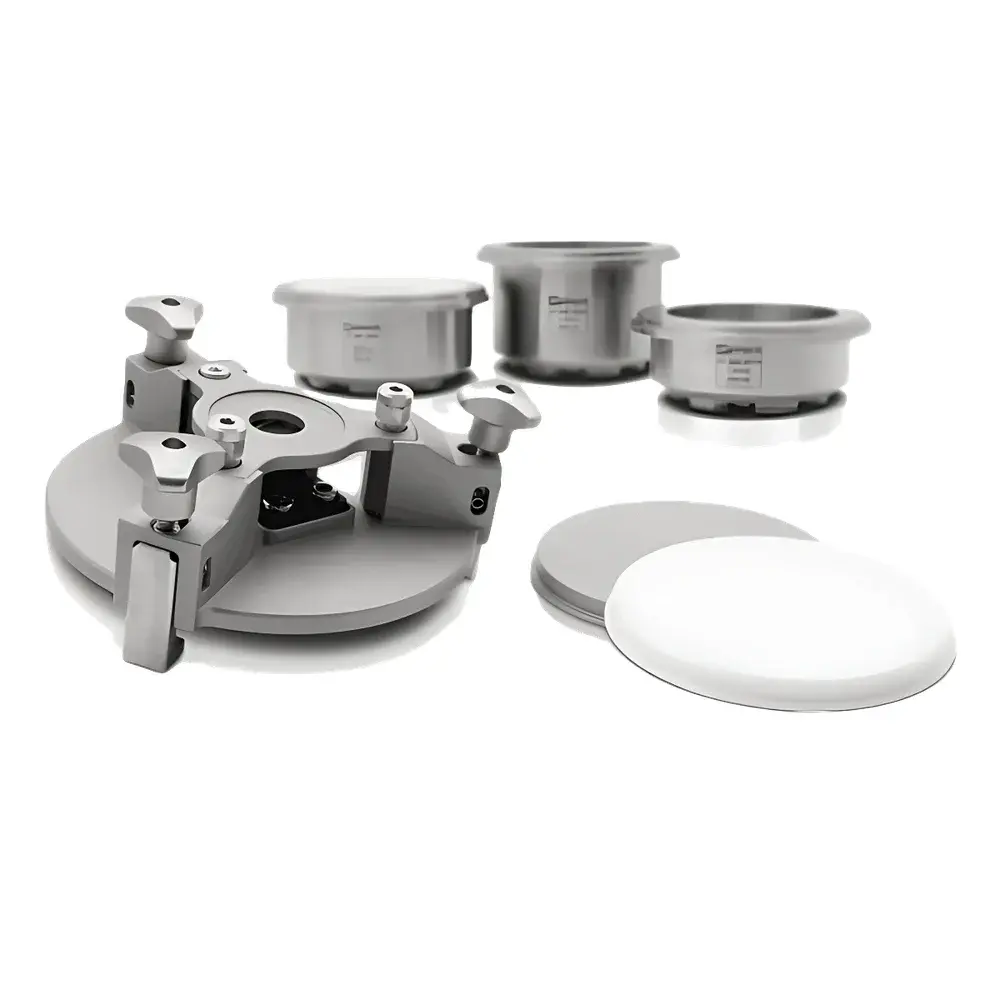
RETSCH PM GRINDCONTROL Grinding Monitoring System
| Brand | RETSCH |
|---|---|
| Origin | Germany |
| Model | PM GRINDCONTROL |
| Instrument Type | Planetary Ball Mill Monitoring System |
| Sample Compatibility | Hard and Brittle Materials |
| Pressure Range | 0–500 kPa |
| Temperature Range | –45 °C to +110 °C (continuous operation up to +85 °C) |
| Wireless Transmission Range | Up to 5 m (indoor, line-of-sight) |
| Battery Life | Up to 150 hours (full charge) |
| Compatible Vessels | Stainless steel grinding jars, 250 mL and 500 mL |
| Data Interface | USB-connected receiver with Windows 10-compatible software |
| Signal Protocol | Industrial-grade unidirectional digital transmission, up to 200 data points per second |
| Software Localization | Multilingual (English, German, French, Spanish, Chinese, Japanese) |
Overview
The RETSCH PM GRINDCONTROL is an integrated real-time monitoring system designed exclusively for planetary ball mills—specifically engineered to capture and log two critical thermodynamic process parameters: internal jar temperature and pressure. Unlike conventional grinding systems where process conditions remain opaque, the PM GRINDCONTROL enables in-situ quantification of energy transfer, exothermic reaction onset, phase transitions, and gas evolution during high-energy mechanical alloying, mechanochemical synthesis, or reactive milling. Its core measurement principle relies on miniature, intrinsically safe wireless transmitters embedded within standardized stainless-steel grinding jars (250 mL and 500 mL), operating under the extreme mechanical stress, centrifugal forces (>30 g), and thermal gradients typical of planetary ball milling. The system does not require any modification to the host mill (e.g., RETSCH PM 100, PM 200, PM 400), preserving original equipment integrity and CE-compliant safety architecture.
Key Features
- Non-invasive, battery-powered transmitter unit housed inside the grinding jar lid—designed for direct contact with process environment without compromising sealing or rotational balance
- Simultaneous dual-parameter acquisition: high-stability platinum RTD (Pt1000) for temperature (–45 °C to +110 °C; ±0.5 °C accuracy at 25 °C) and piezoresistive MEMS sensor for absolute pressure (0–500 kPa; ±2 kPa full-scale)
- Industrial-grade 2.4 GHz ISM-band wireless protocol ensuring electromagnetic compatibility (EMC) in laboratory environments with multiple RF sources
- Unidirectional data transmission at up to 200 Hz sampling rate—optimized for temporal resolution of rapid thermal events (e.g., ignition in solvent-free reactions)
- Robust aluminum transit case (IP65-rated) containing transmitter, receiver, calibration certificate, USB interface cable, and multilingual software suite
- No firmware updates required on mill controller; fully decoupled from mill’s operational firmware stack
Sample Compatibility & Compliance
The PM GRINDCONTROL is validated for use with hard, brittle, and moderately ductile materials—including metal oxides, intermetallic precursors, ceramics, and pharmaceutical co-crystal formers—where conventional thermal analysis (e.g., DSC) fails due to sample mass limitations or inert atmosphere constraints. It complies with ISO 17025 requirements for measurement traceability, with factory calibration traceable to PTB (Physikalisch-Technische Bundesanstalt). All electronic components meet IEC 61000-4 immunity standards and operate within ATEX Zone 2 / UL Class I Div 2 ambient classification limits when used with sealed jars. Data logs are time-stamped and support GLP/GMP-aligned audit trails when exported via CSV or integrated into LIMS platforms.
Software & Data Management
The included Windows 10–native application (v3.x) provides real-time visualization of temperature/pressure curves synchronized with mill runtime, speed, and direction. Raw data export supports direct import into Microsoft Excel, MATLAB, or Python pandas workflows without proprietary format lock-in. The software implements FDA 21 CFR Part 11–compatible user access control (role-based login), electronic signature prompts for critical actions (e.g., calibration reset), and immutable log file generation with SHA-256 hash verification. Language modules include English, German, French, Spanish, Simplified Chinese, and Japanese—enabling multinational R&D team interoperability without translation latency.
Applications
- Mechanochemical synthesis pathway optimization—identifying optimal milling duration before decomposition or side-reaction onset
- Thermodynamic profiling of solid-state reactions (e.g., Li-ion cathode precursor formation, MOF crystallization)
- Process validation for regulatory submissions (ICH Q5, Q7) requiring documented thermal history of active pharmaceutical ingredients (APIs)
- Failure mode analysis in high-energy milling—correlating pressure spikes with jar deformation or media fracture
- Method development for amorphous phase stabilization—monitoring glass transition proxies via localized thermal relaxation events
- Energy efficiency benchmarking across mill models and jar geometries using normalized specific energy input (kWh/kg)
FAQ
Is the PM GRINDCONTROL compatible with non-RETSCH planetary ball mills?
Yes—provided the mill accepts standard DIN 4766-compliant stainless-steel jars (250 mL or 500 mL) and allows unobstructed 5-meter line-of-sight RF transmission between jar and receiver.
Does the transmitter require recalibration after each use?
No. Factory calibration remains stable over 500+ grinding cycles. Annual verification against NIST-traceable references is recommended for GLP compliance.
Can pressure data be used to quantify gas evolution during milling?
Yes—when combined with known jar free volume and temperature-corrected ideal gas law calculations, pressure rise rates provide semi-quantitative estimates of moles of evolved gas (e.g., H₂, NH₃, CO₂) per unit time.
What happens if the transmitter battery depletes mid-run?
The system logs a final timestamped value prior to shutdown; no data loss occurs. Battery replacement uses standard CR2450 cells—no soldering or tooling required.
Is raw signal latency compensated in software?
Yes—transmission delay (<10 ms) and USB polling jitter are corrected via software-side timestamp interpolation using monotonic clock synchronization.



