
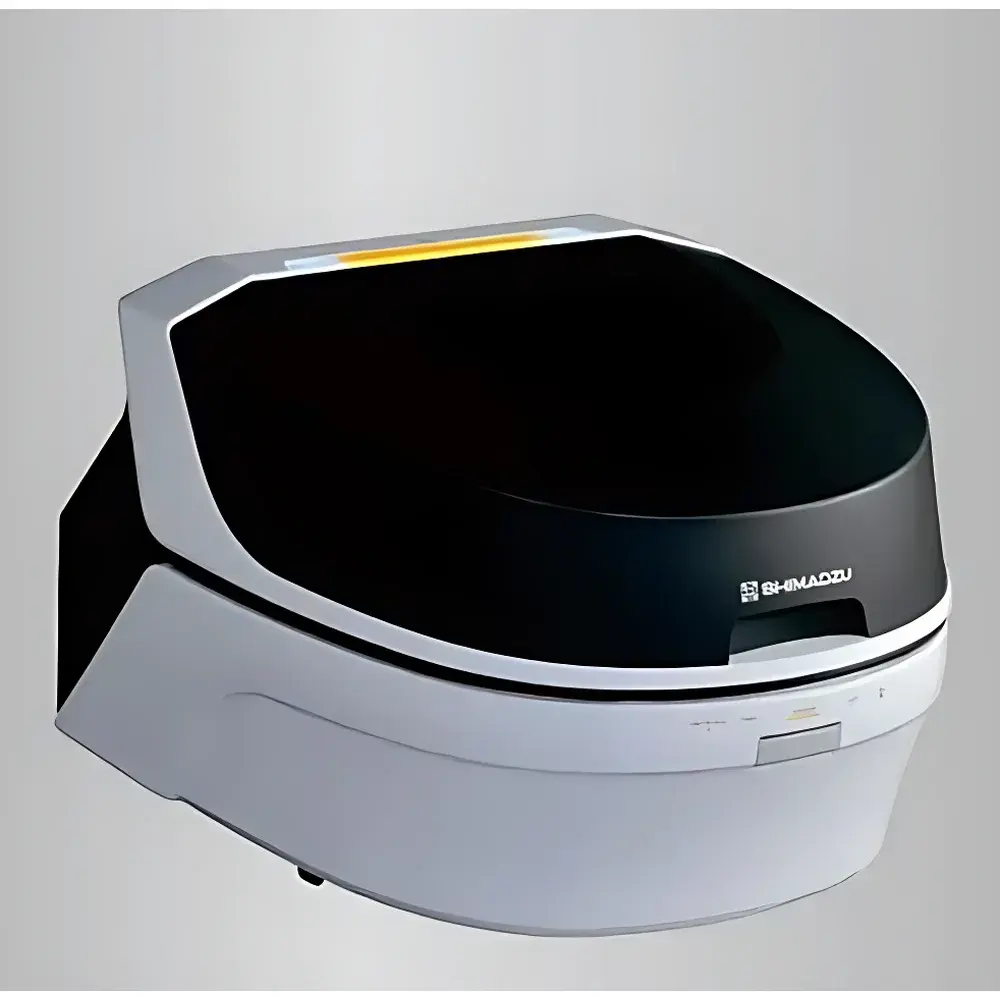
Shimadzu EDX-7000/8000/8100 Energy Dispersive X-Ray Fluorescence Spectrometer
| Brand | Shimadzu |
|---|---|
| Origin | Japan |
| Model | EDX-7000/8000/8100 |
| Elemental Range | C(6)–U(92) |
| Detection Limit | 1 ppm |
| Quantitative Range | 1 ppm–99.99% |
| Energy Resolution | <140 eV |
| Repeatability | <0.1% RSD |
| Sample Chamber Dimensions | 300 mm (W) × 275 mm (D) × 100 mm (H) |
| Excitation | Rh anode X-ray tube with automatic aging compensation |
| Detector | Silicon Drift Detector (SDD), Peltier-cooled |
| Atmosphere Options | Air, vacuum, or N₂ purge |
| Filter System | 5-position auto-switching + OPEN |
| Software Suite | Qualitative ID, quantitative analysis (fundamental parameters method), thin-film FP, background-subtracted FP |
Overview
The Shimadzu EDX-7000/8000/8100 series represents a high-performance line of benchtop and floor-standing energy dispersive X-ray fluorescence (EDXRF) spectrometers engineered for precision elemental analysis across diverse sample matrices. Based on the physical principle of X-ray fluorescence—where primary X-rays eject inner-shell electrons from atoms, inducing characteristic secondary X-ray emission—the system quantifies elemental composition by measuring the energy and intensity of emitted photons. The EDX-7000 supports detection from sodium (Na, Z=11) to uranium (U, Z=92), while the EDX-8000 and EDX-8100 extend sensitivity down to carbon (C, Z=6) via optimized vacuum/N₂-purged optical paths and enhanced low-energy detector response. All models integrate a high-stability rhodium-target X-ray tube with automated tube aging compensation, ensuring consistent excitation output over extended operational lifetimes without manual recalibration.
Key Features
- Silicon Drift Detector (SDD) with Peltier thermoelectric cooling—eliminates reliance on liquid nitrogen while maintaining sub-140 eV energy resolution at Mn Kα (5.9 keV), enabling robust peak separation for overlapping transitions (e.g., S Kα/Pb Mα, Cl Kα/Pb Lα).
- Automated 5-position primary filter changer plus OPEN position—dynamically optimizes excitation conditions for light elements (C–F), mid-Z elements (Na–Br), and heavy metals (Cd–U) within a single sequence.
- Multi-atmosphere sample chamber: configurable for ambient air (for stable solids), vacuum (for ultra-light element analysis and reduced scattering background), or nitrogen purge (for oxygen-sensitive or hygroscopic samples).
- Large-capacity sample chamber (300 × 275 × 100 mm) accommodates irregularly shaped objects, pressed pellets, liquid cells, and multi-sample holders—compatible with standardized ASTM E1621 and ISO 22058 workflows.
- Embedded hardware diagnostics and tube health monitoring—records cumulative exposure time, current/voltage stability, and spectral drift metrics traceable to GLP-compliant audit logs.
Sample Compatibility & Compliance
The EDX-7000/8000/8100 accepts solid blocks, alloys, ceramics, polymers, geological specimens, coated substrates, powders (with binder or pelletized), and homogeneous liquids in sealed cells. No destructive digestion or matrix-matching standards are required for routine screening. The system complies with IEC 61000-6-3 (EMC emissions), IEC 61000-6-2 (immunity), and meets radiation safety requirements per IEC 62495. Software supports 21 CFR Part 11-compliant user access control, electronic signatures, and immutable audit trails for regulated environments including ISO/IEC 17025-accredited testing labs and pharmaceutical QC laboratories adhering to USP /.
Software & Data Management
Shimadzu’s proprietary EDX Navigator software provides integrated qualitative peak identification using library-matched net intensity ratios and interference-corrected deconvolution. Quantitative modules implement fundamental parameter (FP) algorithms with matrix correction (ZAF or α-factor), thin-film FP for layered materials (e.g., electroplated coatings), and background FP for heterogeneous particulates. All calibrations are stored as encrypted .cal files with version timestamps. Raw spectra (.spe), processed reports (.pdf/.xlsx), and method templates (.mth) export directly to network drives or LIMS via configurable FTP/SFTP protocols. Batch processing supports up to 999 samples per queue with auto-resume after power interruption.
Applications
- RoHS/ELV compliance screening: rapid Pb, Cd, Hg, Cr(VI), Br screening in electronics, plastics, and metal components—validated against IEC 62321-5.
- Geochemical exploration: quantification of major oxides (SiO₂, Al₂O₃, Fe₂O₃) and trace metals (Ni, Cu, Zn, REEs) in soils and drill cores without fusion.
- Metallurgical QA: grade verification of stainless steels, aluminum alloys, and superalloys—including light-element interstitials (C, N, O) when operated under vacuum.
- Catalyst characterization: spatially resolved mapping (optional motorized stage) of Pt/Pd/Rh distribution in automotive three-way catalysts.
- Forensic material comparison: non-destructive differentiation of glass, paint chips, and soil evidence based on elemental fingerprinting.
FAQ
Does the EDX-8100 require liquid nitrogen for detector cooling?
No—the SDD is cooled exclusively via Peltier elements, achieving stable operation at –20 °C with <0.02 °C thermal drift over 8 hours.
Can the system analyze carbon in polymer films?
Yes—under high-vacuum conditions and with optimized Be window transmission, the EDX-8000/8100 achieves reliable C Kα detection with MDLs ≤500 ppm in 300 s counting time.
Is method transfer possible between EDX-7000 and EDX-8000 platforms?
Quantitative methods (.mth) are fully interoperable across the EDX-7000/8000/8100 family; only detector calibration and atmosphere settings require validation upon migration.
How is instrument performance verified post-installation?
Shimadzu provides certified reference materials (CRMs) including NIST SRM 2711a (Montana Soil) and BAM BCR-681 (Alloy Steel) for initial qualification and quarterly PQ checks per ISO/IEC 17025 Clause 7.7.
What data security controls are embedded in the software?
Role-based permissions (Administrator, Analyst, Reviewer), password-protected method editing, cryptographic hash logging of all spectrum acquisitions, and export encryption via AES-256 are enabled by default.





