
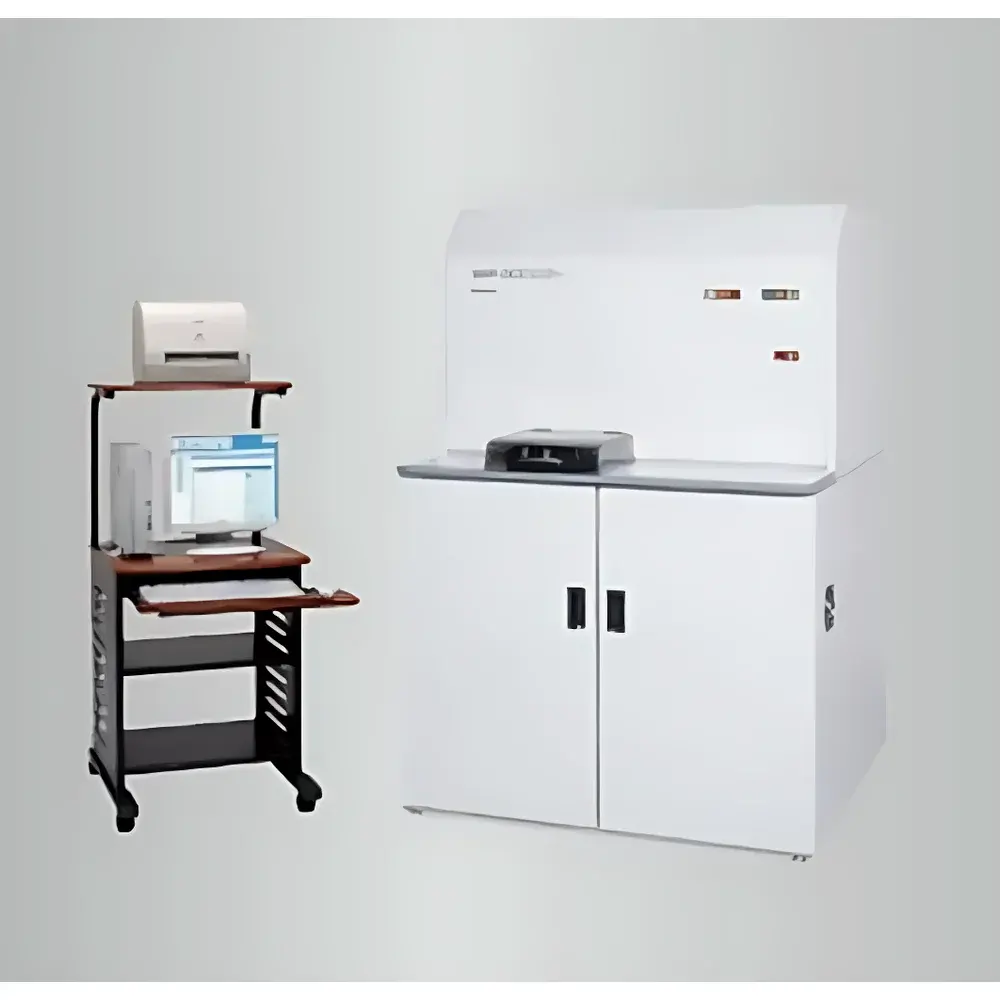
Shimadzu MXF-2400 Wavelength Dispersive X-Ray Fluorescence Spectrometer
| Brand | Shimadzu |
|---|---|
| Origin | Japan |
| Model | MXF-2400 |
| X-ray Tube Power | 4 kW |
| Elemental Range | Be (4) to U (92) |
| Simultaneous Channels | 36 (with optional sequential spectrometer for up to 48 elements) |
| Detection Limit | low ppm level |
| Instrument Type | Multi-channel WDXRF |
Overview
The Shimadzu MXF-2400 is a high-performance, multi-channel wavelength dispersive X-ray fluorescence (WDXRF) spectrometer engineered for precision elemental analysis across industrial, research, and quality control laboratories. Based on the fundamental principle of X-ray fluorescence—where primary X-rays excite sample atoms to emit characteristic secondary X-rays—the MXF-2400 leverages Bragg diffraction through analyzing crystals to resolve emitted radiation by wavelength, enabling high spectral resolution and minimal peak overlap. Its core architecture integrates a 4 kW thin-window X-ray tube, delivering enhanced photon flux for improved signal-to-noise ratio—particularly critical for trace-level detection of light elements (Be through C) and heavy elements (up to uranium). Designed as a factory-lab hybrid system, the MXF-2400 supports fully automated, unattended operation with thermal and mechanical stability optimized for long-term reproducibility in production-critical environments such as steelmaking, cement manufacturing, and electronics materials R&D.
Key Features
- Multi-channel simultaneous detection for up to 36 elements per measurement cycle—enabling quantitative analysis in approximately 60 seconds per sample.
- Optional sequential scanning spectrometer expands elemental coverage to 48 elements, supporting both automatic qualitative identification and high-resolution quantitative profiling.
- 4 kW high-power X-ray tube with beryllium window configuration ensures sufficient excitation energy for light element analysis (Be, B, C) while maintaining thermal stability during extended operation.
- Robust optical path design with fixed crystal positions and pre-aligned detectors minimizes alignment drift and reduces maintenance frequency.
- Integrated vacuum and helium purge pathways enable flexible atmosphere control—essential for optimizing sensitivity of elements below sodium (Z < 11).
- Automated sample changer with programmable positioning accommodates up to 48 standard 32-mm pressed pellets or fused beads, supporting batch analysis workflows compliant with ISO 29581-1 and ASTM C114.
Sample Compatibility & Compliance
The MXF-2400 accepts solid samples in multiple forms—including pressed powder pellets, fused borate glasses, metals, alloys, and thin films—without destructive preparation in most routine applications. It complies with international standards governing elemental analysis instrumentation, including ISO 12847 (XRF for cement), ISO 20053 (metals), and ASTM E1621 (standard guide for WDXRF). For regulated industries, the system supports audit-trail-enabled software operation aligned with FDA 21 CFR Part 11 requirements when configured with Shimadzu’s LabSolutions WDXRF suite, ensuring data integrity, electronic signatures, and user-access controls required under GLP and GMP frameworks.
Software & Data Management
Controlled via Shimadzu’s LabSolutions WDXRF platform, the MXF-2400 provides integrated instrument control, spectral acquisition, calibration management, and statistical reporting. The software includes embedded matrix correction algorithms (e.g., Lucas-Tooth, fundamental parameters), certified reference material (CRM) library management, and customizable report templates exportable in PDF, CSV, and XML formats. Data handling conforms to LIMS interoperability standards (ASTM E1578), allowing seamless integration into enterprise laboratory information systems. All analytical sequences—including calibration, drift correction, and QC checks—are scriptable and schedulable, facilitating 24/7 autonomous operation in central analytical labs.
Applications
The MXF-2400 delivers reliable, standardized elemental quantification across diverse sectors:
- Metallurgy: Rapid analysis of Fe, Mn, Cr, Ni, Mo, V, and trace impurities (e.g., As, Sn, Sb) in steels, cast irons, and ferroalloys; slag composition monitoring for blast furnace control.
- Cement & Construction: Routine determination of SiO₂, Al₂O₃, Fe₂O₃, CaO, MgO, SO₃, and alkalis in raw meals, clinker, and finished cement per ISO 29581-2.
- Electronics & Advanced Materials: Quantification of dopants (e.g., P, B, As) in semiconductor wafers, rare-earth content in magnets, and coating thickness/composition in PCBs and battery cathodes.
- Chemicals & Catalysts: Analysis of transition metals (Co, Ni, Pt, Pd) in heterogeneous catalysts, pigment composition (TiO₂, ZnO, Cr₂O₃), and halogen screening per IEC 62321-5.
- Environmental & Geochemical: Multi-element profiling of soils, sediments, fly ash, and airborne particulates (PM₁₀/PM₂.₅ filters) at detection limits down to 1–5 ppm for most transition metals.
FAQ
What is the minimum detectable concentration for light elements like boron or carbon?
Detection limits depend on sample matrix and measurement time but typically range from 5–20 ppm for B and C under helium atmosphere with 100 s counting time.
Can the MXF-2400 analyze liquid samples directly?
Direct liquid analysis is not supported; however, liquids may be converted to solid forms via evaporation onto low-background substrates or incorporation into fused beads for stable, reproducible measurement.
Is the system compatible with third-party CRM databases?
Yes—LabSolutions WDXRF supports import of user-defined CRM libraries in CSV format and allows cross-referencing against NIST, BAM, and SARM certified materials.
How often does the instrument require recalibration?
With daily drift correction using internal standards, recalibration intervals are typically extended to 3–6 months under stable environmental conditions and routine QC monitoring.
Does the MXF-2400 meet regulatory requirements for pharmaceutical raw material testing?
When operated under validated procedures and with Part 11-compliant software configuration, it satisfies USP <233> and ICH Q2(R2) guidelines for elemental impurity testing in APIs and excipients.
Related Products





